
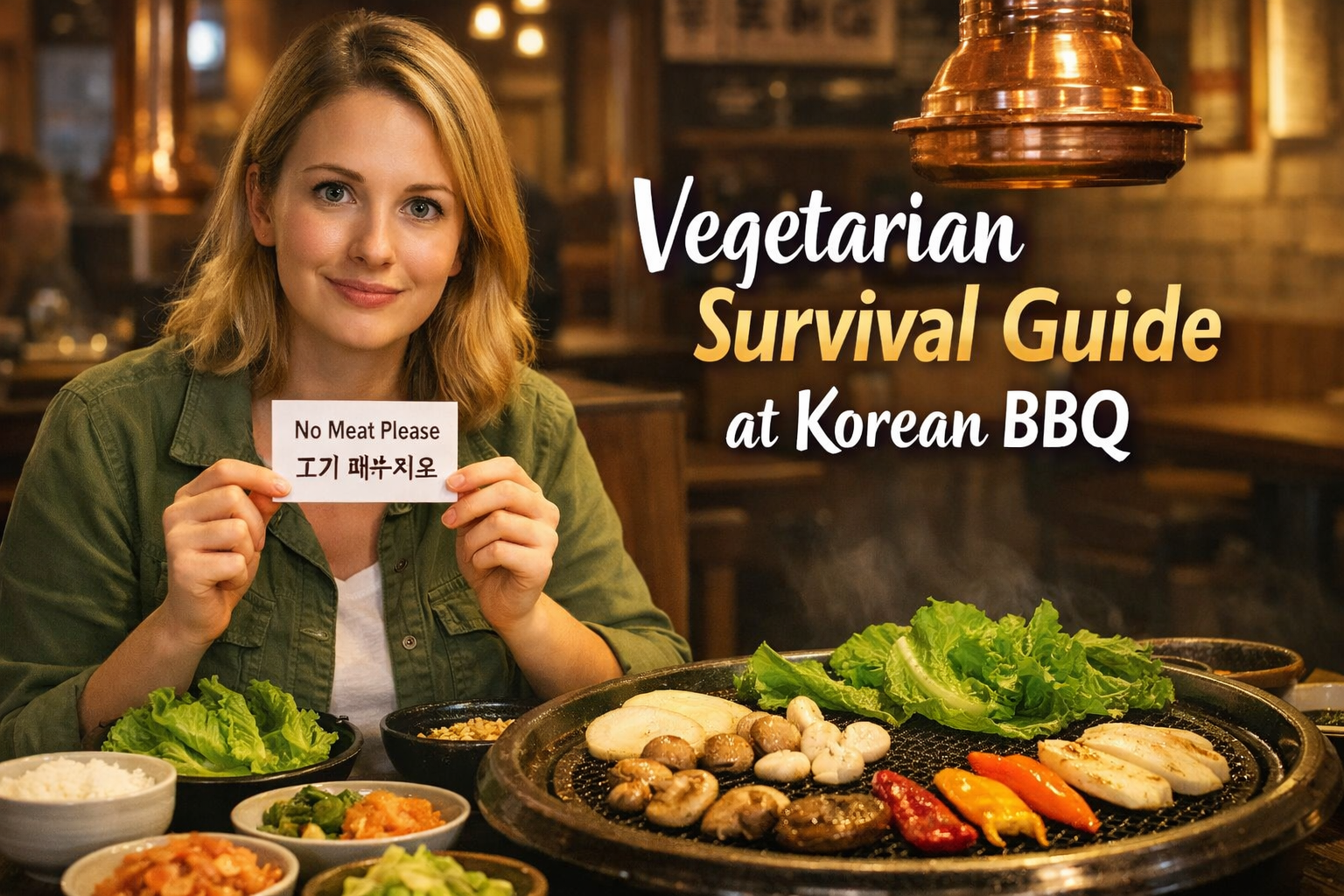
Meta description: Traveling in Korea as a vegetarian? Learn how to ask for “no meat” at a Korean BBQ restaurant with easy Korean phrases, survival tips, flashcards, and practical ordering strategies.
If you are vegetarian and your Korean friends say, “Let’s go for Korean BBQ,” your first reaction might be panic. I get it. Korean BBQ sounds like the last place a vegetarian would want to visit.
But here is the good news. You do not need to avoid the whole experience. With the right Korean phrases, a few smart menu tricks, and realistic expectations, you can survive a Korean BBQ meal without stress. Korea’s official tourism guide also notes that vegetarian travelers should explain their diet clearly because many Korean dishes may include meat, seafood, or broth even when they look vegetable-based. Kimchi, for example, often contains fish sauce or salted seafood. :contentReference[oaicite:0]{index=0}
When I first ate out in Korea as a vegetarian traveler, I learned one thing very quickly: saying only “vegetarian” is often not enough. What works better is being specific. Say exactly what you do not eat. That one small change makes ordering much easier.
💡 Why Korean BBQ Is Tricky for Vegetarians
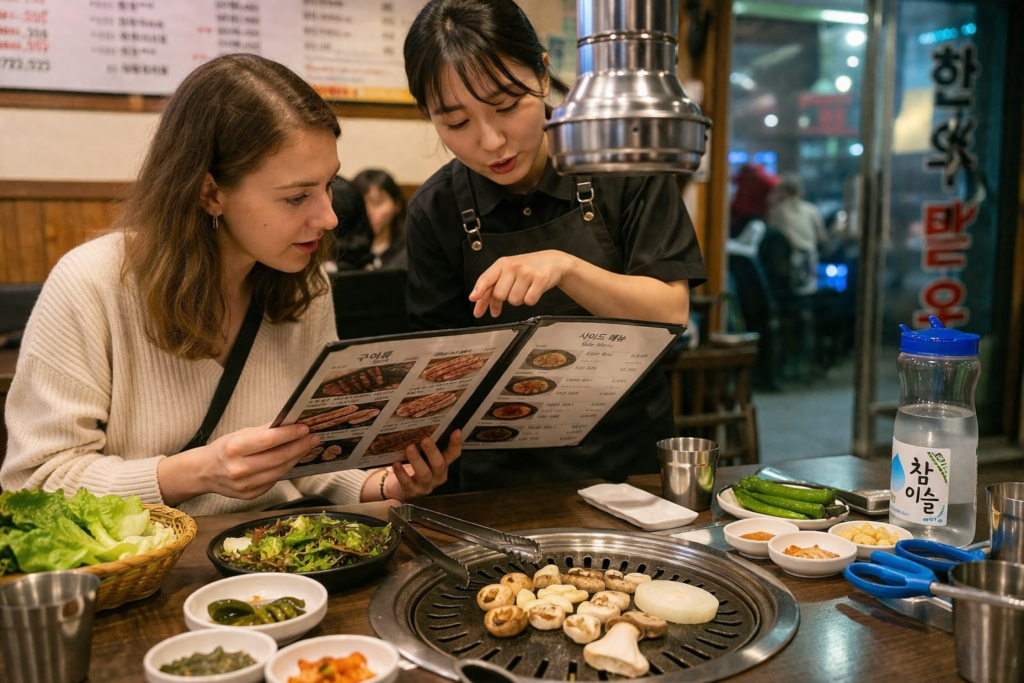
Korean BBQ restaurants are built around shared meat platters. That is the first challenge. The second challenge is hidden ingredients. Even dishes that look safe may contain anchovy broth, fish sauce, shrimp paste, or meat stock. Korea’s tourism guide specifically warns vegetarian visitors to explain their restrictions in detail instead of assuming a dish is meat-free.
At a Korean BBQ restaurant, the biggest risks are:
- Meat-focused set menus
- Shared grills and tongs
- Side dishes made with seafood-based seasoning
- Stews and soups prepared with meat or fish broth
- Sauces or kimchi that are not fully vegetarian
Still, the meal is not automatically impossible. Rice, lettuce wraps, grilled garlic, mushrooms, onions, peppers, plain banchan, and sometimes cold noodles or soybean paste stew can help you build a decent meal. The key is communication first, ordering second.
My personal tip: At Korean BBQ, I do not start with “I’m vegetarian.” I start with “No meat, no fish sauce, no broth.” It gets fewer confused looks and better results.
💡 5 Key Rules Before You Order
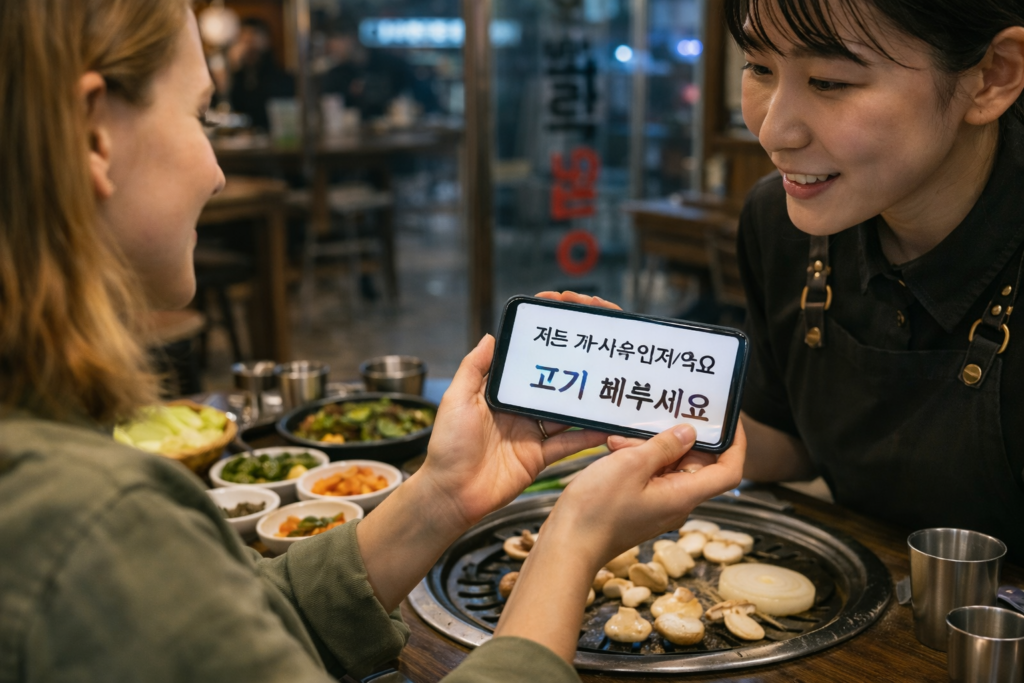
1. Say exactly what you do not eat
The most useful sentence is not just “I’m vegetarian.” It is a detailed sentence like “I do not eat meat or seafood.” Visit Korea recommends explaining your diet clearly in advance because restaurants may not have separate vegetarian menus.
2. Use simple Korean, not long explanations
Short phrases work best in busy restaurants. For example, “고기 빼주세요” means “Please remove the meat,” and “고기는 빼고 주세요” is a natural way to say “Please make it without meat.”
3. Ask about broth and kimchi
This is where many travelers make mistakes. Kimchi often contains fish sauce or salted seafood, and soups or stews often use anchovy or meat broth.
4. Expect cross-contact on the grill
At Korean BBQ, meat and vegetables may be cooked on the same grill. If that matters to you, ask for a clean grill or for vegetables to be cooked separately.
5. Build your meal from safe basics
Rice, lettuce, garlic, mushrooms, onions, peppers, some tofu dishes, and selected vegetable banchan are often your safest starting point. But always confirm the seasoning.
My personal tip: If staff look unsure, I politely repeat the request twice using different words. First, “I’m vegetarian.” Then, “No meat, no seafood.” That combination usually works.
📊 Best Korean Phrases to Use at the Table
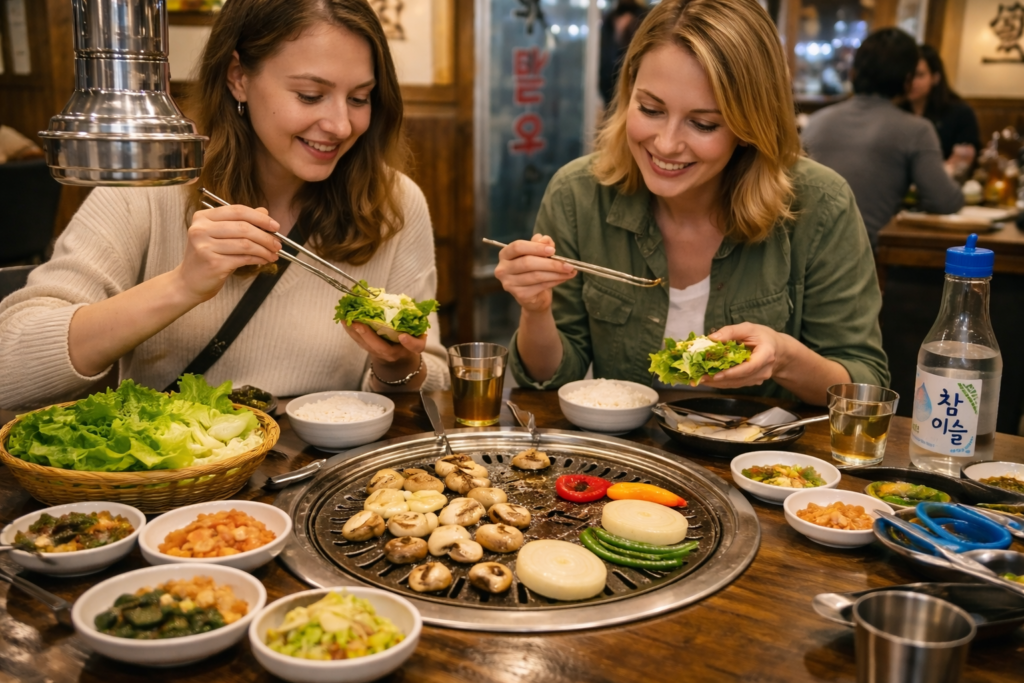
These are the phrases I would actually use in a real Korean BBQ restaurant.
Essential phrase 1
저는 채식주의자예요.
Jeoneun chaesikjuuija-yeyo.
“I’m a vegetarian.”
Essential phrase 2
저는 고기를 안 먹어요.
Jeoneun gogireul an meogeoyo.
“I don’t eat meat.”
Essential phrase 3
고기 빼주세요.
Gogi ppae juseyo.
“Please leave out the meat.”
Essential phrase 4
해산물도 안 먹어요.
Haesanmuldo an meogeoyo.
“I don’t eat seafood.”
Essential phrase 5
육수 들어가요?
Yuksu deureogayo?
“Does it contain broth?”
Essential phrase 6
생선 소스 들어가요?
Saengseon soseu deureogayo?
“Does it contain fish sauce?”
Best all-in-one sentence
저는 채식주의자예요. 고기, 해산물, 육수는 안 돼요.
Jeoneun chaesikjuuija-yeyo. Gogi, haesanmul, yuksuneun an dwaeyo.
“I’m vegetarian. Meat, seafood, and broth are not okay.”
This type of detailed wording fits the advice from Korea’s tourism guide: do not assume “vegetarian” alone will communicate everything you need.
My personal tip: Screenshot your Korean phrase in large font on your phone. In noisy BBQ restaurants, showing text is often faster than speaking.
🪪 Flashcards You Can Show Staff
Flashcard 1
English: I’m a vegetarian.
Korean: 저는 채식주의자예요.
Romanization: Jeoneun chaesikjuuija-yeyo.
Flashcard 2
English: I don’t eat meat.
Korean: 저는 고기를 안 먹어요.
Romanization: Jeoneun gogireul an meogeoyo.
Flashcard 3
English: Please make it without meat.
Korean: 고기 빼주세요.
Romanization: Gogi ppae juseyo.
Flashcard 4
English: I don’t eat seafood either.
Korean: 해산물도 안 먹어요.
Romanization: Haesanmuldo an meogeoyo.
Flashcard 5
English: Does this contain broth or fish sauce?
Korean: 육수나 생선 소스 들어가요?
Romanization: Yuksuna saengseon soseu deureogayo?
📌 Real Survival Strategies That Actually Work
This mindset helps a lot. In Korea, Korean BBQ is often about group culture. You may not get a full vegetarian feast, but you can still enjoy the gathering if you prepare well.
Strategy 2: Order rice and vegetable sides immediately
Do not wait until the meat arrives. Ask for rice, lettuce, grilled garlic, mushrooms, onions, peppers, tofu if available, and any vegetable banchan that staff confirm is meat-free.
Strategy 3: Ask for separate grill space
Try this phrase:
채소는 따로 구워주실 수 있나요?
Chaesoneun ttaro guwo jusil su innayo?
“Could you grill the vegetables separately?”
Strategy 4: Have a backup meal before or after
This is my favorite practical trick. Eat a small meal beforehand or plan a vegetarian-friendly stop later. That way you are not stuck hungry if the restaurant has limited options.
Strategy 5: Use translation apps, but keep your own card ready
Official Korea travel guidance suggests preparing your dietary explanation in advance because language barriers can make ordering harder. A saved note or flashcard is faster and more reliable than typing at the table.
📋 Quick Comparison Table
| Item | Usually Available at K-BBQ? | Vegetarian Risk | What to Ask |
|---|---|---|---|
| Rice | Yes | Low | Plain rice, please |
| Lettuce wraps | Yes | Low | No meat filling |
| Mushrooms / garlic / onion | Often | Low to medium | Cook separately if needed |
| Kimchi | Usually | High | Ask if it contains fish sauce |
| Stews / soups | Often | High | Ask if broth contains meat or anchovy |
| Banchan | Yes | Medium | Confirm ingredients one by one |
💰 Cost and Benefit Analysis
Using a simple vegetarian ordering strategy gives real benefits:
- Time saved: 5 to 10 minutes less confusion at the table when you show a prepared flashcard.
- Stress reduced: much lower chance of accidental meat or seafood when you mention broth and fish sauce clearly.
- Budget control: you can still join a group meal without paying for a full meat set you will not eat.
- Social value: you can join a classic Korea dining experience instead of skipping the outing entirely.
In my experience, the best value comes from combining three things: a saved Korean note, one spoken sentence, and one backup snack plan. That tiny bit of preparation can improve the entire meal by what feels like 80% or more.
My personal tip: Convenience stores in Korea are your secret weapon. A triangle kimbap, fruit cup, salad, or soy milk before dinner can save the whole night.
🧠 Final Takeaway
Being vegetarian at a Korean BBQ restaurant is not always easy. But it is absolutely manageable. The most important lesson is this: do not only say “I’m vegetarian.” Be specific. Say no meat, no seafood, and no broth. Ask about kimchi. Ask about sauces. Show your flashcard. Then build your meal from rice, wraps, vegetables, and confirmed side dishes. That is the real vegetarian survival guide for Korean BBQ.
❓ FAQ
1. Is Korean BBQ a good choice for vegetarians?
Not usually as a food-first choice, but it can still work as a social dining experience if you prepare the right phrases and manage expectations.
2. Is kimchi vegetarian in Korea?
Often no. Many kimchi recipes include fish sauce, salted seafood, or other animal-based flavoring. Always ask.
3. What is the easiest Korean phrase for “no meat”?
고기 빼주세요 is one of the easiest and most useful phrases. It means “Please leave out the meat.”
4. Should I say “vegetarian” or list ingredients I avoid?
List what you avoid. Korea’s official tourism guidance suggests explaining your dietary restrictions clearly because “vegetarian” alone may not be enough.
5. What should vegans watch out for at Korean BBQ?
Fish sauce, anchovy broth, egg, butter, sesame-oil-seasoned dishes with hidden additives, and grill cross-contact are the main issues.