
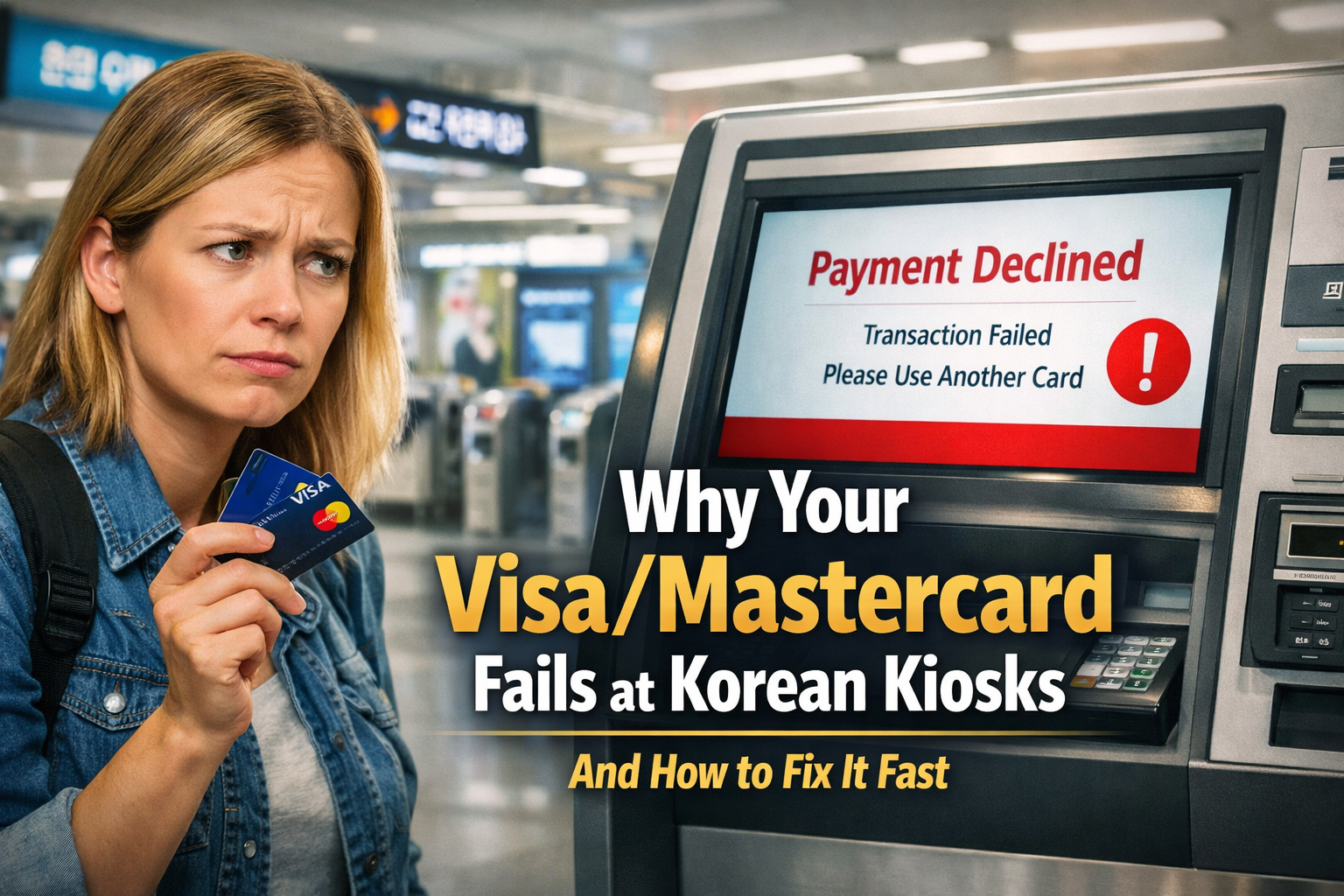
You land in Korea. You are hungry, tired, and ready to buy a train ticket, pay for parking, or order at a kiosk. Then your Visa or Mastercard gets declined.
That moment is more common than many travelers expect. In Korea, card payments work very well in general. But self-service kiosks, parking machines, subway machines, and other unattended terminals can still be a different story. Some machines are designed mainly for domestic cards, some require a payment flow your foreign card does not support, and some simply do not process overseas-issued cards smoothly.
I have seen this catch first-time travelers again and again. The frustrating part is that your card may work perfectly at a staffed counter, but fail two minutes later at a machine in the same building.
In this guide, I will show you why your Visa or Mastercard might fail at Korean self-service kiosks, how to quickly troubleshoot the problem, and what backup methods make travel in Korea much easier. If you want fewer payment surprises in Seoul, Busan, Jeju, or anywhere else in Korea, this is the checklist to save before your trip.
💡 5 Key Reasons Your Visa or Mastercard Might Fail at Korean Kiosks
1. The kiosk accepts cards, but not overseas-issued cards
This is the biggest misunderstanding. Many travelers see a card logo and assume every Visa or Mastercard will work. In reality, some Korean self-service machines are optimized for domestic-issued cards first. That means the terminal may technically accept cards, but not every foreign issuer passes smoothly through the kiosk system.
My personal rule in Korea: if a machine looks old, unattended, or highly local, I assume my foreign card may fail and I prepare a backup before I even tap.
2. Your card needs a verification method the kiosk cannot handle well
Some foreign cards rely on a different verification flow than the machine expects. At a staffed counter, the staff member can sometimes switch the method, retry manually, or guide you through the process. A self-service kiosk usually cannot do that.
This is why the same card may work at a hotel front desk but fail at a parking exit machine or food ordering kiosk.
3. The kiosk is built for local payment habits, not tourist behavior
Korea is highly cashless, but it is also highly optimized for local users. Many kiosks were originally designed around domestic bank cards, Korean payment apps, or local transport systems. Foreign tourists often enter the payment flow from a very different starting point.
The machine may also assume you already have a Korean transit card, local phone number, or a domestic payment setup.
4. Contactless does not always mean globally compatible
Travelers often expect tap-to-pay to work everywhere. But some terminals accept only certain contactless methods, some are updated later than others, and some still behave more reliably with insert-chip or prepaid stored-value options.
In short, seeing a modern-looking kiosk does not guarantee full foreign-card compatibility.
5. Unmanned systems are less flexible when something goes wrong
This is the hidden issue most people do not plan for. At an unmanned machine, you cannot ask staff to override an error, split the payment, retry another route, or explain a foreign issuer problem. That is why payment friction feels much worse at kiosks than at a normal shop counter.
In Korea, the problem is often not “my card is bad.” The real problem is “this exact machine is picky.”
📊 4 Real Situations Where Foreign Cards Fail Most Often
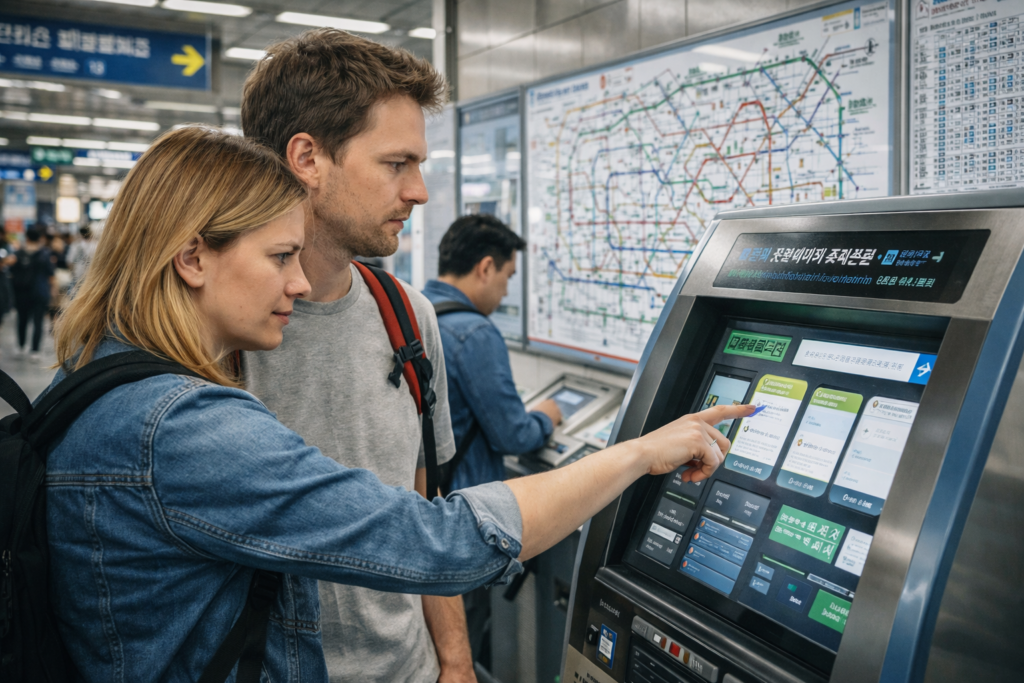
1. Subway ticket or transport reload machines
This has been one of the most common pain points for international visitors. Even though Seoul has been expanding support for overseas cards on newer transit kiosks, travelers still run into machines that behave differently depending on the station, line, or machine generation.
That means two important things:
- A newer kiosk may accept your card.
- An older machine nearby may still reject it.
So if one machine fails, always try another machine or another station counter before assuming your card is unusable.
2. Unmanned parking payment machines
This catches drivers especially hard. Parking lots in Korea are often automated, and some unmanned payment machines are not friendly to international cards. If you rented a car and only brought one overseas card, this can turn into a stressful exit problem very quickly.
3. Restaurant ordering kiosks
Fast-food shops, cafes, rest stops, and casual dining chains in Korea often use self-order kiosks. Some work beautifully with foreign cards. Some do not. In very local neighborhoods, the kiosk may favor domestic payment methods or have a payment interface that foreign cards do not like.
The easy workaround is simple: go to the counter and ask, “Can I pay here with foreign card?” In many places, the staff terminal is more flexible than the kiosk.
4. Ticketing or payment machines in tourist sites and service areas
Ferries, lockers, rest-area services, local attraction kiosks, and smaller transport terminals can be hit-or-miss. These are exactly the situations where travelers lose time because they expected international card acceptance to be universal.
One of my favorite Korea travel habits is this: before relying on a kiosk, I look around for a staffed desk, convenience store, or reload option nearby. That one-minute scan saves a lot of stress.
📌 Practical Fixes That Actually Work
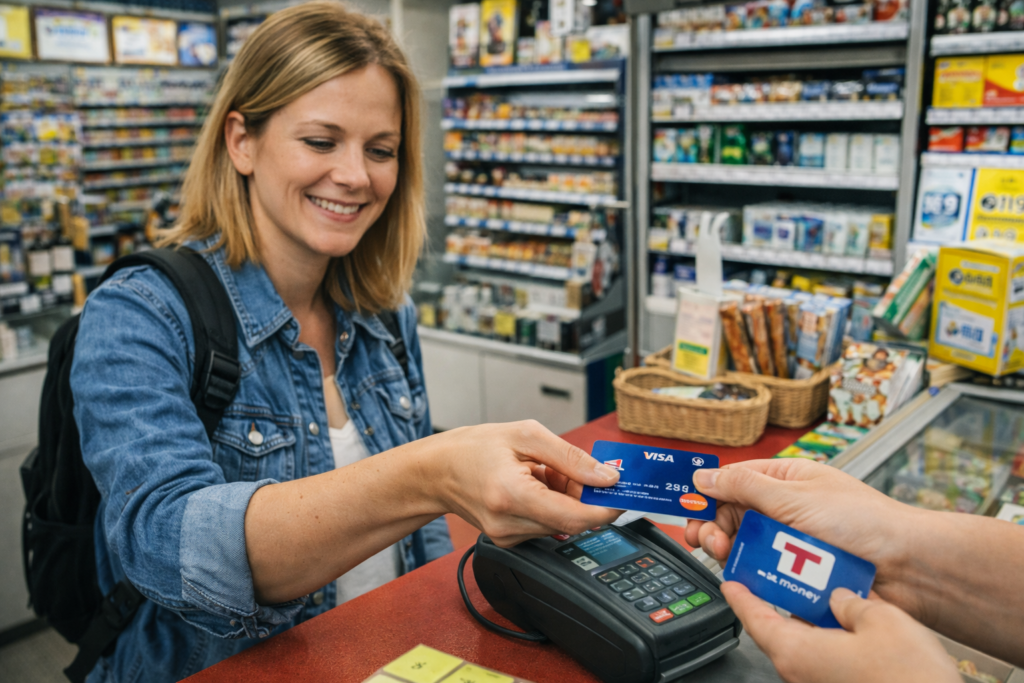
1. Always carry two different foreign cards
Never travel in Korea with only one payment option. Bring at least:
- one Visa
- one Mastercard
- or one main credit card plus one debit card
Sometimes the issue is not the network. It is the specific issuer, card settings, or terminal compatibility.
2. Use a foreigner-friendly prepaid option for daily friction points
For Korea, this is often the smartest move. A prepaid travel card or foreigner-focused payment card can reduce the number of times you depend on a random kiosk to accept your home bank card. It is especially useful for transport, convenience purchases, and situations where unmanned systems are common.
For many travelers, this single step removes 70% to 80% of their payment stress.
3. Try the counter, not the machine
This sounds obvious, but it works surprisingly often. If the kiosk rejects your card:
- cancel the transaction completely
- do not keep retrying the same way five times
- go to a staffed counter if available
- ask whether foreign cards are accepted there
A human-operated payment terminal may succeed where a kiosk fails.
4. Keep a small amount of Korean won for emergencies
Even in a very card-friendly country, a small emergency cash buffer matters. I usually recommend enough for:
- one transport top-up
- one convenience store stop
- one taxi or small emergency payment
You do not need to carry a huge amount. You just need enough to avoid being stuck.
5. Use convenience stores as your backup strategy
In Korea, convenience stores are often the most practical rescue point. You may be able to top up transit cards, buy essentials, or solve a short-term payment problem faster there than at a broken or incompatible kiosk.
6. Save these exact phrases on your phone
- “My foreign card does not work on this kiosk.”
- “Can I pay at the counter?”
- “Do you accept overseas Visa or Mastercard?”
- “Can I reload my transit card here?”
These simple questions solve more problems than people expect.
📋 Quick Comparison Table: Best Payment Backup Options in Korea
| Option | Best For | Pros | Cons | My Take |
|---|---|---|---|---|
| Main Visa/Mastercard | Hotels, major stores, staffed counters | Convenient, familiar, no preload needed | Can fail at unattended kiosks | Use as your primary card, not your only plan |
| Second backup card | Issuer mismatch problems | Easy safety net | Still may fail on some machines | Essential for any Korea trip |
| Prepaid travel/payment card | Transit, small purchases, daily convenience | Reduces kiosk friction, easier for repeated use | Requires setup or reload | Best comfort upgrade for first-time visitors |
| Small cash reserve | Emergency backup | Works when cards fail | Less convenient, not always accepted everywhere | Carry enough for backup, not for everything |
| Staffed counter payment | When kiosk rejects your card | Higher success rate in many cases | Not always available | Try this immediately after a kiosk failure |
💰 Cost, Convenience, and Time-Saving Analysis
Let’s look at this practically.
If you spend 10 to 20 minutes solving one payment failure at a subway station, parking machine, or restaurant kiosk, and that happens just 3 times during your trip, you lose roughly 30 to 60 minutes of travel time.
Add the stress cost:
- missed train timing
- delayed meal orders
- awkward payment moments
- extra ATM withdrawals or exchange fees
By contrast, preparing a backup card setup usually costs very little:
- 2 cards instead of 1 = much lower failure risk
- a small KRW emergency fund = immediate rescue option
- a prepaid travel card = smoother daily transport and kiosk use
In real travel terms, the benefit is clear:
- less stress
- faster payments
- fewer disrupted plans
- better confidence using Korean transport and self-service systems
I would honestly say this is one of the highest-value travel fixes for Korea. It is not expensive. It is not complicated. But it can save your trip from several very annoying moments.
The travelers who enjoy Korea most are not always the ones with the fanciest itinerary. They are usually the ones with the smoothest payment backup plan.
✅ Final Thoughts
If your Visa or Mastercard fails at a Korean self-service kiosk, do not panic. It does not automatically mean your card is blocked or broken.
In many cases, the real issue is the machine itself: its setup, its card-routing logic, or its limited support for overseas-issued cards.
The best strategy is simple:
- bring more than one card
- carry a small KRW backup
- use a prepaid traveler-friendly payment option
- try the counter when the kiosk fails
Do that, and Korea becomes much easier to navigate. You spend less time troubleshooting payments and more time actually enjoying your trip.
❓ FAQ
Q1. Do Visa and Mastercard work in Korea?
Yes, very often they do. Major hotels, department stores, large restaurants, and many staffed counters accept them. The bigger problem is specific unattended kiosks, not Korea as a whole.
Q2. Why does my card work in stores but fail at kiosks?
Because kiosks are less flexible. A staffed terminal can sometimes process foreign cards more smoothly, while a kiosk may be limited to a narrower payment flow.
Q3. What is the best backup for Korea?
The best setup is usually two foreign cards + a small cash reserve + a prepaid travel/payment option. That combination covers most real-life problems.
Q4. Are Korean subway kiosks getting better for foreign cards?
Yes. Support has been improving, especially in Seoul, but travelers should still expect differences between machines and locations.
Q5. Should I rely only on my foreign credit card in Korea?
No. It may work most of the time, but relying on a single overseas card is risky in unmanned payment situations. A backup method is the smarter travel choice.