

The moment you first set foot in Korea is both exciting and a little overwhelming. To start your life in Korea smoothly, the top priorities are getting accurate information quickly and securing reliable transportation. In this guide, we’ll walk you through everything you need right after arrival—from mobile services that keep you connected, to transportation tips, and even the key administrative steps for settling in comfortably.
📱 Getting Connected: How to Choose Between a SIM and an eSIM

One of the very first things you should sort out after landing in Korea is getting connected to mobile data. Whether you need to check directions, contact someone on KakaoTalk, or look up information on the go, having data access is essential from the moment you arrive.
Main Activation Options
- Carrier kiosks at the airport: You can activate a plan instantly at KT, SKT, or LG U+ counters in Incheon, Gimpo, and Gimhae airports.
- Prepaid SIM cards: With just your passport, you can choose unlimited data plans for 5 to 30 days, making them very convenient for short stays.
- Using an eSIM: Instead of swapping a physical card, you can simply scan a QR code and connect right away, which is why eSIMs have become increasingly popular.
- Budget carriers (Altteul Phone): These are affordable for stays longer than a month, but you will need an Alien Registration Card to sign up.
📊 Comparing Mobile Service Options
| Type | Prepaid SIM | eSIM | Budget Carrier |
|---|---|---|---|
| Activation Speed | Immediate | Immediate | After ARC issuance |
| Convenience | Requires card replacement | Software-based | SIM or eSIM options |
| Price Range | Moderate | Moderate | Very affordable |
When I first arrived in Korea, I bought a prepaid SIM card right at the airport, and it was such a relief to be able to search for directions to my accommodation in real time.
💳 Complete Guide to Buying and Reloading a T-money Card

If you plan to use Korea’s excellent public transportation system, one of the first things you should get is a transit card. This small card works like a master key—you can use it on subways, buses, taxis, and even for payments at convenience stores.
Learn More on the T-money Website
Transit Card Tips
- Card types: The most widely used option is T-money, while Cashbee is especially common in the Busan area.
- Where to buy: You can easily buy one at airport convenience stores or subway station vending machines for around 2,500 to 4,000 KRW.
- How to reload: You can top it up with cash at convenience stores or at multilingual recharge machines inside subway stations.
- Transfer discounts: If you tag your card when getting off, you can save money when transferring to another form of transportation within 30 minutes.
If you forget to tap your card when getting off the bus, you won’t receive the transfer discount, so it’s a good habit to always tag your card both when boarding and exiting.
🚇 Mastering Public Transportation: Subway and Bus Etiquette
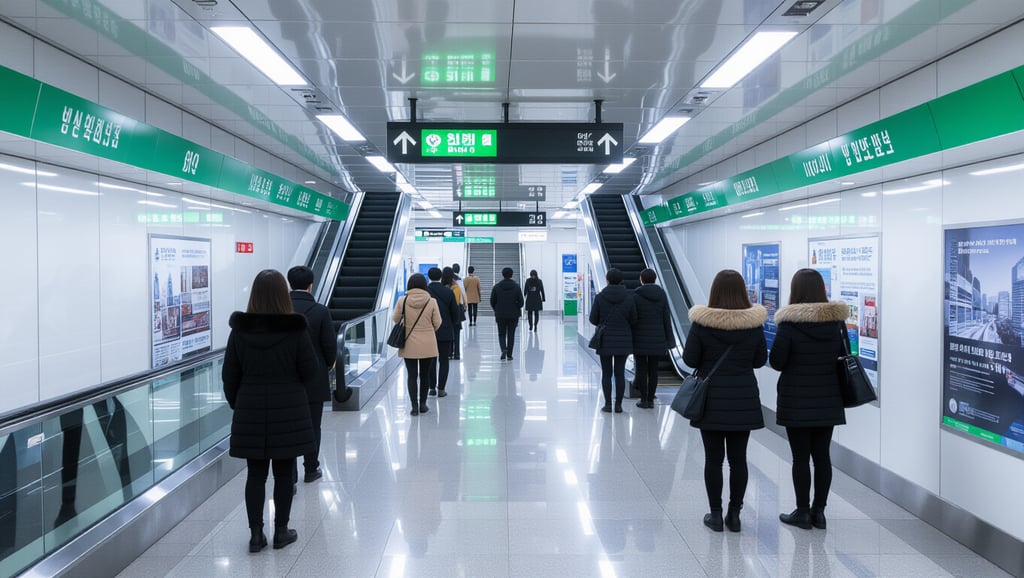
Korea’s public transportation system is famous around the world for being clean, efficient, and punctual, so it doesn’t take long to get used to it. In particular, the Seoul subway is very easy to navigate because each line has its own color and number.
📝 Steps for Using the Subway
- Check your line: First, confirm the line color and number for your destination—for example, Line 2 is green.
- Tap in and out: Tag your transit card at the gate when entering, and make sure to tag again when exiting.
- Follow local etiquette: It’s considered polite not to speak loudly on the phone, and people generally stand on the right side of escalators.
The subway gets extremely crowded around commuting hours—roughly 8 AM and 6 PM—so if you’re carrying a lot of luggage, it’s best to avoid those times.

In Korea, local apps are often much more accurate than Google Maps. Because they reflect real-time local data more effectively, it’s strongly recommended to install at least one Korean navigation app as soon as you arrive.
Recommended Must-Have Apps
- NAVER Map: Excellent for real-time bus arrival information and walking directions, and it supports multiple languages.
- KakaoMap: Known for its intuitive interface and detailed place information, making it one of the most widely used map apps in Korea.
- Kakao T: A must-have for calling taxis, and entering your destination in advance helps reduce language barriers.
Even when I was going somewhere for the first time, NAVER Map’s street view feature made it much easier to find the right building before I arrived.
✈️ From the Airport to the City: Choosing the Best Transportation Option

After arriving at the airport, your options for getting into the city generally fall into three categories, depending on your budget and how much luggage you have. Thinking about the best option in advance can save you a lot of stress once you land.
Visit the Official Incheon Airport Website
📊 Comparing Transportation Options
| Option | Pros | Cons | Best For |
|---|---|---|---|
| AREX Airport Railroad | Fast and punctual | You still need to travel from the station to your accommodation | Travelers with light luggage who want the fastest option |
| Airport limousine bus | Stops near many hotels and neighborhoods | Affected by traffic conditions | Travelers with heavy luggage who want a more comfortable ride |
| Taxi | Door-to-door convenience | Most expensive option | Groups or late-night arrivals |
When I had a lot of luggage, taking the limousine bus straight to a stop near my hotel was far more comfortable than hauling bags up and down subway stairs.
📄 Essential Early Settlement Step: Alien Registration and Administrative Procedures

If you plan to stay in Korea long term, one of the most important things to handle early is your alien registration. Completing the required process within the designated period is essential for maintaining your legal stay status.
Key Points About the Process
- Appointment required: You usually need to make a reservation in advance through the Hi Korea website before visiting the immigration office.
- Application deadline: In most cases, if you plan to stay more than 90 days, you must complete registration within 90 days of entering Korea.
- Required documents: The documents vary depending on your visa type, so it’s important to check carefully before your appointment.
Appointments on Hi Korea can fill up quickly, so one of the best tips is to book your slot as soon as you arrive in Korea.
💡 Everyday Convenience Tips: Public Wi-Fi and Convenience Stores

Korea has one of the best internet infrastructures in the world, so making good use of public Wi-Fi can help you cut down on communication costs. Convenience stores also serve as much more than simple shops—they function as everyday service hubs.
Useful Services You Can Take Advantage Of
- Free Wi-Fi: You can often connect to networks such as “Public Wi-Fi Free” on subways, buses, and at major tourist spots.
- Convenience store services: Open 24 hours a day, convenience stores can help with transit card top-ups, parcel services, and the purchase of basic over-the-counter medicine.
- Cafe Wi-Fi: Most cafes offer high-speed internet, and the password is often printed on the receipt or displayed somewhere inside the store.
I still remember how relieved I was to find simple cold medicine and digestive tablets at a convenience store when the pharmacy was already closed.
📌 Final Thoughts

We’ve now covered the most important things you’ll deal with right after arriving in Korea—from setting up your mobile service and using public transportation to handling key administrative steps. Small actions like preparing a SIM card at the airport and topping up your transit card can make your first days in Korea far smoother and more enjoyable. A new environment can feel intimidating at first, but if you follow this guide step by step, you’ll soon find yourself settling in and enjoying everything Korea has to offer. I truly hope your well-prepared start leads to a memorable and rewarding experience in Korea.
Frequently Asked Questions
Where can I buy a SIM card at the airport?
You can buy and activate a prepaid SIM card right away with just your passport at major carrier kiosks such as KT, SKT, and LG U+ inside Incheon, Gimpo, and Gimhae airports.
What is the difference between T-money and Cashbee transit cards?
Both cards offer almost the same functions, including use on subways, buses, and convenience store payments. However, T-money is more widely used nationwide, so it’s generally the better choice for first-time visitors.
How can I receive transfer discounts on public transportation?
Make sure to tap your transit card when getting off the bus or subway. If you transfer to another mode of transportation within 30 minutes, you can receive a fare discount.
Is it okay to use Google Maps for directions in Korea?
In Korea, it’s usually much more convenient and accurate to use local apps like NAVER Map or KakaoMap, which provide better real-time information than Google Maps.
When do I need to complete alien registration?
If you plan to stay in Korea for more than 90 days, you must complete alien registration at the appropriate immigration office within 90 days of your arrival.