
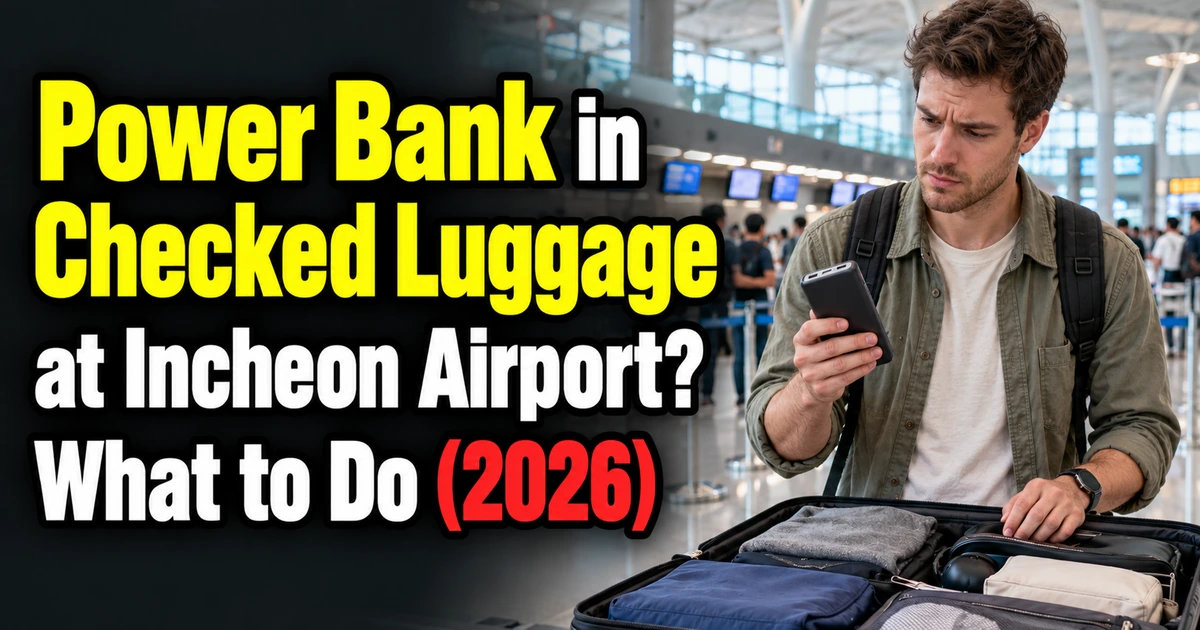
Accidentally packed a power bank in your checked luggage at Incheon Airport? If your suitcase is still with you, remove the battery before checking it in. If you have already handed the suitcase over to the airline, notify the staffed check-in or baggage-service counter immediately.
Power banks are not allowed in checked baggage on flights departing Korea. Since April 20, 2026, the general carry-on limit has been two power banks per passenger, each no larger than 160Wh. Batteries above 100Wh require airline approval, and using or charging power banks during the flight is prohibited.
What you should do next depends on whether you still have your suitcase, have already dropped it off, or have passed airport security.
This guide explains the correct steps at Incheon International Airport, including Terminal 1 and Terminal 2 baggage screening, power bank capacity limits, and what to say to airline staff.
What to Do Right Now If You Packed a Power Bank in Checked Luggage
First, identify where your suitcase is. The safest next step changes once the airline has accepted your checked baggage.
| Your situation | What to do immediately |
|---|---|
| Your suitcase is still with you | Remove the power bank before checking in the bag. |
| You have already dropped off the suitcase | Tell your airline’s check-in or baggage-service staff immediately. |
| You have already passed security | Inform airline or airport staff inside the secure area. |
| Staff cannot retrieve the suitcase | Follow their instructions. Retrieval or repacking is not guaranteed. |
Never try to enter a restricted baggage-handling area or retrieve your checked suitcase without permission. The airline and airport security personnel must determine whether the bag can be located, opened, or processed differently.
Before Bag Drop: Remove the Power Bank From Your Suitcase
If your suitcase has not yet been accepted by the airline, you can usually correct the packing mistake before checking it in.
- Move to a safe area where you can open your suitcase without blocking other passengers.
- Check electronic accessory cases, pockets, and compartments for portable power banks.
- Remove every separate power bank from the suitcase.
- Read the capacity information printed on each battery.
- Protect the battery terminals against short circuits using an individual pouch, separate zip bag, or another permitted protection method.
- Keep eligible power banks in your cabin belongings and confirm the operating airline’s requirements.
Remember that removing a power bank from checked baggage does not automatically make it eligible for cabin carriage.
A battery may still be refused if it exceeds the permitted capacity, has an unreadable capacity label, is damaged, or is otherwise restricted by the airline.
After Bag Drop: Tell Airline Staff Immediately
If you have already handed over your suitcase, return to your airline’s staffed check-in or baggage-service counter as soon as you realize a power bank may be inside.
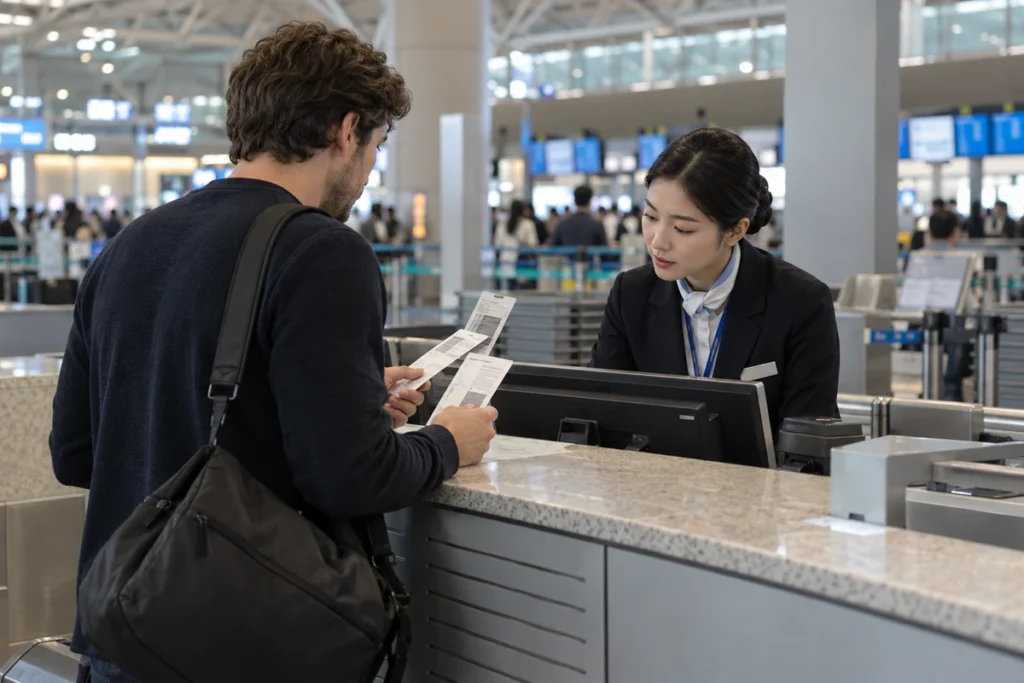
Bring your passport, boarding pass if available, and baggage-claim receipt. Explain that the battery was left inside the suitcase and tell staff approximately where it is packed.
You can say:
“I accidentally left a power bank in my checked suitcase. I’ve already dropped off the bag. Could you help me check whether it can be retrieved?”
If you need to show staff a Korean sentence, use:
위탁수하물에 보조배터리를 실수로 넣었습니다. 수하물을 확인할 수 있을까요?
“I accidentally put a power bank in my checked baggage. Could you help me check the suitcase?”
Keep your baggage receipt available so airline staff can identify the correct suitcase.
Depending on the bag’s location and processing status, staff may need to coordinate with baggage handlers or airport security personnel.
Retrieval is not guaranteed. Whether the suitcase can be returned or reopened depends on airport procedures, baggage processing, and the time remaining before departure.
Terminal 1: Wait for Checked-Baggage Screening
Incheon Airport’s official English baggage guide advises passengers at Terminal 1 to wait nearby for approximately five minutes after check-in while their checked baggage passes X-ray inspection.
If you remember the battery during that period, tell airline staff immediately.
However, this five-minute period is not a guaranteed opportunity to retrieve the suitcase. Staff must confirm whether the baggage can still be accessed.
Terminal 2: Follow the Designated Screening Procedure
At Terminal 2, the airport instructs passengers to use the designated screening area in the departure hall to confirm that checked baggage has passed X-ray inspection.
If you realize that a power bank is inside your suitcase, notify the airline counter and follow the instructions provided.
The procedures and waiting locations differ between terminals, so do not assume that Terminal 1 and Terminal 2 follow identical steps.
Official information: Incheon International Airport – Baggage Check-in and Screening.
What Happens If Airport Screening Finds a Power Bank?
Incheon Airport warns that prohibited items discovered during baggage screening may require additional security checks or may be confiscated.
The outcome depends on the item, when it is detected, and the instructions of the airline or security authorities.
Possible outcomes include:
- The airline contacts you about an additional inspection.
- Staff ask you to follow a baggage-handling procedure.
- The prohibited battery is removed or confiscated.
- The airline gives you further instructions before boarding.
These are possible outcomes, not guaranteed procedures for every passenger.
Do not assume the airport will automatically remove the battery and transfer it into your cabin baggage.
If the battery cannot legally be carried because of its capacity, damage, or another restriction, simply moving it into a carry-on bag is not an acceptable solution.
Ask airline staff whether your checked bag has been cleared and whether you need to take any further action before boarding.
Official information: Incheon Airport – Restricted Items.
Incheon Airport Power Bank Rules in 2026
Korea’s strengthened power bank carriage rules took effect on April 20, 2026.
For ordinary portable power banks, the main capacity and quantity limits are as follows.
| Battery capacity | Cabin carriage | Checked baggage |
|---|---|---|
| 100Wh or less | Generally permitted, up to two power banks per passenger | Prohibited |
| Over 100Wh to 160Wh | Airline approval required; subject to the two-power-bank limit | Prohibited |
| Over 160Wh | Prohibited | Prohibited |
Every permitted power bank must be protected against short circuits.
Common protection methods include covering exposed terminals with insulating tape, storing each power bank in its own protective pouch, or placing each one separately in a zip bag.
During the flight, power banks must not be used to charge electronic devices or be charged themselves. They must not be stored in overhead compartments. Keep them with you or in the seat pocket as instructed by the cabin crew.
Important: These rules concern ordinary portable power banks. Spare camera batteries, batteries installed inside equipment, certain medical devices, and other specialized batteries may be subject to different requirements.
For authoritative details, see the Korean government’s April 2026 power bank announcement and the Asiana Airlines power bank notice.
Damaged or Recalled Power Banks
Battery capacity is not the only safety consideration.
A power bank that is swollen, overheating, visibly damaged, or subject to a safety recall may be refused even if its capacity is within the usual limit.
For example, Air Premia published a notice on October 2, 2026, stating that recalled power banks presenting fire or other safety risks are not permitted on board its flights.
If you are unsure whether your battery has been recalled, check the manufacturer’s official recall information and your operating airline’s requirements.
Official notice: Air Premia – Restrictions on Recalled Power Banks.
How to Check Whether Your Power Bank Is Under 100Wh
Power bank limits are measured in watt-hours (Wh), but many portable chargers are marketed by their milliamp-hour (mAh) capacity.
If the battery’s nominal voltage is known, you can calculate its approximate energy capacity using this formula:
Wh = mAh × nominal voltage (V) ÷ 1,000
For example, using a nominal voltage of 3.7V:
| Advertised capacity | Calculated energy | General category |
|---|---|---|
| 10,000mAh | 37Wh | Below 100Wh |
| 20,000mAh | 74Wh | Below 100Wh |
| 30,000mAh | 111Wh | Airline approval required |
| 50,000mAh | 185Wh | Over 160Wh; prohibited |
These are calculation examples only. The actual watt-hour rating depends on the battery’s nominal voltage and manufacturer specifications.
Always check the original product label first. Do not automatically use the USB output voltage for the calculation.
If the capacity marking is missing, unreadable, or inconsistent, ask the operating airline before passing security. A battery whose rating cannot be verified may not be accepted.
Can You Use or Charge a Power Bank During the Flight?
No. Under Korea’s updated 2026 rules, bringing an eligible power bank into the cabin does not mean you can use it during the flight.
Charging another device from the power bank and recharging the power bank itself are prohibited during the flight.
Keep the battery accessible and protected against short circuits. Follow the cabin crew’s instructions regarding storage.
If a battery becomes unusually hot, swells, emits smoke, or shows another warning sign, notify a flight attendant immediately. Do not attempt to puncture, repair, or dismantle it.
Using an ordinary charging cable connected directly to an aircraft’s approved power outlet is a separate matter. Availability and permitted use depend on the airline and aircraft.
Official information: Air Premia – Power Bank Carry-on Policy Effective April 20, 2026.
What If Your Flight Is Departing Soon?
If your boarding time is approaching, contact your operating airline immediately rather than attempting to locate your suitcase yourself.
- Identify the airline operating your flight.
- Show staff your boarding pass and baggage-claim receipt.
- Explain that a power bank may be inside the checked suitcase.
- Ask whether additional baggage screening or an inspection is necessary.
- Confirm whether you should proceed through security or wait for further instructions.
- Follow any baggage and boarding instructions provided by authorized staff.
Do not assume that the absence of a warning means the baggage has been cleared.
If you have already passed departure security, inform airline or airport staff inside the secure area. Do not return to the public check-in hall without permission.
If the problem also involves arriving at the wrong terminal, read our Incheon Airport Terminal 1 and Terminal 2 transfer guide before changing locations.
Frequently Asked Questions
Will Incheon Airport Automatically Remove a Power Bank From Checked Luggage?
No automatic correction should be assumed. Prohibited items may trigger additional screening or confiscation, but the airport does not guarantee that a power bank will be removed and returned to the passenger. Inform airline staff as soon as you discover the mistake.
Can I Put a Small 10,000mAh Power Bank in Checked Baggage?
No. An ordinary portable power bank is prohibited in checked baggage regardless of whether it is below 100Wh. An eligible battery must be transported in the cabin according to the applicable quantity, protection, and storage requirements.
What If I Discover the Battery After Passing Security?
Tell airline or airport staff in the secure area immediately. Provide your baggage receipt and flight details so staff can determine whether any action is possible. Do not attempt to enter restricted areas or return through security without authorization.
Will I Miss My Flight If a Power Bank Is Found in My Suitcase?
Not necessarily. The result depends on the bag’s processing status, any required security checks, and the time remaining before departure. Contact the operating airline promptly and follow its instructions. Neither retrieval nor on-time boarding can be guaranteed.
Final Checklist Before Leaving the Check-in Area
- Remove every separate power bank from checked luggage.
- Check the Wh rating and the number of batteries you are carrying.
- Get airline approval for eligible power banks above 100Wh.
- Protect batteries individually against short circuits.
- Do not travel with damaged or recalled power banks that are prohibited by the airline.
- Keep eligible power banks accessible in the cabin.
- If a power bank is already inside checked baggage, inform airline staff immediately.
- Follow the applicable Terminal 1 or Terminal 2 screening instructions.
The most important question is whether your suitcase has already been accepted by the airline. Before bag drop, remove the power bank yourself and confirm that it is eligible for cabin carriage. After bag drop, report the mistake immediately and allow authorized staff to determine the next step.
Official Sources and Information Date
Last checked: October 18, 2026. The updated two-power-bank limit and in-flight restrictions took effect on April 20, 2026. Always confirm the operating airline’s latest rules, especially when taking connecting flights.