

Planning a trip to Seoul and worried about subway fares, bus transfers, or confusing transportation rules? You are not alone. Many first-time visitors want a simple and budget-friendly way to get around, but Korea’s transit system can feel overwhelming at first.
The good news is that the Climate Card, also called the Gihu Card, can make Seoul travel much easier. It gives you unlimited rides on eligible subways and buses for a fixed period, which is especially useful for tourists who plan to move around the city a lot.
In this guide, you will learn exactly how tourists can use the Climate Card, when it saves money, where it works, and what mistakes to avoid. This article is designed for international travelers who want practical, no-stress advice before landing in Korea.
📌 ON THIS PAGE
- 💡 1. 5 key things tourists should check before buying a Climate Card
- 📊 2. Best Climate Card pass options for different travel styles
- 📌 3. How to use the Climate Card step by step like a pro
- 📋 4. Climate Card comparison table for tourists
- 💰 5. How much money can tourists actually save?
- ❓ FAQ
💡 1. 5 Key Things Tourists Should Check Before Buying a Climate Card

Before you buy a Climate Card in Seoul, check these five points first. This will help you avoid wasting money and choose the best pass for your trip.
1) Know what the Climate Card actually is
The Climate Card is a public transport pass for Seoul. It allows unlimited rides on eligible subway lines and Seoul-licensed buses during the selected validity period. For short-term visitors, this can be much cheaper than paying per ride.
2) Short-term passes are the best choice for tourists
Tourists usually choose the short-term versions: 1-day, 2-day, 3-day, 5-day, or 7-day. These passes are easier and more practical for a short Seoul itinerary than a 30-day commuter pass.
My tip: If your Seoul schedule includes palaces, shopping districts, and a day at the Han River, a short-term Climate Card usually feels much more relaxing than counting every subway fare.
3) Not every route is covered
This is the most important part. The Climate Card works on eligible subway sections and Seoul-licensed buses, but not every single transport line in the wider capital area is included. Some airport and regional routes have limits, so always check your route before boarding.
4) Tourists should understand the airport rule
The card can be very useful when coming from central Seoul toward eligible airport rail sections, but coverage rules matter. Some airport boarding or exit conditions can be limited depending on the station and direction, so do not assume the pass works exactly like a nationwide transport card.
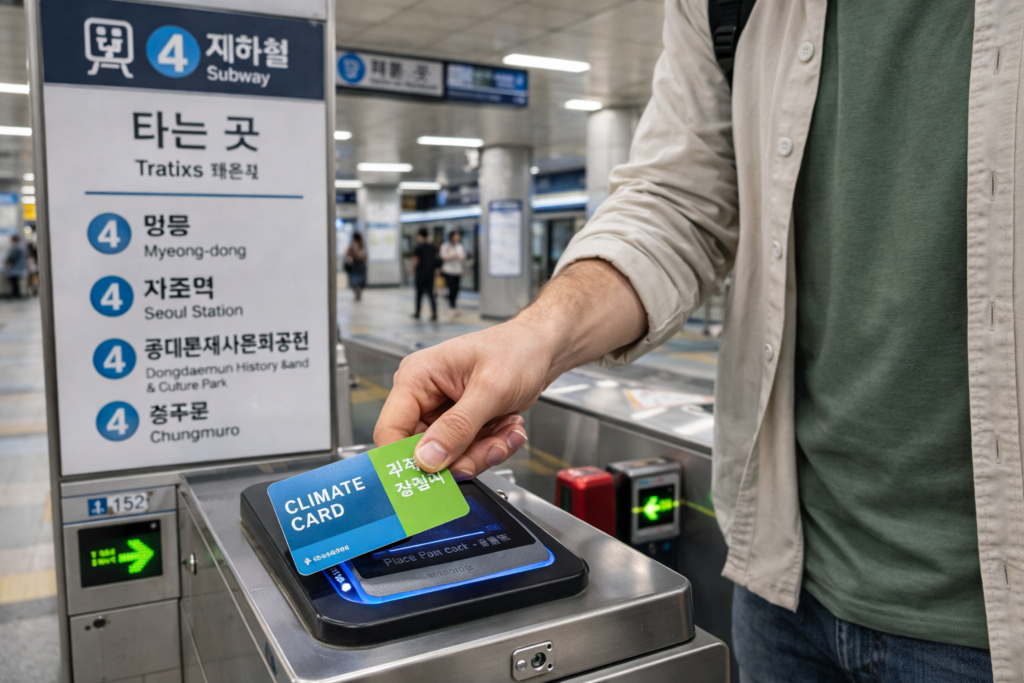
5) You must tap in and tap out
Always tap when you board and when you get off. Missing your exit tap can create problems, and repeated missed taps may temporarily suspend use. That is an easy mistake for first-time visitors, especially after a long day of sightseeing.
My tip: Treat the Climate Card like a hotel key card. Tap every time, even when you are tired. This tiny habit prevents bigger transit headaches later.
📊 2. Best Climate Card Pass Options for Different Travel Styles
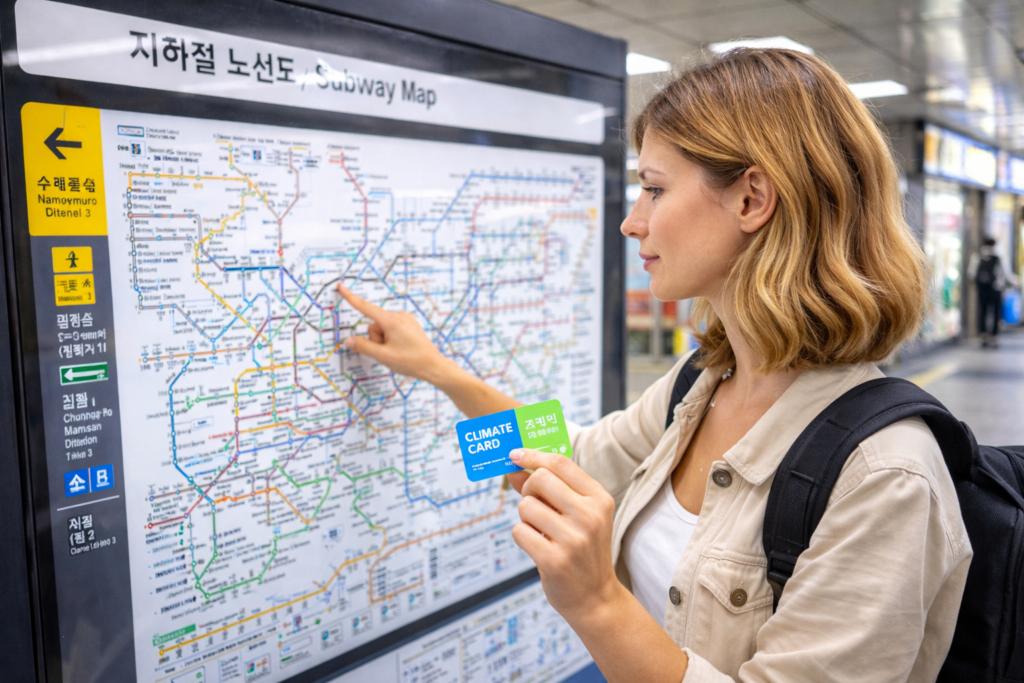
Not every tourist travels the same way. Some stay only one night. Others spend a full week in Seoul. Here are the best pass choices based on common travel patterns.
A) 1-day pass: best for stopover travelers and fast city tours
If you have one packed day in Seoul, this is often the smartest option. It works well for travelers visiting multiple areas such as Gyeongbokgung, Myeongdong, Hongdae, and Dongdaemun in a single day.
Best for: layovers, business travelers, same-day city explorers
B) 2-day or 3-day pass: best for short city breaks
This is the sweet spot for many tourists. A 2-day or 3-day pass gives enough flexibility for major attractions, late-night dinners, shopping, and easy transfers without worrying about individual fares.
Best for: weekend travelers, first-time Seoul visitors, couples
C) 5-day pass: best for classic Seoul itineraries
If you are staying around five days, this pass can be excellent value. It fits well with a standard Seoul itinerary that includes royal palaces, museums, cafés, K-pop shopping areas, and neighborhood hopping.
Best for: first-time Korea travelers focused mainly on Seoul
My tip: Many travelers underestimate how often they ride the subway in Seoul. Even a “light” sightseeing day can easily turn into 4 to 6 rides.
D) 7-day pass: best for slow travel and flexible planning
This is ideal for visitors who want to explore Seoul at a relaxed pace. It is also great for travelers who enjoy visiting different neighborhoods each day without tracking every transportation cost.
Best for: digital nomads, repeat visitors, slow travelers
E) When not to buy a Climate Card
If you plan to stay mostly in one neighborhood, walk a lot, or take only a few rides per day, a regular T-money card may be cheaper. The Climate Card gives the best value when you move around often.
📌 3. How to Use the Climate Card Step by Step Like a Pro
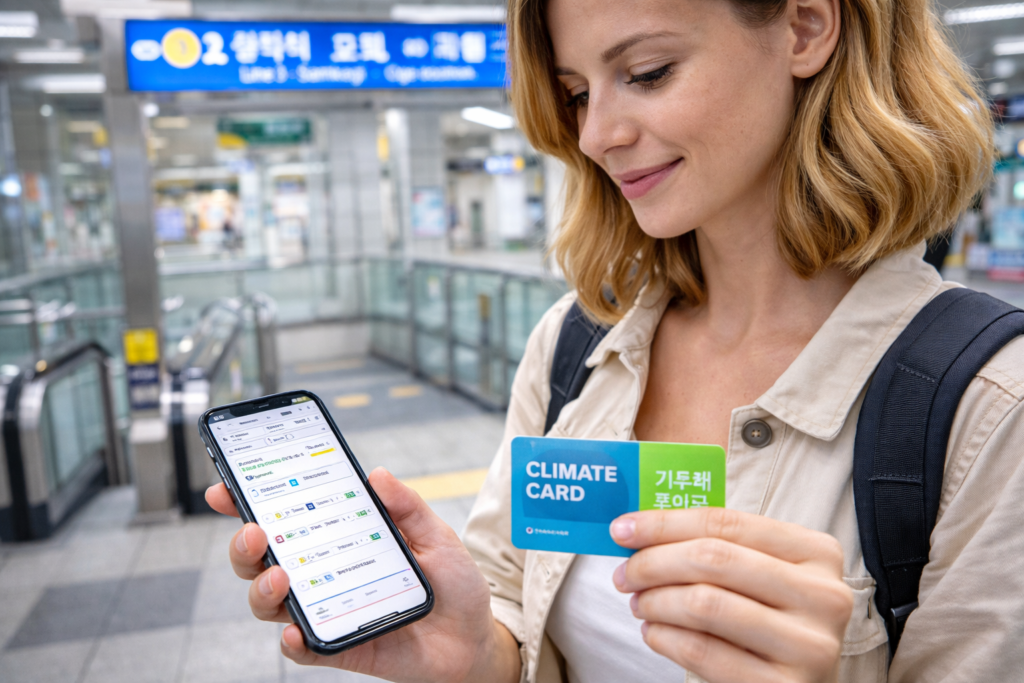
Here is the easiest practical method for tourists.
Step 1: Buy the physical card or use the supported mobile option
Tourists can use a physical Climate Card, which is the simplest option for many international visitors, especially iPhone users. Physical cards are sold at eligible subway station vending machines and some convenience-store-linked locations near subway stations.
Step 2: Choose the right short-term pass
Select the pass that matches your real itinerary: 1, 2, 3, 5, or 7 days. Remember that short-term passes start based on the charging date and cannot be charged in advance the same way longer commuter products can.
Step 3: Tap in and out correctly
On buses and subways, tap the card when entering and again when exiting. This is essential. Missing the exit tap can lead to errors or service restrictions.
Step 4: Double-check your destination line
Before you travel, confirm that your subway line and destination station are within the valid service range. This matters even more when you are going beyond central Seoul.
Step 5: Register when possible
Card registration can be important for refunds and some extra functions. Unregistered physical cards may have limitations. Many tourists skip this step, but it can save trouble if something goes wrong.
My tip: Save a screenshot of your hotel name in Korean and your nearest subway station. It makes route checking much faster when you are tired or offline.
Step 6: Use it heavily on attraction-heavy days
The best strategy is simple: use the Climate Card on days with many stops. Plan museum visits, shopping districts, café hopping, and evening views on the same pass days to maximize value.
📋 4. Climate Card Comparison Table for Tourists
This table gives you a quick visual overview.
| Pass Type | Price (KRW) | Best For | Main Advantage | Watch Out For |
|---|---|---|---|---|
| 1-day | 5,000 | Stopovers / busy one-day trips | Very low-cost unlimited rides for one day | Only worth it if you move around a lot |
| 2-day | 8,000 | Weekend travelers | Good balance of flexibility and cost | Check activation timing carefully |
| 3-day | 10,000 | Short Seoul city breaks | Strong value for first-time visitors | Less useful if you take taxis often |
| 5-day | 15,000 | Classic Seoul itineraries | Excellent for daily sightseeing | Coverage still depends on route |
| 7-day | 20,000 | Slow travel / longer stays | Best for flexible neighborhood hopping | May be unnecessary for light transit users |
Important note: short-term passes do not include Ttareungi bike access or Hangang Bus access by default in the same way some monthly products do, so tourists should not assume all mobility services are bundled together.
💰 5. How Much Money Can Tourists Actually Save?
Let’s make this practical.
A typical tourist in Seoul may take 4 to 6 rides per day. That can include subway trips between neighborhoods, bus transfers, and late returns to the hotel. Over several days, those individual fares add up quickly.
Example 1: 1-day heavy sightseeing
If you ride 5 times in one day, a 1-day Climate Card at KRW 5,000 can already feel efficient. Add a few transfers, and the convenience value becomes even better.
Example 2: 3-day city break
A 3-day pass costs KRW 10,000. For a tourist doing multiple daily rides across major districts, the average daily transport cost can become much lower than paying ride by ride.
Example 3: 5-day Seoul trip
At KRW 15,000, the 5-day pass can reduce transport stress dramatically. Even if the direct cash savings vary by itinerary, many travelers gain something equally important: freedom to explore without overthinking cost.
Real benefit in numbers:
- 1-day pass: KRW 5,000 total
- 3-day pass: about KRW 3,333 per day
- 5-day pass: KRW 3,000 per day
- 7-day pass: about KRW 2,857 per day
The longer you move around Seoul actively, the lower your effective daily transport cost becomes.
My tip: The biggest savings are not only in money. They are also in mental energy. Not calculating every ride makes Seoul feel much easier and more fun.
✅ Final Thoughts
The Climate Card, or Gihu Card, is one of the smartest transit tools for tourists visiting Seoul. It is simple, affordable, and especially powerful for travelers who plan to explore several neighborhoods in one trip.
The key is to use it strategically. Choose the pass length that matches your itinerary. Check route coverage before boarding. Tap in and out every time. And focus your busiest sightseeing days on the pass period.
For many tourists, this small card can make a big difference. It saves money, reduces stress, and gives you more freedom to enjoy Seoul like a confident traveler.
❓ FAQ
1. Can tourists buy the Climate Card in Seoul?
Yes. Tourists can buy short-term Climate Card products, including 1-day, 2-day, 3-day, 5-day, and 7-day passes.
2. Is the Climate Card better than a T-money card for tourists?
It depends on your travel style. If you will take many rides each day, the Climate Card is often better. If you will move around only a little, a regular T-money card may be cheaper.
3. Does the Climate Card work from Incheon Airport?
Coverage rules can be limited depending on station and direction, so travelers should verify airport rail eligibility carefully before using it for airport travel.
4. Can I use the Climate Card on every subway and bus in Korea?
No. The pass is designed for eligible Seoul transit services and selected covered sections. Always check whether your route is inside the valid service range.
5. What is the biggest mistake tourists make with the Climate Card?
The most common mistake is forgetting to tap out. Another major mistake is assuming the card works on every airport or regional route without checking coverage first.
SEO keywords: Climate Card Korea, Gihu Card Seoul, Seoul tourist transportation card, unlimited subway pass Seoul, Seoul travel tips, Korea tourist transit pass, Climate Card for foreigners