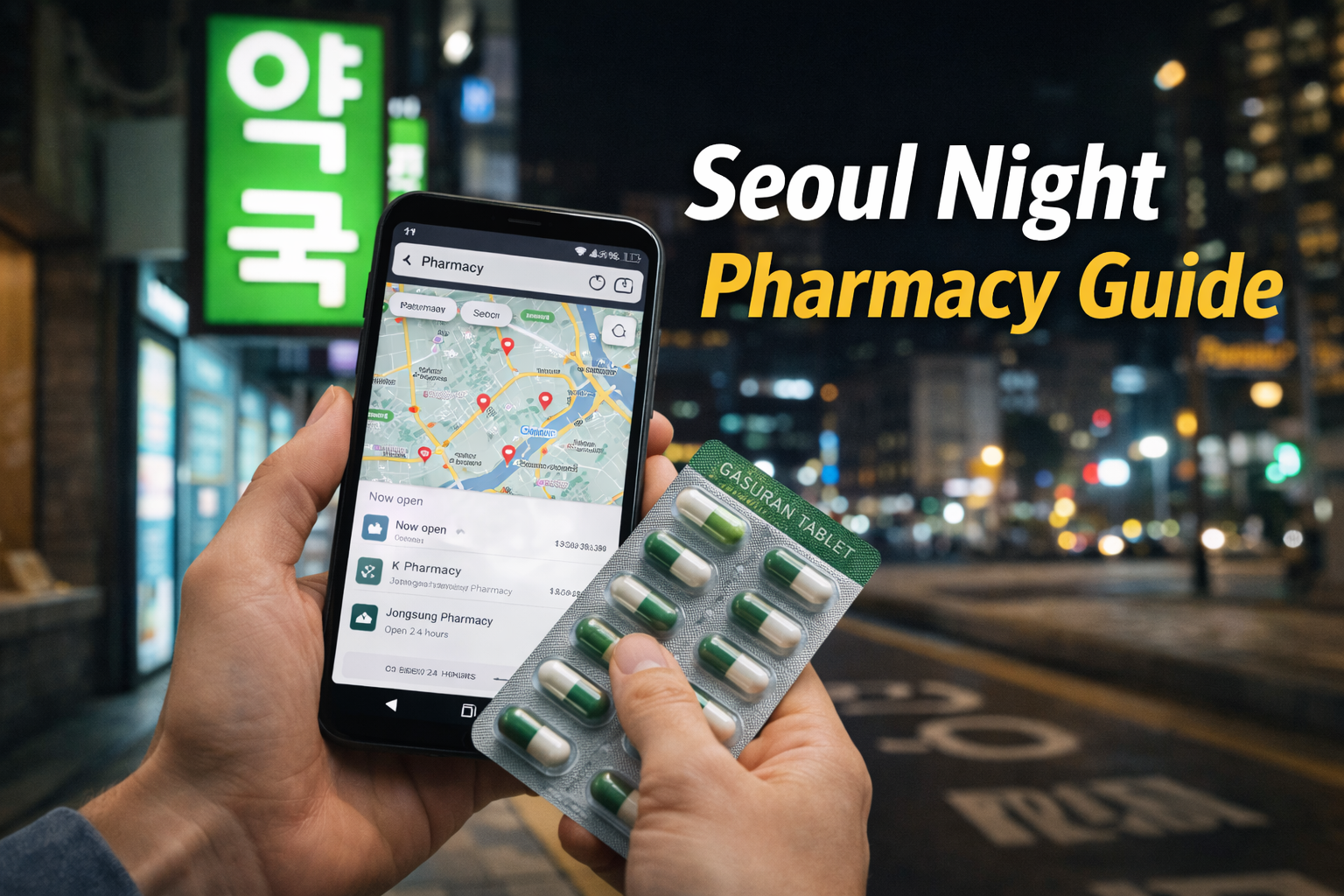
Getting sick late at night in Seoul can feel much worse when you are a visitor. Maybe your stomach suddenly turns after street food. Maybe you develop a fever after a long travel day. Or maybe you just need allergy medicine at midnight and realize every nearby pharmacy looks closed.
I have seen this happen to travelers more than once. The biggest mistake is wasting time walking from block to block hoping to spot a green pharmacy sign still lit up. In Seoul, the smarter move is to use the right official tools first.
This guide explains how to find foreigner-friendly night-duty pharmacies in Seoul, what numbers to call, what to say, and how to avoid turning a small medical problem into a stressful night.
Quick answer: Start with the E-GEN emergency medical portal for live hospital and pharmacy information, use 119 for urgent medical emergencies, and contact 1330 or 120 Dasan if you need language or local support. Seoul also operates designated public late-night pharmacies across all 25 districts.
💡 5 Key Things to Check Before Searching
Before you rush outside, pause for two minutes and check these five things first. This simple habit can save you a lot of time.
1. Is it a pharmacy problem or a true emergency? 🚑
If you have chest pain, breathing trouble, severe bleeding, fainting, signs of stroke, or a dangerous allergic reaction, skip the pharmacy search and call 119 immediately. Seoul’s official travel guide lists 119 as the emergency medical help number.
2. Do you need over-the-counter medicine or a prescription? 💊
Some late-night pharmacies can help with common symptoms like pain, fever, stomach trouble, or colds. But if you need a prescription-only medicine, you may need an open clinic or hospital first. Korea Tourism Organization guidance also suggests bringing medical records or an English prescription for more complex cases.
3. Can you explain your symptoms clearly in English? 🗣️
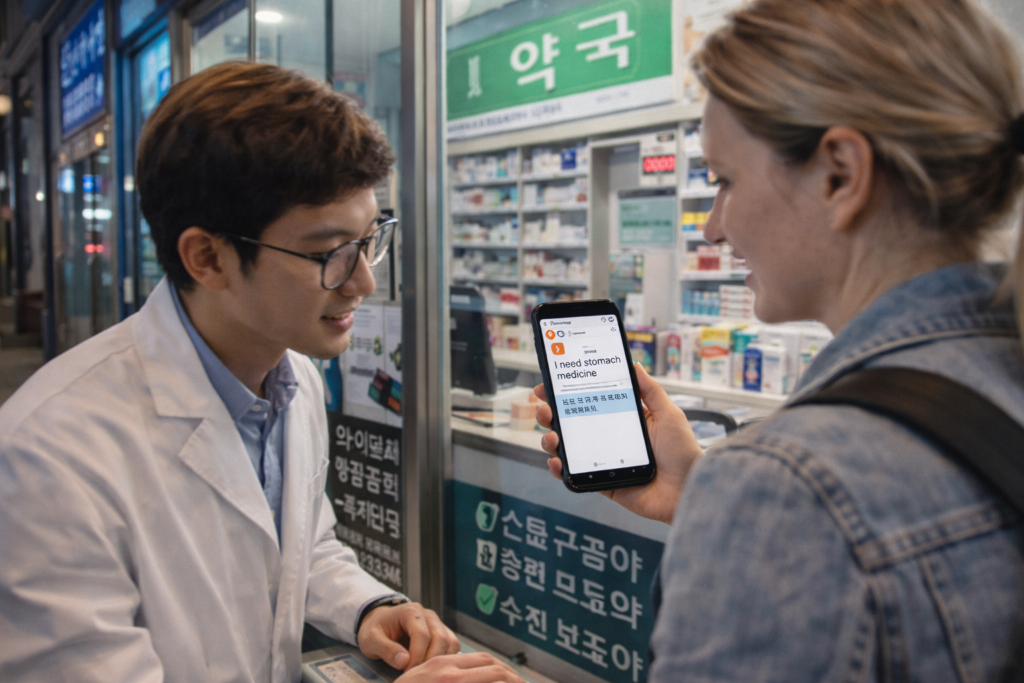
KTO’s pharmacy guide recommends using a translation app and even showing a photo of the medicine you want. That is one of the easiest ways to bridge the language gap at Korean pharmacies.
4. Are you searching by location, or just by luck? 📍
Do not rely on random walking. Seoul now operates 39 public late-night pharmacies across all 25 districts, and the city says users can check locations and hours digitally.
5. Do you have backup support if the first pharmacy is closed? ☎️
Late-night availability can change by day, district, and schedule. KTO specifically recommends noting contact information in advance and calling if needed, which strongly suggests that confirming before you go is the safer move.
My personal tip: when I travel in Seoul, I save one nearby pharmacy, one backup pharmacy, and one hospital before I ever need them. It feels unnecessary until 11:40 PM.
📊 Best Ways to Find a Foreigner-Friendly Night-Duty Pharmacy Fast
1. Use E-GEN first for real medical search results
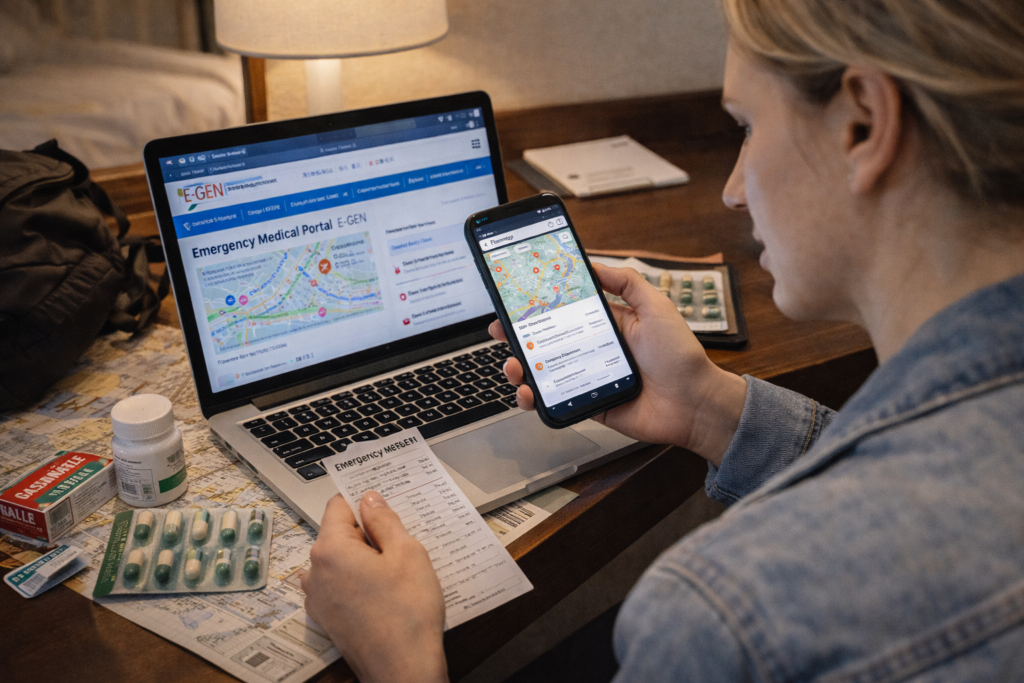
The E-GEN portal is run by Korea’s National Emergency Medical Center and is the most official starting point for emergency medical information. If you need a pharmacy or hospital late at night, this should be your first tool.
Best use: Search nearby emergency medical facilities and check available options before leaving your hotel.
2. Look for Seoul’s designated public late-night pharmacies
Seoul officially announced that its public late-night pharmacy system now spans all 25 districts, with 39 designated locations. The city says these pharmacies generally operate from 10 PM to 1 AM, and many locations are listed with district, address, contact number, and operating schedule.
Best use: Great for common nighttime needs like pain relief, fever medicine, digestive medicine, and respiratory symptom treatment. Seoul’s own 2025 usage data shows these were among the most common reasons people visited.
3. Call 119 if you are unsure whether it is urgent
Seoul’s emergency system handles medical emergencies through 119, and the city has also described 119 as a route for first-aid instructions and directions to hospitals and pharmacies. Seoul has additionally stated that interpretation support is available for foreign callers in emergency contexts.
Best use: Use this when symptoms might be serious or when you need immediate medical direction rather than general travel help.
4. Use 1330 for traveler-friendly support
The 1330 Korea Travel Helpline is a 24/7 service for tourists. It provides travel information and support to people traveling in Korea. In practical late-night situations, it can be useful when you need tourist-oriented help and do not know which local service to start with.
Best use: Good when you are a visitor, feel stuck, and need help in English navigating where to go next.
5. Use 120 Dasan if your problem is Seoul-specific
Seoul’s 120 Dasan Call Center offers foreign-language consultation related to life in Seoul, tourism, and local information. Seoul says the foreign-language service covers English, Chinese, Japanese, Vietnamese, and Mongolian.
Best use: Helpful when you need Seoul-specific guidance, especially if you are in a hotel and want a local support route.
6. Ask your hotel front desk to call for you
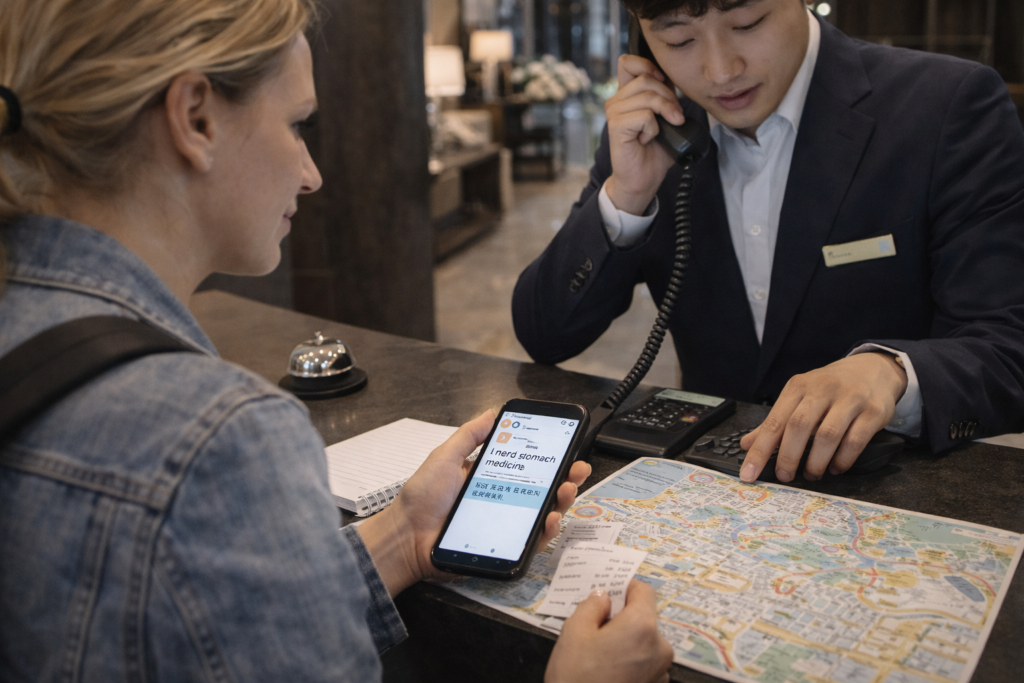
This is not just a convenience trick. It is often the fastest way to confirm whether a nearby pharmacy is really open and whether it can handle your request. Since pharmacy schedules can vary, a Korean-speaking hotel staff member can save you a wasted trip. KTO also recommends keeping contact information for duty pharmacies and calling in emergencies.
7. Use a translation app and medicine photos
KTO’s official pharmacy guide specifically recommends using a translation app and showing a photo of the medicine you need. It also notes that pharmacies in visitor-heavy areas may have language-assistance signs.
My personal tip: screenshot your symptom in simple English and simple Korean before you go. It is much easier than trying to explain a stomach cramp at midnight when you are exhausted.
📌 Practical Late-Night Pharmacy Tips in Seoul
Search before you leave your room
Do not assume the closest pharmacy on the map is open. Start with E-GEN or Seoul’s late-night pharmacy listings first.
Call ahead whenever possible
KTO’s guidance encourages travelers to note pharmacy contact details and call for assistance when needed. That is one of the simplest ways to avoid showing up to a closed location.
Prepare four pieces of information
Have your hotel address, your current location, your symptoms, and any allergies ready. Pharmacies are much easier to use when you can communicate clearly.
Know the most common late-night medicine needs
Seoul’s public late-night pharmacy data shows the most common purchases were pain and fever relief, digestive medicine, and respiratory treatments. That is useful because it means these pharmacies are often geared toward the exact problems travelers commonly face.
Do not force a pharmacy solution for serious symptoms
If the issue feels more serious than a normal travel illness, move to emergency care quickly. That is what 119 is for.
My personal tip: if you are traveling with children, save the nearest late-night pharmacy before dinner. Problems never seem to start at 3 PM. They start when everything is closing.
📋 Quick Comparison Table
| Situation | Best First Action | Why It Helps | Priority |
|---|---|---|---|
| Mild fever, headache, upset stomach | Search E-GEN or a Seoul public late-night pharmacy | Fastest route to common medicine | High |
| You do not speak Korean | Call 1330 or ask hotel staff to help | Language support reduces mistakes | High |
| Need Seoul-specific local guidance | Call 120 Dasan | Useful for city information and local support | Medium |
| Possible emergency or symptoms getting worse | Call 119 | Fast medical direction and emergency response | Critical |
| Need help identifying the right medicine | Use translation app + show medicine photo | Improves communication with pharmacist | High |
💰 Why the Right Method Saves Time, Money, and Stress
Using the right search flow has real benefits.
- Less wasted time: Seoul’s official late-night pharmacy network gives you targeted options instead of random searching.
- Better odds of finding the right medicine: Seoul’s night pharmacies are commonly used for fever, pain, digestive, and respiratory medicine.
- Less language stress: 1330, 120 Dasan, and hotel staff can reduce communication problems for foreign visitors.
- Safer decisions: Knowing when to move from “find a pharmacy” to “call 119” can protect your health.
In my experience, the biggest win is emotional. Once you know which number to call and which tool to open, the whole situation feels much more manageable.
✅ Final Thoughts
If you need a foreigner-friendly night-duty pharmacy in Seoul, do not rely on luck. Start with the official system: E-GEN for search, Seoul’s public late-night pharmacy network for practical local options, 1330 for tourist help, 120 Dasan for Seoul support, and 119 for anything urgent.
The smartest travel health strategy is simple: save these tools before you need them.
❓ FAQ
1. What is the best official site to find a late-night pharmacy in Seoul?
The best official starting point is the E-GEN emergency medical portal, run by Korea’s
2. Are there public late-night pharmacies in Seoul?
Yes. Seoul says it now operates 39 public late-night pharmacies across all 25 districts, generally open from 10 PM to 1 AM.
3. What number should foreigners call for a medical emergency in Seoul?
For urgent medical emergencies, call 119. Seoul’s official travel guidance lists 119 as the emergency medical number.
4. What number can travelers call if they need help in English?
1330 is Korea’s 24/7 travel helpline for tourists, and 120 Dasan is useful for Seoul-specific support.
5. How can I communicate with a Korean pharmacist if I do not speak Korean?
KTO recommends using a translation app and showing a photo of the medicine you need. Some pharmacies in visitor-heavy areas may also offer language assistance.