
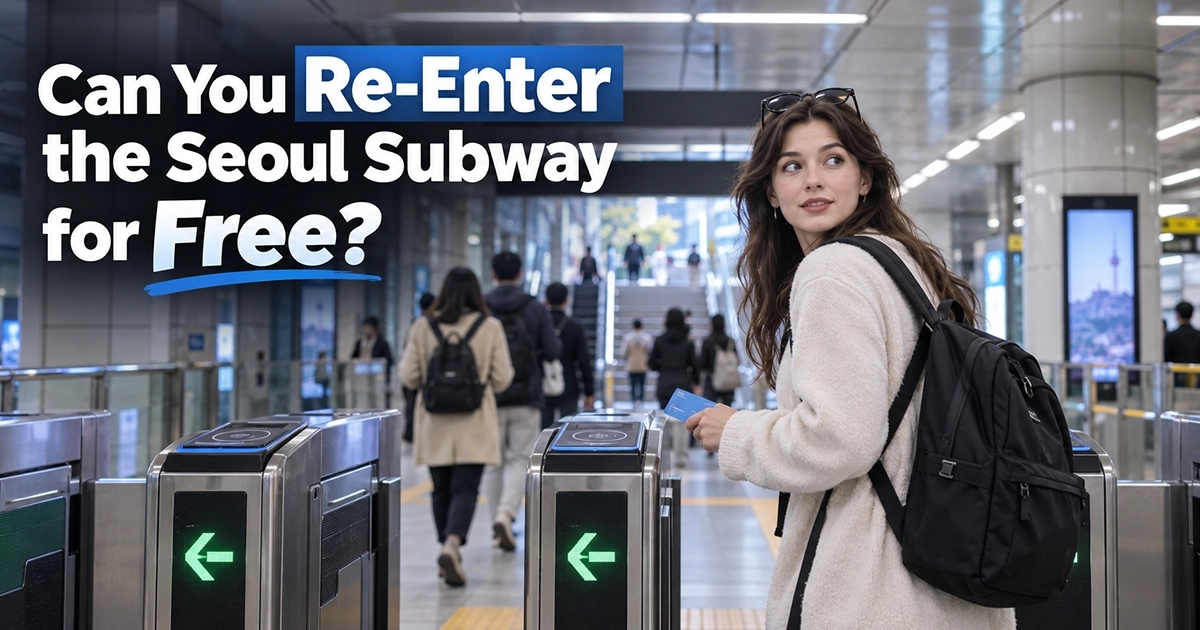
Yes. On participating sections, the Seoul subway 15-minute re-entry rule can let you exit through the fare gates and enter again without paying another basic fare, provided you return to the same station and the same line within 15 minutes using the same eligible transit card.
For most tourists using a standard prepaid transit card such as T-money, the important details are the clock, the line you return through, and the operator running that part of the railway. The benefit applies once during a subway journey, so it is not an unlimited free exit-and-entry system.
Quick answer: Tap out, return to the same station and the same subway line within 15 minutes, and tap the same eligible transit card to re-enter. On a participating section, the re-entry is treated as a transfer so another basic fare is not charged. The benefit is limited to one qualifying re-entry during a subway journey.
How the 15-Minute Subway Re-Entry Rule Works
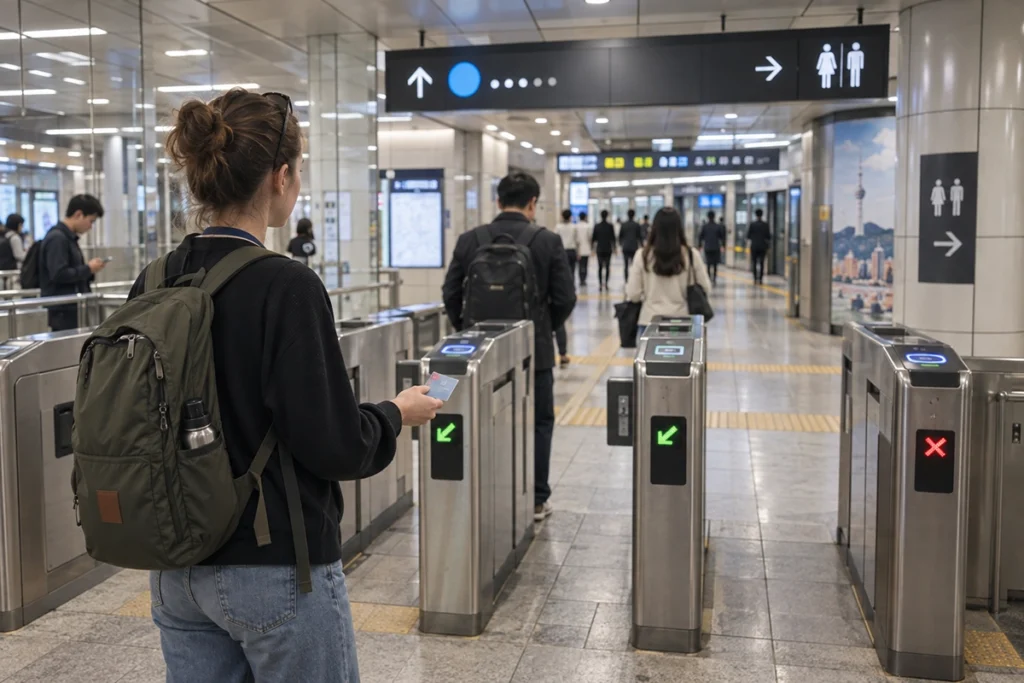
The 15 minutes start when you tap your transportation card to exit. You need to complete the new entry tap before that time runs out.
- Tap your transit card when leaving the fare-controlled area.
- Finish whatever required you to leave, such as finding a restroom or correcting a direction mistake.
- Return to the same station and the same subway line.
- Tap the same eligible transportation card within 15 minutes.
- The re-entry is processed as a transfer rather than a completely new boarding with another basic fare.
This is useful when a restroom is outside the paid area, you have gone through the wrong fare gates, or you need to leave the gates after missing a stop or choosing the wrong direction. Seoul introduced the system to reduce the extra-fare problem caused by situations such as urgent restroom visits and travel mistakes.
The rule does not make the rest of your subway journey free. It prevents an additional basic fare from being charged for the qualifying exit and re-entry. Normal distance-based and other fare rules for the journey can still apply.
The Same Station and Same Line Conditions Matter
Returning to the same station is not enough at a large interchange. You should re-enter through the fare gates for the same line you exited from.
For example, if you leave through the Line 1 gates at an interchange station, do not assume you can walk outside the paid area and return through another line’s gates just because both entrances belong to the same station complex.
| Situation | What to Expect |
|---|---|
| Same station, same line, within 15 minutes, eligible transit card | Re-entry can be treated as a transfer without another basic fare |
| Same station but a different line’s gates | Do not assume the 15-minute re-entry rule will apply |
| Re-entering at a different station | Not a qualifying same-station re-entry |
| More than 15 minutes after tapping out | Normal entry fare rules can apply |
| Single-journey ticket or commuter pass | Not eligible for the automatic re-entry treatment under the published rules; ask station staff |
The same-line condition is especially easy to miss at stations where several subway lines have separate gate areas.
Which Seoul Subway Lines Use the Rule?
The Seoul Metropolitan Government subway guide lists the city’s 15-minute re-entry coverage. Its Seoul-operated coverage includes all of Lines 2, 5, 8 and 9, the Ui-Sinseol Line and the Sillim Line, plus specified sections of Lines 1, 3, 4, 6 and 7.
That Seoul list is not the whole current picture. From June 20, 2026, the national government and Korail expanded the 15-minute re-entry system to eligible Korail-operated metropolitan railway sections.
The government’s 2026 policy guide lists Korail-operated sections of Lines 1, 3 and 4 as well as the Gyeongui-Jungang, Suin-Bundang, Seohae, Gyeonggang and Gyeongchun lines.
This expansion is useful for travelers because a line number does not always tell you which railway company operates the section you are standing in. Before June 2026, that operator boundary could change whether the re-entry benefit worked.
Some Metropolitan Rail Lines Are Still Excluded
Do not interpret the 2026 expansion as a universal 15-minute rule covering every railway in and around Seoul. The Korail expansion does not cover privately operated railways, and the government’s announcement also identifies Incheon Transit Corporation sections that remain outside the new Korail rule.
- Airport Railroad (AREX)
- Shinbundang Line
- Gimpo Goldline
- Uijeongbu Light Rail
- Yongin EverLine
- Incheon Subway Lines 1 and 2
- The Line 7 section from Kkachiul to Seoknam operated by Incheon Transit Corporation
The official June 2026 announcement is available through the Ministry of Land, Infrastructure and Transport policy briefing.
This distinction matters if you are heading toward Incheon Airport or traveling through the wider Seoul metropolitan rail network. Do not leave the paid area on an excluded service assuming that the Seoul or Korail re-entry rule will automatically apply.
Use a Transit Card Rather Than Assuming Every Ticket Qualifies
The automatic re-entry system is designed around transportation-card tap records. For most visitors, a standard prepaid T-money card fits the transport-card requirement because the system can connect the exit tap with the qualifying re-entry tap.
The published Seoul and Korail rules exclude single-journey tickets and commuter passes from the automatic re-entry treatment. If you are using one of those products, ask station staff rather than assuming that tapping back in will preserve the fare. Korail instructs those passengers to contact staff and use the emergency gate when necessary.
If you are still learning how entry taps, exit taps and card records work, the KoreaEasyTrip guide to using a T-money card at Seoul subway gates covers the normal procedure in more detail.
Do Not Treat the 15 Minutes as an Unlimited Stopover
The rule is meant to preserve an ongoing subway journey when you temporarily need to leave the paid area. It is not an unlimited pass for repeatedly leaving and returning through the gates.
Both Seoul’s published operating rule and Korail’s 2026 rule limit the basic-fare exemption to one qualifying re-entry during a subway journey. A qualifying re-entry is processed as a transfer rather than a completely separate free trip.
If you know before leaving the gates that your situation may take longer than 15 minutes, asking station staff first can prevent confusion. This is particularly useful when you have a single-journey ticket, are using a pass product, are unsure which company operates the station, or cannot identify the correct line-specific entrance.
The Practical Rule to Remember
For an ordinary T-money user in Seoul, remember four things: same station, same line, same card, within 15 minutes. When all four conditions are met on a participating section, you can normally re-enter without triggering another basic fare.
Forgot to tap out instead? Read our 2026 Seoul subway missed-exit extra fare guide to learn what happens on your next ride.
The June 2026 Korail expansion made the rule available across substantially more of the metropolitan railway network, but important exceptions remain. At Airport Railroad, Shinbundang and other excluded services, check the operator’s own rules or ask station staff before leaving the paid area.
Last checked: September 15, 2026. Subway operators, participating sections and fare rules can change, so check the linked Seoul Metropolitan Government and national government guidance if your trip is still several months away.