Last checked: August 3, 2026. Store hours, product stock, promotions, payment support, transportation-card procedures, tax-refund participation and customer facilities can vary by branch and change over time. Follow the current signs and staff instructions at the store you actually visit.
Korean convenience stores can be useful for ready-to-eat food, drinks, snacks, transportation cards and small travel supplies, but not every branch works the same way. Seating, microwaves, ramen cookers, waste stations, payment options and opening hours can differ even between stores from the same chain.
The easiest approach is to treat each store as its own location rather than assuming that every CU, GS25, 7-Eleven or emart24 offers identical facilities. Pay before opening food, read the promotion label carefully, use only the equipment provided for customers and keep Korean-won cash available for an ordinary physical T-money purchase or reload.
Quick answer: Check what the branch actually provides, pay before opening or heating food, read 1+1 and 2+1 labels before checkout, follow that store’s waste system, do not treat a customer bin as a public trash can, keep merchandise payment separate from T-money transactions, check tax-refund participation before paying and be prepared to show identification for age-restricted products.
1. Convenience Stores Offer More Than Snacks, but Services Vary
Korean convenience stores commonly sell packaged meals, drinks, snacks, toiletries, umbrellas, tissues, charging accessories and other small travel supplies. Some locations also provide customer seating, hot water, microwaves or ramen-cooking equipment.
That does not mean every branch is a miniature restaurant or travel center. A small residential store may be designed mainly for takeaway purchases, while a larger or specialized location may provide more space and equipment.
The official VISITKOREA guide to convenience stores in Korea introduces major chains, exclusive products and the food-and-promotion culture around Korean convenience stores.
2. Seating, Microwaves and Ramen Cookers Vary by Branch
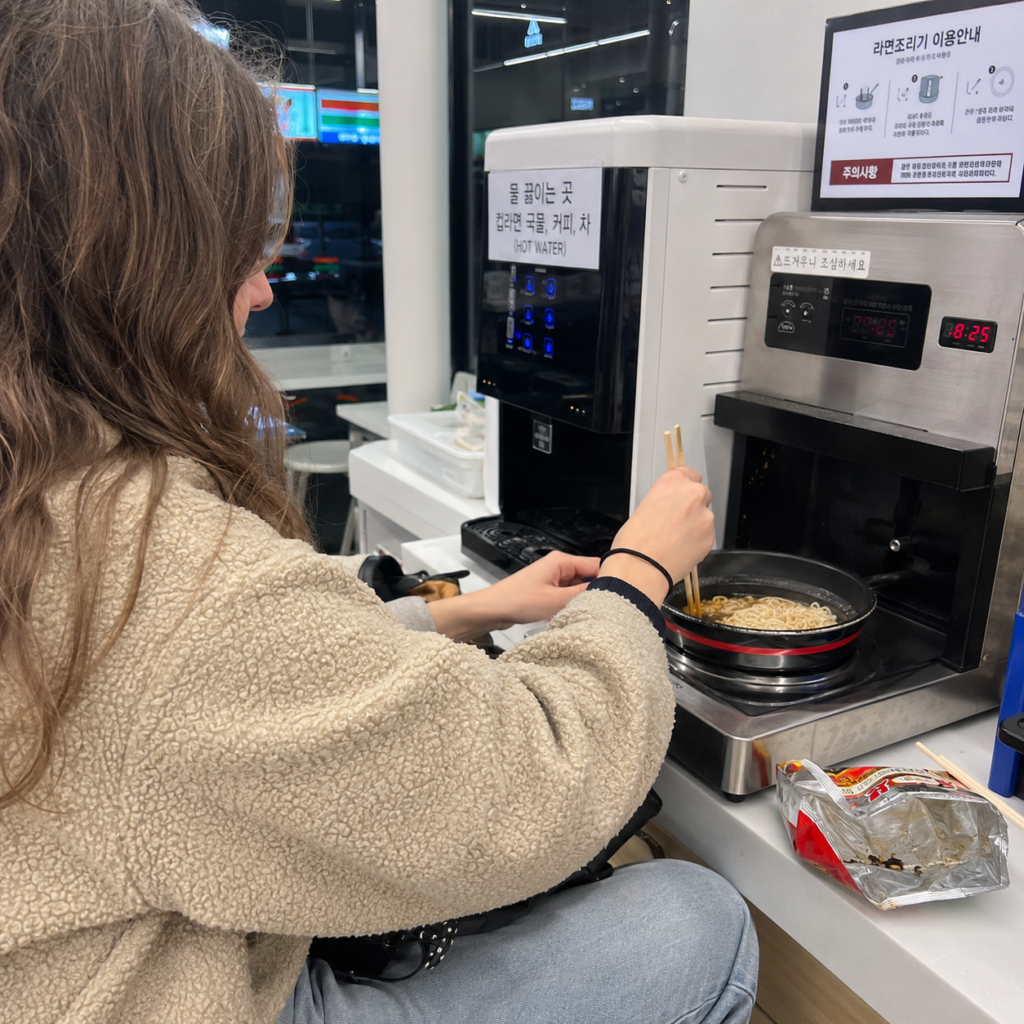
Before choosing food that you plan to eat immediately, check whether the branch actually provides a customer eating or preparation area.
- a clearly designated table or counter
- a microwave available for customers
- a hot-water dispenser
- a ramen cooker with instructions
- utensils or napkins
- a customer waste or return station
Do not create your own eating area on an entrance step, narrow sidewalk, neighboring property or apartment ledge. If there is no customer seating, keep the purchase closed and take it somewhere appropriate.
How to Use a Ramen Cooker
Pay for the noodles first. Then check the product and machine instructions, use only the container intended for that cooker and add ingredients in the order shown.
Machines and controls are not identical at every store. If the equipment is unclear, ask staff or choose a product that uses a simpler preparation method rather than copying another customer’s settings.
3. Pay Before Opening or Heating Food
An item on the shelf has not been purchased until checkout is complete. Unless staff clearly instruct you otherwise, do not open, taste, microwave or prepare the product before paying.
- Choose the product.
- Check its price and promotion label.
- Pay at the staffed cashier or available self-checkout.
- Keep the receipt when you may need it.
- Move to the customer preparation area.
- Heat or prepare the food according to its instructions.
Use only packaging that is suitable for the appliance provided. Remove foil, metal lids or other materials when the product instructions require it, and do not guess whether unfamiliar packaging is microwave-safe.
4. Understand 1+1, 2+1 and Promotion Labels
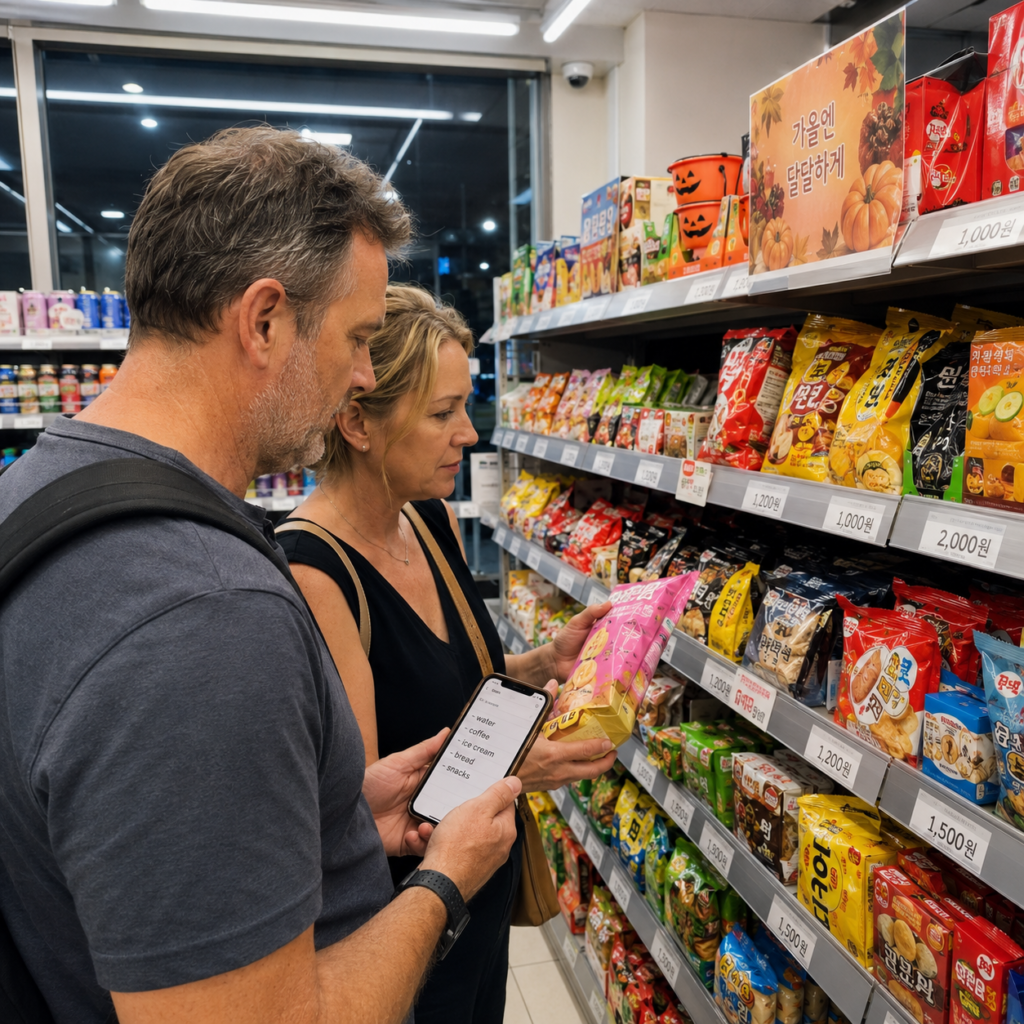
Korean convenience stores frequently use promotions such as 1+1, 2+1, discounts and additional gifts. VISITKOREA also identifies these types of promotions as a common feature of Korean convenience-store shopping.
A 1+1 promotion typically means you buy one qualifying item and receive one additional qualifying item under that offer. A 2+1 promotion typically requires two qualifying purchases for one additional qualifying item.
| Shelf Label | What to Check |
|---|---|
| 1+1 | Take both qualifying items and confirm the promotion at checkout. |
| 2+1 | Take the required three qualifying items and check the promotion period. |
| 증정 | A gift or extra product may be included when the stated conditions are met. |
| 할인 | The price is discounted; check whether membership or another condition applies. |
The exact shelf label and checkout result are the final guide. A nearby flavor, size or package may not qualify even when it looks almost identical.
Do not assume that the cashier will automatically add a promotional item you did not bring to the counter. Check the display before paying.
5. Follow the Store’s Trash System Instead of Guessing
Customer waste stations differ by branch. One store may separate leftover liquid, food waste, cans, bottles, plastic and general waste, while another may provide fewer categories or no customer bin at all.
- Empty leftover liquid only into a clearly marked container or drain.
- Use a food-waste container only when the store provides one.
- Separate cans, bottles and other waste when the labels instruct you to.
- Do not pour drinks into an unmarked sink or waste opening.
- Do not leave cups, wrappers, chopsticks or broth on the table.
Follow the labels at that branch rather than inventing your own sorting system.
A Convenience-Store Bin Is Not Automatically a Public Trash Can
A customer bin is generally intended for waste connected with purchases or use of that business. Do not bring in a full bag of street-food containers, coffee cups or unrelated travel waste and assume that the store must accept it.
If no suitable disposal point is available, keep the waste temporarily and see our guide to where to find public trash cans in Seoul.
6. Chains and Branches Do Not Carry Identical Products
CU, GS25, 7-Eleven, emart24 and other chains can offer different private-label products, collaborations, meal sets, desserts, drinks and seasonal promotions. Stock can also differ between branches of the same chain.
A snack that is trending online may be sold out, discontinued, limited to a particular chain or available only during a promotion. Do not make an important part of your itinerary depend on one product unless searching several branches is itself part of the activity.
If you find something you may want later, photograph the exact name, size, flavor and package. Similar-looking versions may contain a different flavor, quantity or promotional configuration.
If you need a larger grocery-style haul rather than a quick convenience-store stop, our Lotte Mart Seoul Station shopping guide covers larger food shopping, luggage planning and airport-day timing.
7. Store Payment and T-money Transactions Are Different
A payment method that works for snacks does not necessarily work for a transportation-card transaction. Treat ordinary merchandise purchases and T-money purchase or reload requests as separate transactions.
The Korea Tourism Organization’s current transportation guide states that foreign-issued credit cards are not accepted for the purchase or top-up of a standard prepaid T-money card through the ordinary convenience-store and subway-station route, and directs travelers to use cash.
For an ordinary physical T-money transaction at a convenience store, prepare Korean-won cash instead of assuming that a foreign card accepted for merchandise can also be used for the transportation card.
See the Korea Tourism Organization transportation guide for the current foreign-card payment overview. For the complete purchase, cash-reload, subway and bus process, see our guide to using a T-money card in Seoul.
For an ordinary store purchase, use a payment method accepted by that terminal. If a foreign-issued card fails, our guide to what to do if your credit card is declined in Korea explains practical backup steps.
8. Tourist Tax Refund Is Available Only at Participating Stores
Tourist tax refund is not a universal convenience-store service. VISITKOREA states that immediate tax refund has expanded to select convenience stores, so participation must be checked at the individual location.
Current general eligibility guidance includes:
- a participating certified tax-refund store
- a qualifying purchase of at least KRW 15,000
- goods that remain new, unopened and unused
- departure from Korea within three months of the purchase date
- passport presentation and a refund request when required during checkout
Look for a Tax Refund or Tax Free sign and ask before paying. Keep the receipt and any refund documents until the relevant departure process is complete.
Check the current VISITKOREA Duty Free & Tax Refunds guide before relying on the benefit.
For a small drink or snack purchase, the transaction may fall below the current minimum or the branch may not participate in the tax-refund system. Treat the refund as a possible benefit rather than a reason to choose one convenience store over another.
9. Alcohol and Tobacco Sales Are Age-Restricted
Alcohol and tobacco are age-restricted products under Korean law. Under the current Youth Protection Act, a youth is generally a person under 19, but a person is excluded from that definition from January 1 of the calendar year in which they turn 19.
You can review the current definition in Korea’s Youth Protection Act.
Staff may request identification to verify that a customer is eligible to buy an age-restricted product. If your age or identification cannot be verified, expect the transaction to be refused rather than assuming that the rules from your home country apply.
If the branch provides customer seating, follow any posted rules about drinking, noise and closing time. Seating policies can differ between locations.
A Simple First-Visit Plan
- Check the branch. Confirm whether it has seating or preparation equipment if you want to eat there.
- Choose the food. Read the product label, ingredients and heating instructions.
- Check the promotion. Confirm whether 1+1, 2+1 or another condition applies.
- Pay first. Do not open or heat the product before checkout.
- Prepare the food. Use only customer equipment and follow the product instructions.
- Sort the waste. Follow the labels at that specific store.
- Check your belongings. Take your phone, wallet, bags and transportation card before leaving.
Common first-visit choices include packaged rice meals, sandwiches, instant noodles, snacks, drinks and small desserts. Product availability and ingredients vary, so choose according to your own diet and preferences instead of relying only on a viral product list.
Frequently Asked Questions
Can tourists eat inside Korean convenience stores?
Yes, when the branch provides a customer seating area and allows customers to use it. Some locations have indoor or outdoor seating, while others are designed mainly for takeaway purchases.
Can tourists use the ramen machine?
Yes, when the store provides one for customers. Pay first, use the correct container and follow the instructions for both the machine and the product.
Can I recharge T-money with a foreign credit card at a convenience store?
For a standard prepaid T-money purchase or top-up through the ordinary convenience-store route, current Korea Tourism Organization guidance says foreign-issued credit cards are not accepted and travelers should use Korean-won cash.
Are Korean convenience stores open 24 hours?
Not all of them. Many branches operate long hours, but opening hours are location-specific. Check the store you plan to use instead of assuming every branch stays open overnight.
Can every convenience store provide a tourist tax refund?
No. The location must participate in the tax-refund system and the transaction must meet the current eligibility requirements. Check for the applicable sign and ask before paying.
Can I use a convenience-store bin for outside trash?
Do not treat it as a public bin unless the store clearly allows that use. Customer waste facilities are generally intended for waste connected with that business.
Final Takeaway
Korean convenience stores are useful because they combine food, drinks, small travel supplies and some transportation-related services in one place. Their convenience does not mean that every branch provides the same facilities or follows the same procedures.
Check the store before opening food, pay first, read promotion labels carefully, follow the branch’s waste system and prepare Korean-won cash for an ordinary physical T-money purchase or reload. Confirm tax-refund participation before paying and be prepared to show identification when purchasing age-restricted products.
The easiest way to use Korean convenience stores is not to memorize one rule for every chain. Look at the branch in front of you, read the signs and use only the services and equipment that store clearly provides.