
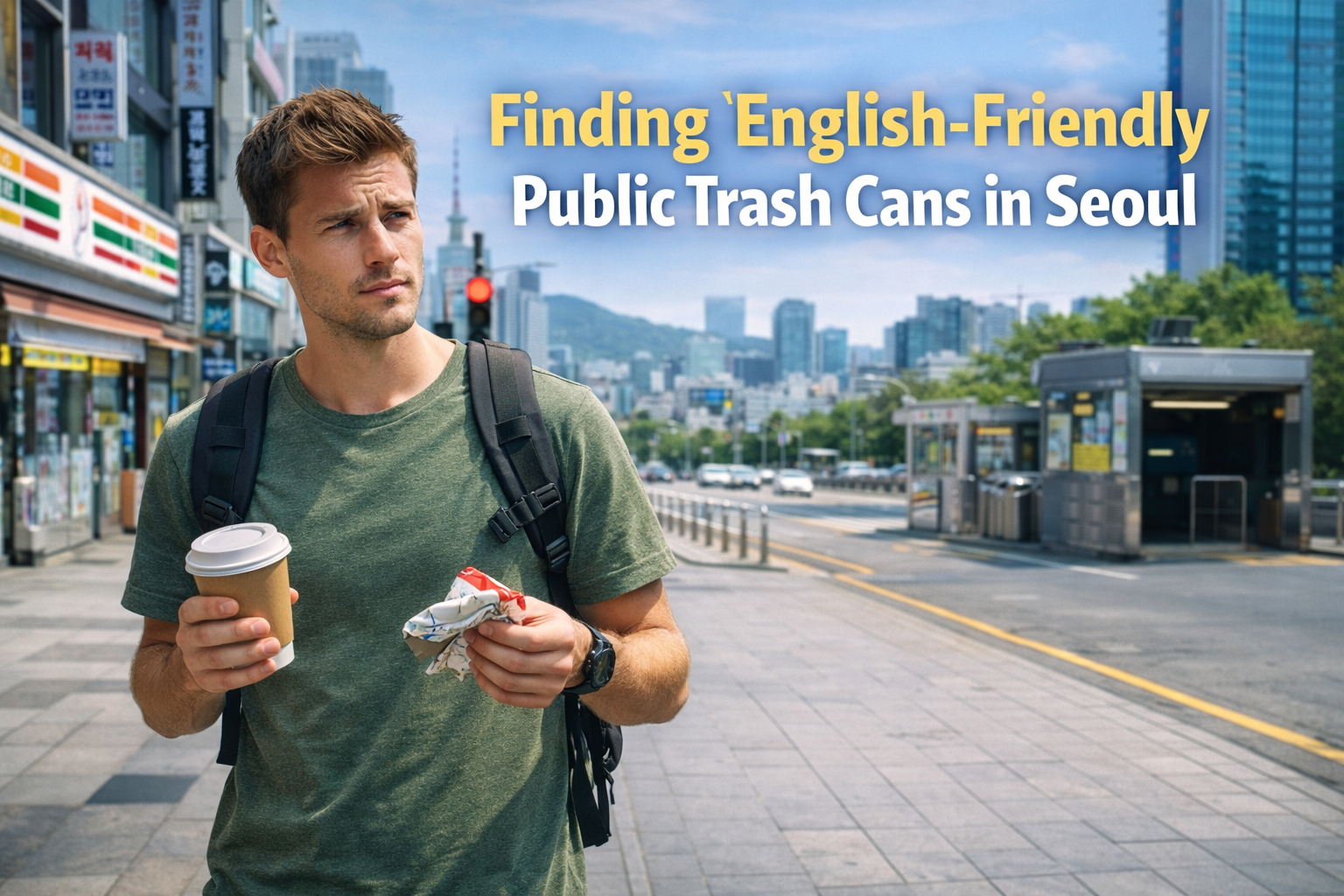
If you have ever walked around Seoul with an empty coffee cup, snack wrapper, or takeaway container and thought, “Why is it so hard to find a public trash can here?”, you are not imagining it.
For many first-time visitors, Seoul feels ultra-modern, clean, and convenient. But public trash cans can still feel surprisingly rare, especially if you do not read Korean or you are moving between busy tourist areas. I have run into this problem many times while walking through Myeongdong, Hongdae, Gwanghwamun, and along the Han River. The city is clean, but the disposal system is not always obvious.
The good news is this: trash cans do exist in Seoul. They are just not evenly placed, and they are often easier to spot in specific zones rather than on every block. In this guide, I will explain why public trash cans feel hard to find, where foreign visitors should actually look, and how to avoid carrying trash for an hour.
💡 Why Public Trash Cans in Seoul Feel So Hard to Find

There are five main reasons this happens.
1. Trash cans are not evenly distributed across the city
Seoul does have public bins. But they are spread across a very large city, so visitors often experience long stretches with none in sight. This is one reason bins feel “missing” even when they technically exist.
2. Many bins are placed where maintenance is practical
Street bins are easier to find in areas where the city can monitor and service them. Bin placement is closely tied to maintenance, cleanliness, and illegal dumping concerns, not just tourist convenience.
My tip: When I cannot find a bin on a shopping street, I stop looking randomly and head toward a subway entrance, a riverside park entrance, or a convenience store cluster. That usually works faster.
3. Some public places expect you to carry waste out
In Seoul, not every public space provides easy disposal. Some event and outdoor spaces clearly tell visitors to take trash with them or use designated bins only. That means the city’s cleanliness often depends on a “carry-in, carry-out” habit in certain areas.
4. Waste sorting culture is stricter than many tourists expect
Korea’s waste system is built around separation, recycling, and proper disposal. For visitors, this can make disposal feel less casual than in cities where every corner has a general-purpose bin.
5. English signage is inconsistent
Some bins are easy to understand. Others are not. You may see Korean labels, recycling icons, or category-only openings without clear English text. So the problem is not always the total number of bins. Sometimes it is simply that the bins are harder for foreign visitors to identify confidently.
For official background, Seoul’s own city update is useful here:
Seoul trash bin management with QR codes.
📍 Where to Look First for Public Trash Cans in Seoul
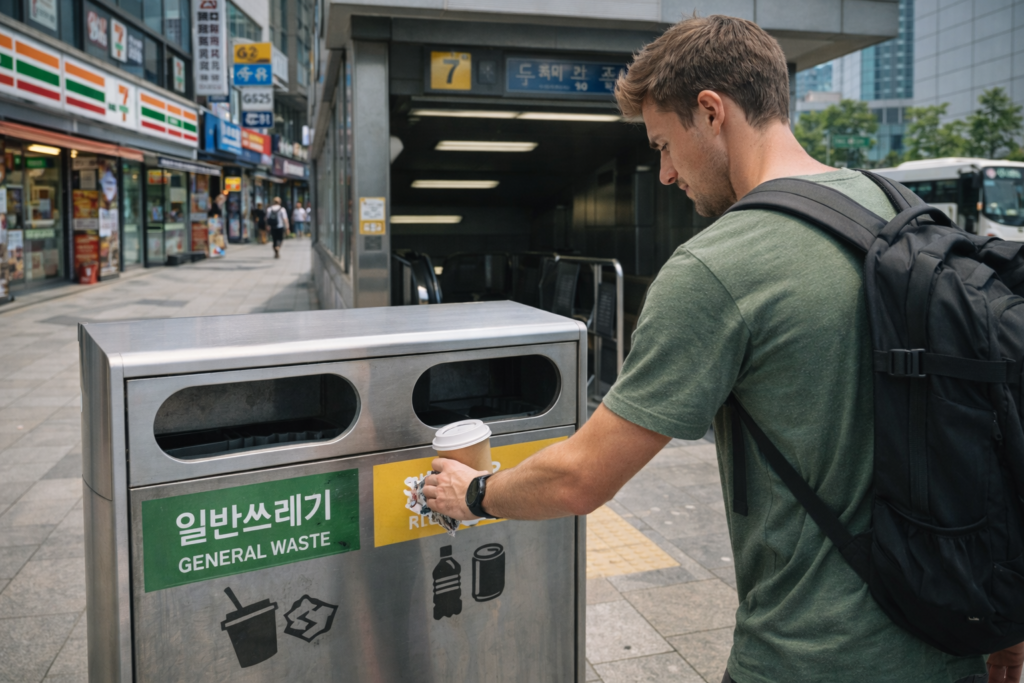
Here are the places where I have had the best luck.
1. Near major subway station exits
This is often the best first check. Not every station exit has a bin, but larger stations and busier transfer areas are more promising than ordinary side streets. Transit zones are still worth checking before giving up.
2. Convenience stores, especially around busy commercial zones
If you bought the drink or snack there, this is often the easiest solution. Many travelers forget that the most practical “English-friendly trash can” in Seoul is not always a city bin. It is often a convenience store disposal area. Staff may expect you to discard only store-related waste, so be polite and use common sense.
My tip: In Hongdae and Myeongdong, I usually finish my drink near the store where I bought it instead of carrying it around. It saves time and avoids awkward bin-hunting.
3. Han River parks and large public event zones
Open park areas can be hit or miss on normal days, but designated event spaces often provide larger bins or temporary disposal points. On event days, disposal can actually be easier than on ordinary weekdays.
4. Around staffed public facilities
Tourist information centers, cultural venues, libraries, large museums, and some public buildings may have indoor or controlled disposal points. These are usually more predictable than random outdoor streets.
5. Food courts, department stores, and large malls
This is one of the most reliable backup options. If you are in central Seoul and cannot find a public street bin, step into a mall, department store basement, or food hall. These spaces usually have clearer waste stations and are easier for international visitors to understand.
Read the official Living in Seoul waste disposal guide
Another helpful official reference is this resource on sorting and disposal rules in Seoul.
multilingual food waste disposal guidance in Seoul
📌 Practical Strategies That Actually Work
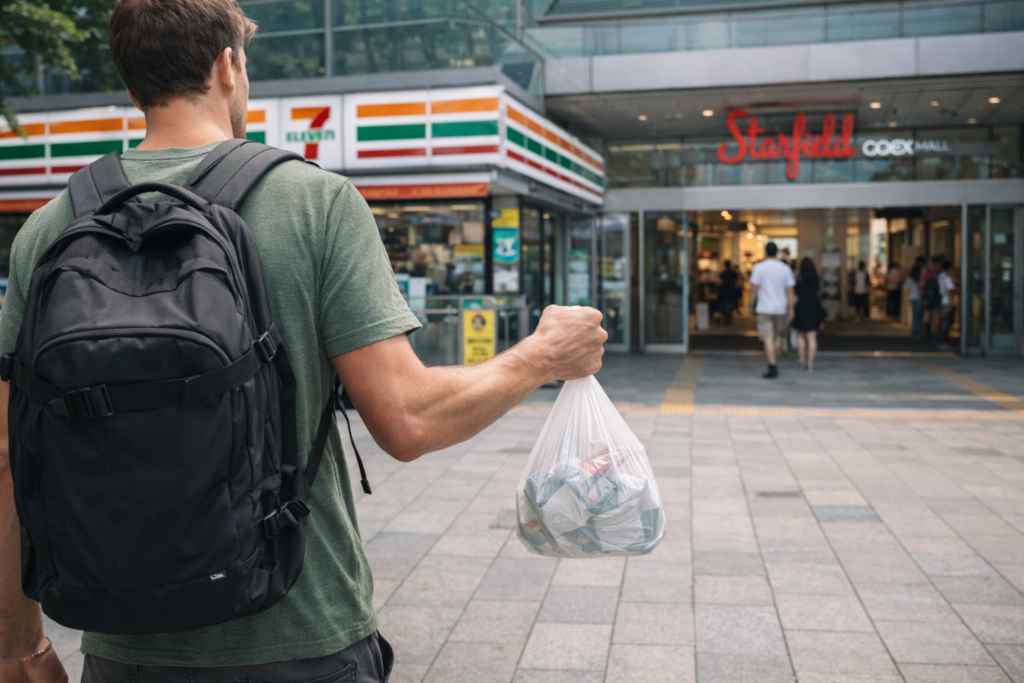
These are the strategies I personally recommend to travelers.
Carry a small disposable bag
This sounds simple, but it changes everything. A small pouch or plastic bag turns a frustrating problem into a minor inconvenience. If you cannot find a bin quickly, you can carry your trash neatly until you reach a better disposal point.
Finish items near where you bought them
This is one of the smartest Seoul travel habits. Coffee chains, convenience stores, and takeaway shops often make disposal easiest right after purchase. Once you leave the area, your options narrow fast.
Target “managed” zones, not random sidewalks
When you need a bin, do not wander aimlessly. Go straight to one of these areas: a subway entrance, convenience store row, department store, food hall, major park entrance, or event venue. These are much more reliable than backstreets.
My tip: I treat trash disposal in Seoul the same way I treat finding a restroom abroad. I do not wait until the last minute. I plan one likely stop ahead.
Separate recyclables when possible
If a bin has separate slots for cups, bottles, cans, or general waste, take an extra second to sort correctly. It makes the process smoother and matches local expectations.
Do not assume every outdoor public space will help you
Some well-maintained places in Seoul are clean precisely because people are expected to hold onto their trash. This surprises many visitors, but once you understand the system, it feels far less confusing.
📊 Quick Comparison Table: Where You Are Most Likely to Find a Bin
| Location Type | Chance of Finding a Bin | English-Friendly | Best Use Case |
|---|---|---|---|
| Major subway station exits | Medium to High | Medium | Drinks, small wrappers, quick disposal |
| Convenience stores | High | High | Items bought nearby, cups and bottles |
| Han River parks and event spaces | Medium | Medium | Picnic waste, takeaway packaging |
| Malls and department stores | Very High | High | Reliable indoor fallback option |
| Random side streets | Low | Low | Avoid depending on these |
💰 What You Gain by Knowing This System
Understanding how Seoul’s disposal culture works gives you real practical benefits.
- Save 10 to 20 minutes per day by not wandering around with cups and wrappers.
- Reduce travel stress in high-footfall areas like Myeongdong, Hongdae, and Jamsil.
- Make cleaner travel decisions by sorting waste more confidently.
- Avoid awkward moments when entering shops with obvious trash in your hands.
- Travel more like a local by using managed disposal points instead of expecting a bin on every corner.
In practical terms, this small habit can easily save you one or two frustrating searches every day. Over a four-day Seoul trip, that can mean 40 to 60 minutes saved and a much smoother walking experience.
✅ Final Thoughts
Seoul is not a dirty city. Far from it. The real issue is that its waste-disposal system is more controlled, more location-specific, and sometimes less obvious for foreign visitors than people expect.
That is why “English-friendly” public trash cans can feel hard to find. The bins are there, but they are easier to find in managed places such as subway areas, convenience-store zones, large indoor facilities, and event spaces.
If you remember just one thing, remember this: do not search randomly. Head for a subway entrance, convenience store, mall, or major park facility first. That single mindset shift makes Seoul much easier to navigate.
❓ FAQ
Are public trash cans rare in Seoul?
They are not completely rare, but they are less visible and less evenly distributed than many travelers expect. That makes them feel rarer than they actually are.
Where is the easiest place to throw away a coffee cup in Seoul?
The easiest place is often the convenience store or café area where you bought it. After that, try a major subway station entrance or a mall.
Are subway stations in Seoul a good place to look for trash cans?
Yes, especially larger stations. They are usually a better bet than ordinary sidewalks, though not every entrance will have one.
Why do some clean public places in Seoul still have no trash cans?
Because some spaces rely on controlled disposal points or expect visitors to carry waste out. This helps with sorting, maintenance, and cleanliness.
What should foreign visitors do if they cannot find a bin?
Carry a small bag, keep the waste with you temporarily, and head to a convenience store, mall, transit hub, or staffed public facility.
Related Posts