


Why Korean Cafes Ask You to Return Trays and Cups Yourself: 5 Reasons It Makes Sense
If you are new to Korea, this is one of those tiny cafe moments that can feel weirdly confusing at first.
You finish your coffee, stand up, and then notice something important: nobody is coming to clear your table. Instead, there is usually a return station near the trash area, and people quietly carry their own trays, cups, lids, and straws back by themselves.
I remember the first few times I saw this, I honestly hesitated for a second. I had that little internal debate of, “Do I leave this here? Or am I supposed to take it back?” After spending more time in Korean cafes, especially in Seoul, it became obvious. In a lot of places, returning your tray is not just a helpful thing to do. It is simply part of how the cafe works.
In this post, I’ll explain why Korean cafes ask you to return trays and cups yourself, why it feels so normal once you understand the system, and what visitors should do so they do not feel awkward the next time they order a drink in Korea.
💡 5 Reasons Korean Cafes Ask You to Return Trays and Cups Yourself
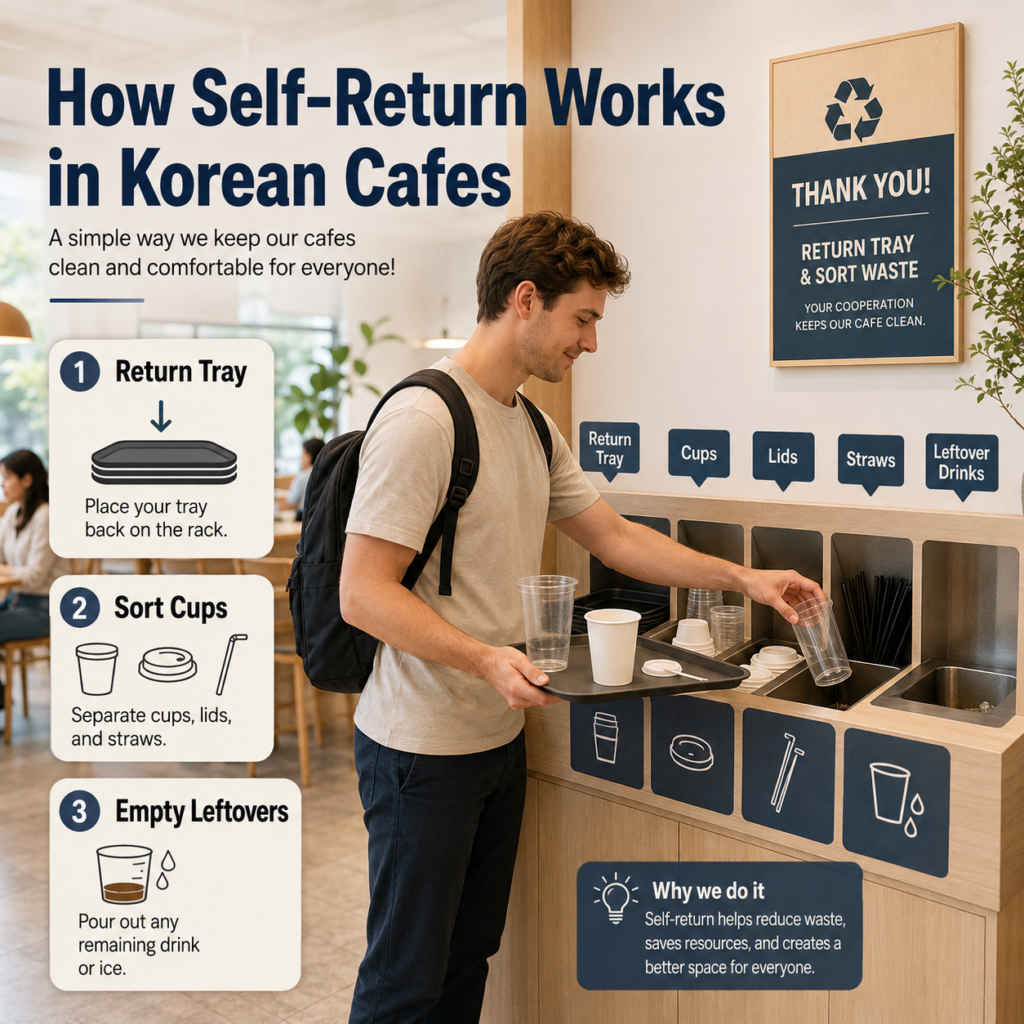
1. It keeps busy cafes moving faster
Korean cafes can get crowded very quickly. That is especially true near subway stations, office districts, university areas, and shopping streets. When customers return their own trays, staff do not have to constantly leave the counter to clear tables one by one.
From what I have seen, this makes a huge difference during peak hours. A table clears faster, the next person sits down sooner, and the whole place feels smoother without anyone making a big deal out of it.
Once I got used to it, the self-return system stopped feeling strict and started feeling efficient. In a packed cafe, it honestly makes a lot of sense.
2. Korean cafe culture often runs on self-service from start to finish
In many cafes, you order at the counter or kiosk, wait for your number, pick up your drink yourself, and then return the tray when you are done. It is a full self-service flow.
That is why tray return usually does not feel random in Korea. It matches the whole structure of the cafe experience. You are not being singled out. You are just following the normal rhythm of the place.
3. Waste sorting is a bigger deal than many visitors expect
Another reason is waste separation. In Korea, recycling and proper sorting are taken pretty seriously in everyday life. That same mindset shows up in cafes too. A lot of return stations are designed so people can empty leftover drinks, separate cups and lids, and place trays back in one organized spot.
That part becomes much easier when customers bring their own items to the return station instead of leaving everything scattered around the cafe.
If you want background on why sorting matters so much, the Korean Ministry of Environment’s Land & Waste overview explains Korea’s long-running separate disposal system, and the Yeongdeungpo-gu English recycling guide shows the practical basics of emptying, rinsing, removing lids, and disposing items separately.
4. It helps staff focus on the work only they can do
At first glance, carrying back a tray might seem like the cafe is pushing work onto customers. But in reality, a lot of Korean cafes are running with very lean staffing. One or two people may be handling drink orders, food prep, mobile orders, cleaning, and delivery pickup all at once.
When customers return trays themselves, staff can stay focused on making drinks, handling orders correctly, and keeping the place running.
I have seen tiny neighborhood cafes where one person was basically doing everything. In places like that, returning your tray feels less like a rule and more like basic common sense.
5. In many places, it is also seen as polite
At some point, this becomes more than just an operating system. It turns into etiquette. In many Korean cafes, returning your tray is simply understood as considerate behavior.
That does not mean every single cafe works the same way. Some places still clear tables for you. But in many casual cafes, leaving a full tray behind can feel a little off because everyone else is quietly cleaning up after themselves.
My personal rule now is simple: if I carried the tray from the counter to the table, I assume I should probably carry it back unless the cafe clearly works differently.
📊 4 Common Situations Where You’ll Notice Self-Return the Most
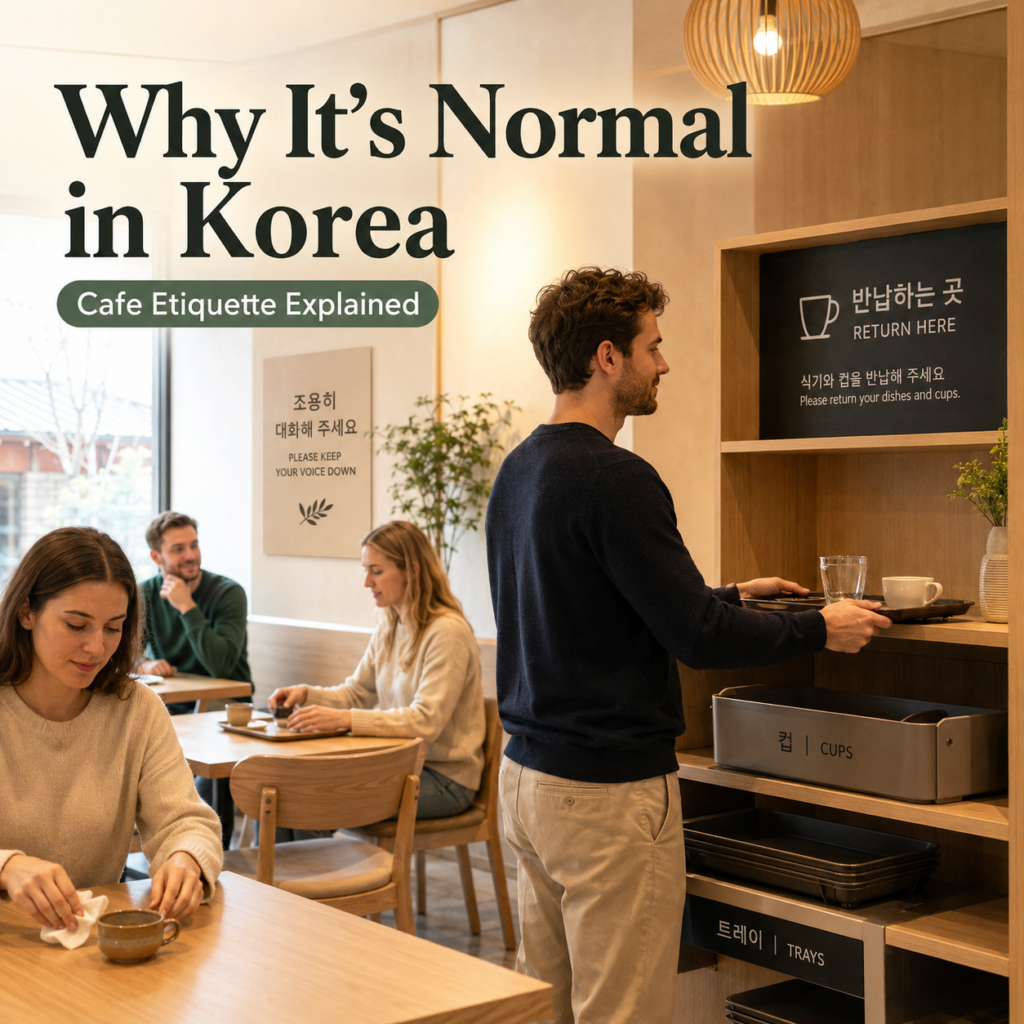
1. Large chain cafes
This is where most visitors notice it first. Big franchise cafes usually have a very clear return station near the trash bins. The whole layout is built for fast customer turnover.
2. University-area cafes
These cafes tend to be packed with students staying for long hours with laptops, books, and group projects. Self-return helps staff handle a lot of people without constantly walking the floor.
3. Office district cafes
In business areas, people often rush in during lunch breaks or coffee runs. Speed matters. A self-return setup keeps things moving and reduces bottlenecks when a lot of customers arrive at once.
4. Trendy dessert cafes that still use casual systems
This one surprises people. A cafe may look beautiful, stylish, and expensive, but still expect customers to return trays. In Korea, pretty interiors do not always mean full table service.
There is also an environmental reason behind some of these habits. Korea has had rules and policy discussions around reducing disposable cup use in cafes, including dine-in restrictions on single-use cups and broader efforts to improve cup return and collection systems. You can get a useful overview from the Ministry of Environment’s English notice on disposable plastic cups in cafes.
Look for the return station early
The easiest trick is to notice the return station when you first pick up your drink. That saves you from awkwardly looking around later with a tray in your hands.
Watch what local customers are doing
If you are not sure whether a cafe expects self-return, just look around. In Korea, other customers are usually the best clue. If everyone is carrying trays back, that is your answer.
Separate leftovers and trash if the station is set up that way
If there is a spot for leftover liquid, use it. If lids, straws, and cups are separated, follow the labels as best as you can. Nobody expects perfection from a visitor, but making the effort is always better than leaving a messy table.
Do not overthink it
Most people are not waiting to judge tourists. Even if you pause for a second, that is fine. This is one of those habits that feels unfamiliar on day one and completely normal a few cafe visits later.
📋 Self-Return Cafes vs Full-Service Cafes in Korea
| Cafe Type | What Usually Happens | What You Should Do | Common Places |
|---|---|---|---|
| Large chain cafe | Order at counter, pick up drink, return tray yourself | Look for the return station near the trash area | Stations, malls, business districts |
| University cafe | High turnover, long stays, self-return common | Follow what other customers are doing | Campus areas, study-heavy neighborhoods |
| Independent cafe | Varies by owner and service style | Check signs or observe the flow | Residential and local neighborhoods |
| Premium-looking dessert cafe | May still use self-return even with nicer interiors | Do not assume table service | Touristy and trendier districts |
💰 The Real Benefit: Time, Cleanliness, and Less Friction
Returning a tray sounds like a small thing, but it changes how a cafe functions.
- Faster table turnover: tables can be reused more quickly
- Less interruption for staff: workers stay focused on orders and drinks
- Cleaner shared space: fewer abandoned cups and trays sitting around
- Better waste sorting: cups, lids, and leftover drinks can be handled in one place
- Smoother customer flow: especially during rush hours
Honestly, this is one of those Korean habits that may look a little strict from the outside, but once you experience a few packed cafes, it starts to feel completely reasonable.
✅ Final Thoughts
So, why do Korean cafes ask you to return trays and cups yourself?
Because it saves time, fits the self-service structure of many cafes, supports Korea’s strong waste-sorting culture, and feels like a basic courtesy in shared public spaces.
The key thing to understand is that it is usually not about being unfriendly. It is about keeping a busy cafe clean, efficient, and easy for everyone to use. Once you know that, the whole system feels much less confusing.
If you are visiting Korea, the simplest rule is this: when in doubt, return the tray. You will almost never go wrong with that.
FAQ
Q1. Do all Korean cafes expect customers to return trays themselves?
A. No. Not every cafe does. But it is very common, especially in chain cafes, campus areas, and busy neighborhoods.
Q2. Is it rude to leave your tray on the table in Korea?
A. In many self-service cafes, yes, it can feel inconsiderate. If there is a return station, it is usually best to use it.
Q3. Why do Korean cafe return stations often have multiple bins?
A. Because separating cups, lids, straws, and leftover drinks supports Korea’s broader recycling and waste-sorting system.
Q4. What should I do if I am not sure whether a cafe is self-return or full-service?
A. Watch what other customers do. That is usually the clearest answer.
Q5. Is this only about cleaning up, or is it also about etiquette?
A. It is both. It helps operations, but in many places it is also seen as polite and considerate.
You Might Also Like:7 Smart Ways to Buy K-pop Concert Tickets in Korea