
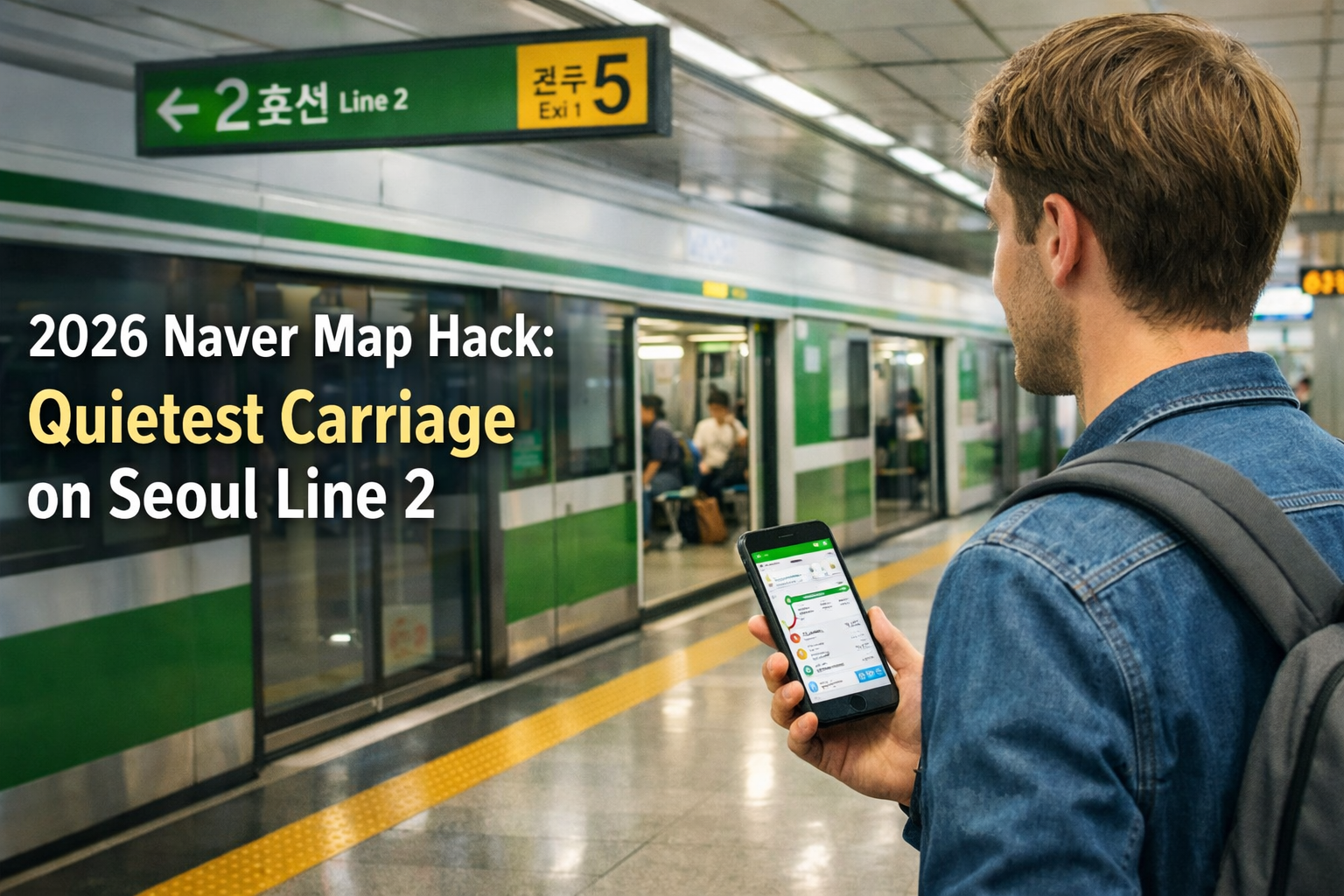
If you have ever boarded Seoul Subway Line 2 at Gangnam, Hongdae, or Jamsil and felt like the whole city entered the same train with you, you are not alone.
As someone who rides Seoul subways often, I can tell you this: the “least crowded” carriage is usually not about luck. It is about reading the route smartly before the train arrives. In 2026, Naver Map is still one of the most useful apps for planning subway rides in Korea, especially when you want a smoother Line 2 trip without getting trapped in the busiest door zone.
In this guide, I will show you how to use Naver Map in a practical way to identify the quietest carriage area on Seoul Subway Line 2, how to avoid the most crowded boarding spots, and when you should double-check with official Seoul transit crowding tools for the best result.
💡 Why Finding a Quieter Carriage Matters on Seoul Subway Line 2
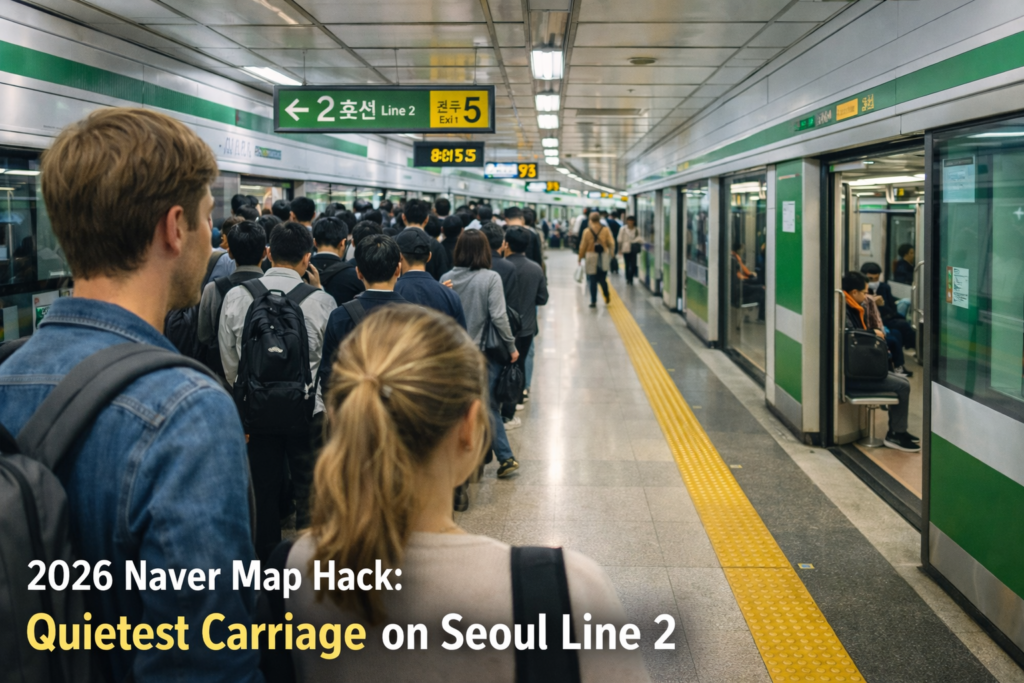
Line 2 is one of the busiest subway lines in Seoul. It circles the city and connects major business, shopping, nightlife, and university areas. That means one wrong boarding choice can turn a normal ride into a stressful one.
Most riders focus only on getting on the train fast. I do the opposite. I focus on where other people are likely to gather. That simple mindset changes everything.
Here is why this matters:
- Less physical stress: You get more personal space and better air flow.
- Faster exits: You do not get trapped behind heavy transfer crowds.
- Safer travel: Less pushing at major transfer stations.
- Better tourist experience: You keep your luggage, shopping bags, and phone secure more easily.
- More predictable rides: You can build a repeatable “quiet zone” habit.
My personal rule in Seoul: the carriage closest to the most famous transfer or exit is often the most convenient on paper, but not always the most comfortable in real life.
For many travelers, the real trick is this: Naver Map does not always hand you a giant “quietest carriage” badge, but it gives you enough route and station detail to make a smart decision before the train arrives.
✅ 5 Key Criteria to Check Before Choosing the Quietest Carriage
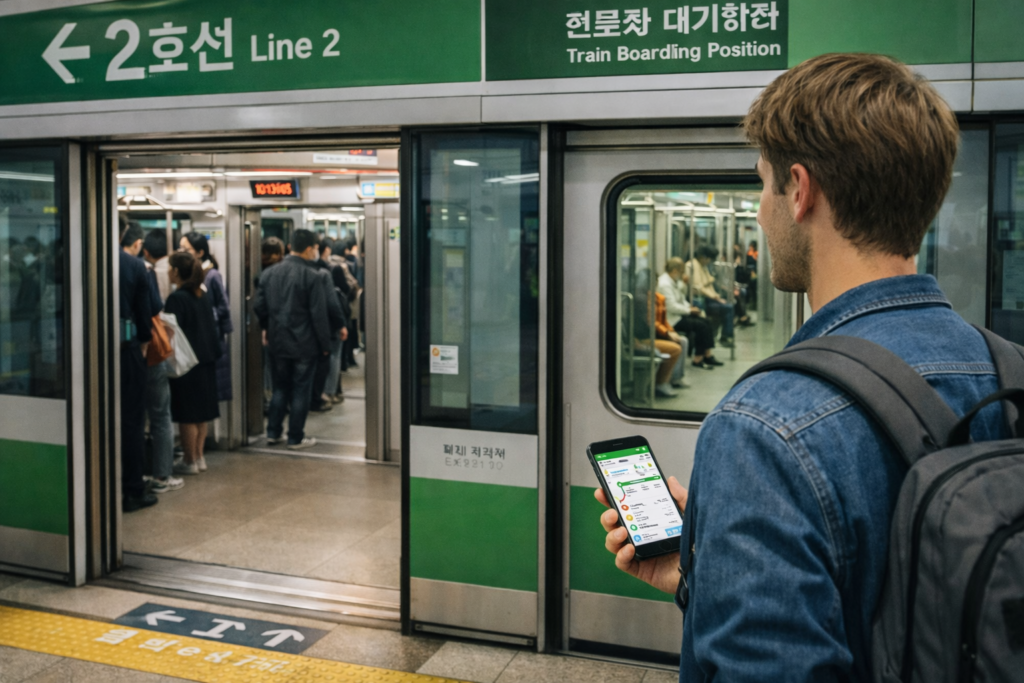
Before boarding Line 2, I usually check these five things.
1. Transfer-heavy stations nearby 🚉
If your route passes through stations like Gangnam, Jamsil, Hongik Univ., City Hall, or Samsung, crowding often builds around the doors that align with the fastest transfer path or the most popular exit. Those sections get packed first.
2. Exit-focused boarding patterns 🚪
Naver Map often helps riders choose the quickest exit or transfer path. That is useful, but it also means many people gather around the same few cars. If you want a quieter ride, move one or two cars away from the “most efficient” boarding position.
3. Travel direction on the loop 🔄
Line 2 has both clockwise and counterclockwise flow patterns. Depending on office-hour direction, one side of the loop can feel much more intense. Morning rides into major work zones are usually more crowded than reverse-direction rides.
4. Time of day ⏰
The same carriage can feel fine at 11:00 a.m. and terrible at 8:20 a.m. Weekday commute peaks are the hardest. Mid-morning, early afternoon, and later evening usually give you better flexibility to step away from the most crowded boarding area.
5. Platform position and human behavior 👣
People naturally cluster near escalators, platform stairs, and familiar waiting points. Even without checking detailed data, you can often avoid a crush by walking farther down the platform than most riders are willing to go.
One of my favorite Line 2 tricks is simple: if everyone stops near the middle staircase, I keep walking. Even 20 to 30 extra seconds on the platform can make the ride much calmer.
Travelers with luggage should avoid the most “efficient” door unless they have a very tight transfer. A slightly longer walk inside the station is often much easier than squeezing into the busiest carriage.
Check Seoul Metro’s official subway comfort and crowding guidance
📊 4 Real-Life Line 2 Situations and the Smartest Choice
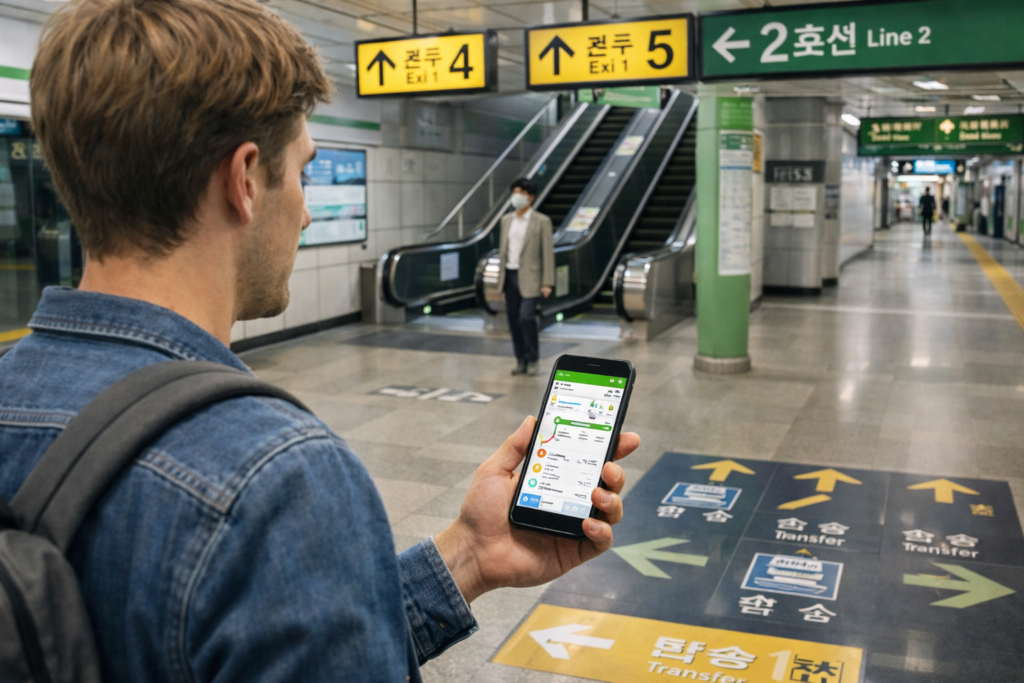
Below are four common Seoul travel situations and how I would use Naver Map to reduce crowd stress.
1. Going from Hongik Univ. to Gangnam 🎒
This is a classic tourist-to-business-district ride. Many riders choose the fastest transfer or exit position. On crowded days, I recommend checking the route in Naver Map, identifying the “best” boarding area, and then intentionally boarding one carriage away from that zone.
Best strategy: Trade a slightly longer walk at arrival for a much less stressful ride.
2. Riding from Jamsil after shopping or an event 🛍️
Jamsil can get extremely busy, especially after baseball games, concerts, or peak mall hours. In these cases, the quietest carriage is rarely the one closest to the main escalator. Walk farther along the platform and board where the waiting line looks thinner, even if it feels less convenient.
Best strategy: Watch platform crowd clusters first, then confirm your route logic in Naver Map.
3. Morning commute through Gangnam 💼
If you board during weekday rush hour, do not chase the “ideal” transfer carriage unless saving one minute matters more than comfort. On Line 2, the perfectly optimized car is often the perfectly crowded car.
Best strategy: Pick the second-best transfer position, not the first-best one.
4. Short hop between tourist stops on the loop 📍
For short rides, many travelers over-optimize. You do not need the perfect door for a three-stop trip. You need the easiest boarding experience. In that case, the quietest carriage is usually the one with fewer people already lining up.
Best strategy: Favor visible space over theoretical efficiency.
My “tourist day” rule is different from my “commute day” rule. When I am sightseeing, I always choose comfort first. Saving one minute is rarely worth standing shoulder to shoulder with a crowd.
Here is the exact method I recommend.
Enter your starting station and destination. Check the subway route, transfer points, travel time, and arrival station details.
Step 2. Identify the “most efficient” boarding logic 🧭
Look at the route details and station flow. Which carriage area seems designed for the fastest transfer or easiest exit? That is usually where more riders will gather.
Step 3. Do not stand exactly there ❌
Instead, move one carriage forward or backward from the obvious high-demand boarding zone. In many real situations, this gives you the best balance between comfort and efficiency.
Step 4. Read the platform, not just the app 👀
Once you arrive, compare what the app suggested with actual human behavior. Are crowds bunching near escalators, center platform doors, or a transfer staircase? Adjust immediately.
Step 5. Use official crowding tools when the ride is important 📡
If you are traveling during rush hour, carrying luggage, or heading to a high-traffic station, double-check official Seoul transit crowding guidance as a second layer. That gives you a better read than relying on instinct alone.
My best summary is this:
Naver Map is excellent for predicting where the crowd wants to be. The quietest carriage is often the place just next to that.
Seoul TOPIS subway information for Line 2
📋 Comparison Table: Best Way to Choose a Carriage on Line 2
| Method | Best For | Pros | Cons |
|---|---|---|---|
| Board at the fastest transfer car | Tight schedules | Quick exit, less walking later | Usually more crowded |
| Board one car away from the optimal spot | Most travelers | Best comfort-to-efficiency balance | Slightly longer station walk |
| Board near the emptiest visible platform area | Short rides, off-peak trips | Simple and stress-free | May be less ideal for transfers |
| Check official crowding info first | Rush hour, luggage, heat, long rides | Most data-informed choice | May require a second app |
💰 Benefit Analysis: What You Actually Gain
Choosing a quieter carriage may sound small, but the practical benefits add up fast.
- 1 to 3 minutes saved by avoiding blocked door areas and slow crowd flow.
- Noticeably less physical fatigue on busy sightseeing days.
- Lower stress during peak hours, especially on hot or rainy days.
- Better space for bags and shopping if you are exploring Seoul as a visitor.
- More consistent travel habits once you learn your preferred platform position.
For frequent riders, even saving just 2 minutes per ride across two subway trips a day can mean roughly 20 minutes saved in a work week. But honestly, the bigger benefit is comfort. In Seoul, less crowding often feels more valuable than a tiny time gain.
✨ Final Thoughts
If you want the quietest carriage on Seoul Subway Line 2 in 2026, do not ask only, “Which car is fastest?” Ask, “Which car will everyone else choose?”
That is where Naver Map becomes useful. It helps you understand the route, transfer logic, and arrival structure. Then you make the smarter move by stepping slightly away from the obvious crowd magnet.
That is the real travel hack.
For me, the best Line 2 strategy is simple:
Use Naver Map to predict the busy zone. Then board next to it, not inside it.
❓ FAQ
Not always in a simple labeled way. But it gives enough route, station, and boarding logic to help you avoid the busiest carriage area.
2. What is usually the most crowded part of a Line 2 train?
Cars aligned with the fastest transfer path, major exits, escalators, or busy platform center points are often the most crowded.
3. Is this strategy useful for tourists?
Yes. It is especially helpful for travelers carrying luggage, shopping bags, or visiting major stations like Hongik Univ., Gangnam, Jamsil, and City Hall.
Use official crowding information during weekday rush hour, extreme weather, event nights, or whenever comfort matters more than shaving off one minute.
5. What is the easiest rule to remember?
If a boarding spot looks perfect for transfers, it is probably crowded. Try the next carriage instead.