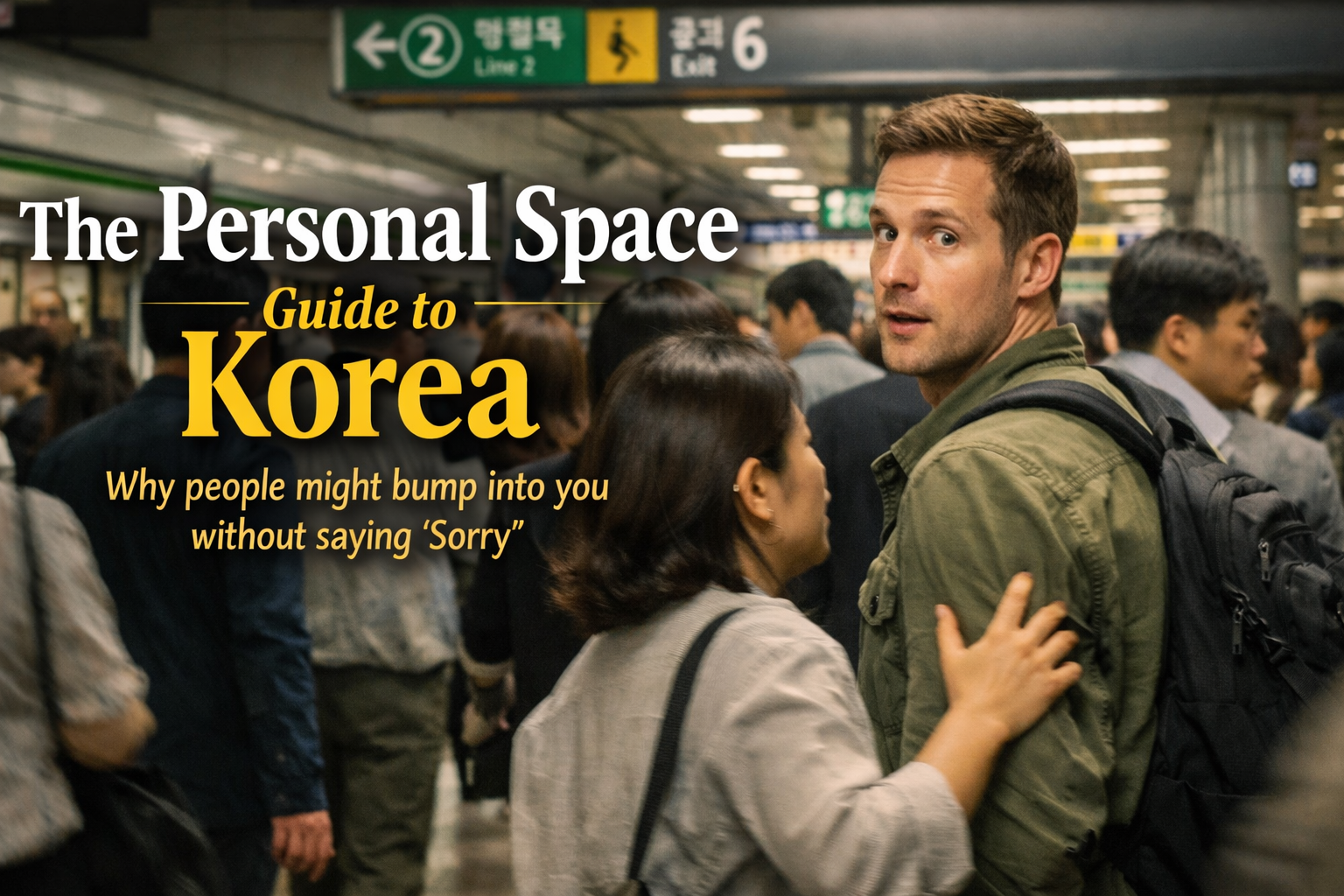
Have you ever walked through Seoul Station, a busy subway platform, or a crowded shopping street in Korea and thought, “Why did that person just bump into me and keep going?” You are not alone.
For many first-time visitors, this can feel rude. Even a little shocking. I had the same reaction on my first few days in Korea. But after years of living, traveling, and writing about Korean culture, I learned something important: in many situations, it is not personal hostility. It is often a mix of speed, crowd density, indirect communication, and different expectations around public space.
This guide will help you understand what is really happening. More importantly, it will help you travel more comfortably, react less emotionally, and read Korean social signals more accurately.
💡 5 Key Reasons People in Korea May Bump Into You Without Saying “Sorry”
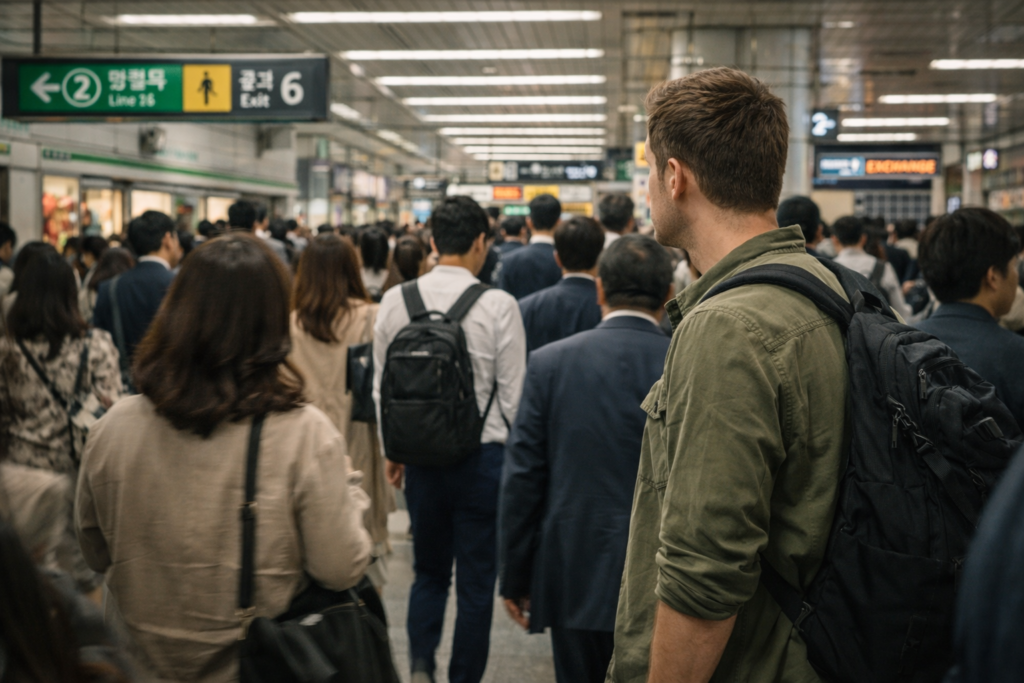
Before judging the moment, it helps to understand the context. In Korea, public behavior is often shaped by environment as much as personality.
1. High-density city life changes body language
In large Korean cities, people are constantly moving through tight public spaces. Subway stairs, escalator exits, station gates, convenience stores, and department store corridors can all feel compressed. When a society gets used to crowded movement, light physical contact can become normalized.
My tip: In Seoul, I stopped interpreting every shoulder tap as aggression. Once I treated small contact as “traffic” rather than “emotion,” my daily stress dropped immediately.
2. Silence does not always mean rudeness
In many Western cultures, saying “sorry,” “excuse me,” or “pardon me” is an automatic social lubricant. In Korea, people may not always verbalize that small apology in fast public situations. They may simply keep moving. That does not always mean they think they did nothing wrong. It can mean the moment was considered too minor to stop the flow.
3. Efficiency often wins in crowded public spaces
Korean cities move fast. Very fast. People often prioritize getting through the space smoothly over verbally acknowledging every tiny interruption. This is especially true during commuting hours, at transfer stations, and in high-foot-traffic business districts.
4. Personal space expectations are different
“Personal space” is not a universal measurement. It changes by culture, city design, and daily habits. In Korea, the comfortable distance between strangers can feel smaller than what some travelers expect, especially in elevators, lines, buses, and subway cars.
My tip: The biggest culture shock for me was not the bumping itself. It was how little emotional meaning locals seemed to attach to it.
5. The behavior is situational, not a full picture of Korean kindness
This is the most important point. Koreans can be incredibly generous, warm, and helpful. I have had strangers walk me to the correct bus stop, help me read menus, and even call a taxi for me. So do not let one crowded subway moment define the entire culture.
Public-space behavior and private kindness are not always expressed the same way.
For broader context on Korea’s travel environment and cultural experiences, a useful official resource is the
Korea tourism information guide in English.
📊 4 Real-Life Situations Where Travelers Notice This Most
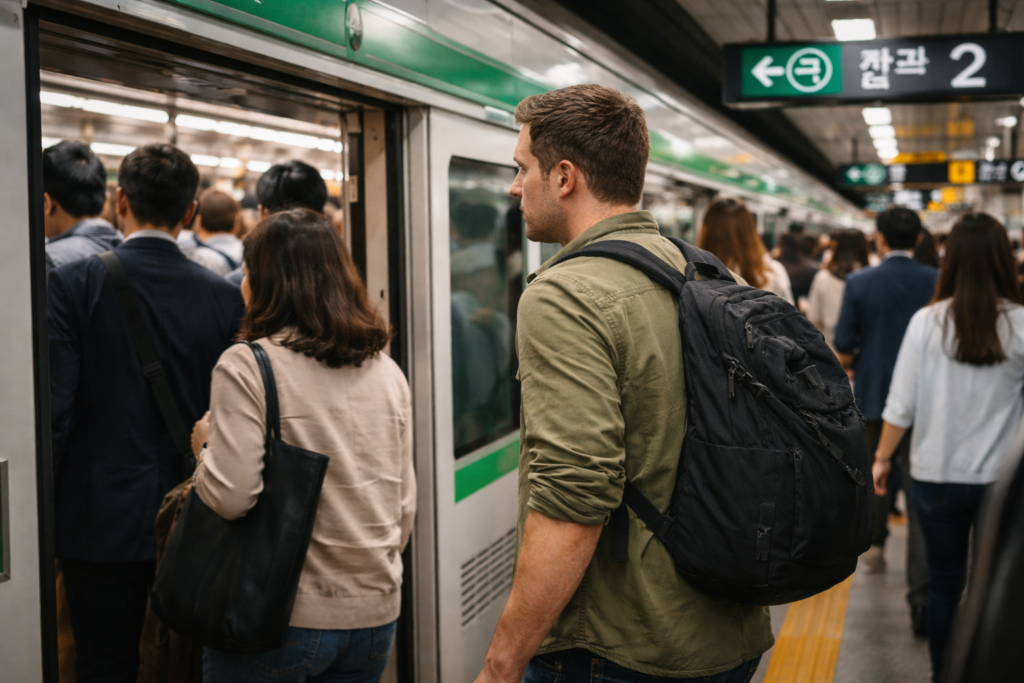
Not every place in Korea feels the same. These are the situations where foreign travelers usually notice the “bump-without-sorry” pattern most clearly.
1. Subway stations during rush hour
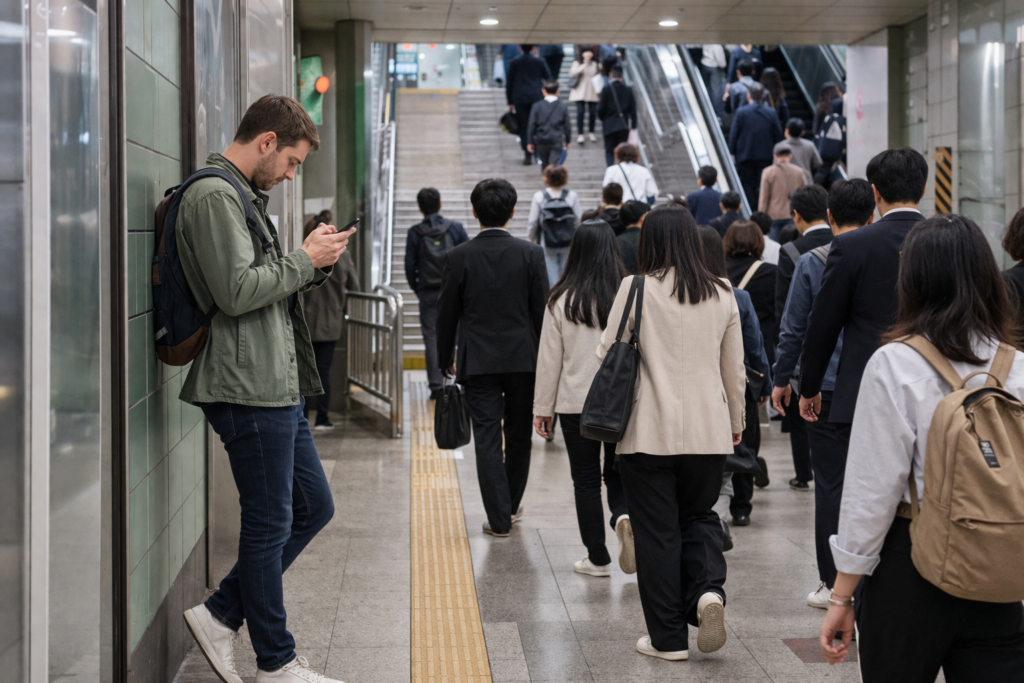
This is the number one example. People are trying to exit quickly, switch lines, or catch trains before the doors close. If you pause near a gate, hesitate at a staircase, or stop to check your phone, someone may brush past you without a word.
What it means: Usually impatience with the flow, not personal anger.
2. Escalator exits and narrow sidewalks
In Korea, standing still right after an escalator or in the center of a sidewalk creates an instant traffic problem. Locals often expect people to keep moving. If you slow down suddenly, physical contact becomes much more likely.
3. Busy cafés, shopping malls, and convenience stores
Smaller retail spaces can create more unintentional contact than travelers expect. A person reaching past you for a drink, tray, or product may not always say “excuse me” first.
4. Queue-like spaces that are not always strict queues
In some situations, lines in Korea look more fluid than in countries with rigid queue culture. Boarding areas, elevator entrances, and bus doors can feel more like “moving groups” than clearly protected personal zones.
See South Korea urban population data
My tip: If you need to stop in a station, step fully to the side first. That one habit solves half of the “Why is everyone pushing me?” problem.
📌 Practical Strategies: How to Handle It Without Stress
You do not need to “fight back.” You just need a smarter travel rhythm.
1. Walk predictably
Sudden stops create friction. If you need to check directions, move to the wall, a pillar, or a quiet corner first.
2. Protect your lane
In crowded areas, walk with purpose. Not aggressively. Just clearly. A confident walking line reduces random collisions.
3. Do not over-personalize minor contact
This mindset shift helps the most. Ask yourself: Was that intentional, or was it simply crowded urban movement? In many cases, it is the second one.
4. Use simple local-friendly phrases when needed
If a situation really bothers you, stay calm and use short phrases. You can say:
- “Excuse me.”
- “Please be careful.”
- “It’s crowded here.”
Polite tone matters more than long explanation.
5. Watch what locals do
This is one of my favorite Korea travel strategies. Instead of guessing the rule, observe the micro-pattern. Where are people standing? How fast are they moving? When do they step aside? Korea becomes much easier when you copy the flow first and analyze later.
My tip: In Korea, “good manners” often means not blocking others. That is sometimes valued more than verbal politeness in busy public spaces.
📋 Korea Personal Space and Public Contact: Quick Comparison Table
| Situation | What Travelers Often Feel | What It Often Means in Korea | Best Response |
|---|---|---|---|
| Subway rush hour | “People are pushing” | Fast crowd movement | Keep walking, move aside before stopping |
| Escalator exit | “Why did they bump me?” | You may be blocking the flow | Step away from the landing area immediately |
| Small shops or cafés | “That felt abrupt” | Tight space, low verbal signaling | Shift slightly, don’t assume hostility |
| Bus or train boarding | “People cut in” | Flexible crowd compression | Stay alert and hold your place calmly |
💰 What You Gain by Understanding This Cultural Pattern
Learning this one social rule can save you much more than a few awkward moments.
1. Less travel stress
If you stop interpreting every small bump as disrespect, your frustration can easily drop by 50% or more during busy city travel days. In my own case, that mindset change made crowded Seoul feel far more manageable.
2. Better cultural accuracy
Instead of saying, “Koreans are rude,” you start seeing the difference between urban crowd behavior and personal kindness. That is a much smarter and fairer reading.
3. Smoother day-to-day movement
When you learn where to stand, when to move, and how to avoid blocking traffic, you save real time. Even 5 to 10 minutes a day matters when you are transferring lines, navigating stations, or sightseeing on a short trip.
4. Fewer emotional misunderstandings
Misreading social behavior can ruin a day. Understanding context protects your mood, helps your relationships, and makes you a more confident traveler.
Historically, many Korean social practices were shaped by long Confucian influence, which helps explain why etiquette can be expressed through role awareness, situational behavior, and indirect signals rather than constant verbal apology. For background reading, the UNESCO overview of Korean Neo-Confucian social practices
is a strong reference.
✅ Final Thoughts
So, why might people in Korea bump into you without saying “sorry”?
Usually, it is not because they hate foreigners. It is not because they are trying to insult you. And it is not because manners do not exist in Korea.
More often, it is because Korean public space operates under a different rhythm. Crowded cities create different body habits. Verbal politeness works differently. Flow matters. Speed matters. Predictability matters.
Once you understand that, Korea starts to make much more sense.
And once Korea makes sense, it becomes much easier to enjoy it.
❓ FAQ
Is it rude to say “sorry” or “excuse me” in Korea?
Not at all. Polite language is always safe. Just do not expect every stranger to use the same verbal habits you are used to.
Do Koreans dislike personal space?
No. It is more accurate to say that personal space is managed differently in crowded settings, especially in big cities.
Is this behavior worse in Seoul than in smaller cities?
Usually yes. Seoul’s pace and crowd density make these moments more common than in smaller or slower places.
Should I confront someone who bumps into me?
In most cases, no. If it was minor, let it go. If it was serious, stay calm and respond politely.
Does this mean Korean people are unfriendly?
Absolutely not. Many travelers find Korea extremely helpful and welcoming once they move beyond first impressions in crowded public spaces.
Related read: Korean Table Bell Etiquette