
Last checked: August 3, 2026. Cafe service styles, return stations and cup systems vary by business. Follow the signs and staff instructions at the cafe you are visiting when they differ from general guidance.
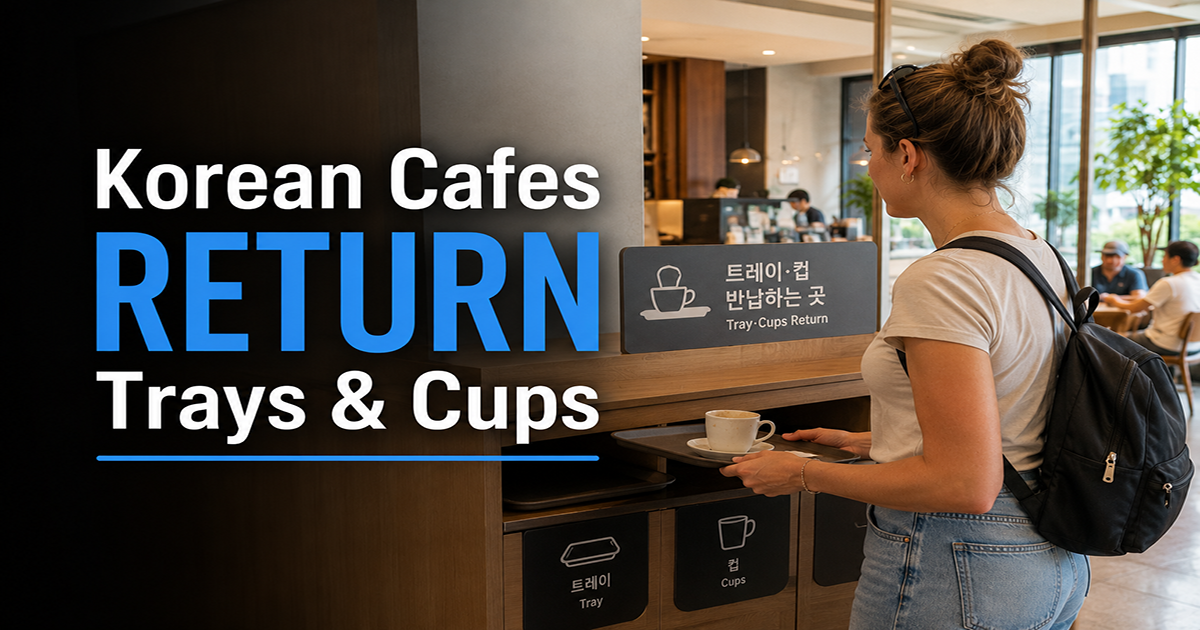
In many self-service Korean cafes, customers return used trays, cups and dishes to a marked return area before leaving. But this is not a rule you should assume at every cafe.
The easiest approach is to look for a return shelf, waste station or sign such as 반납, 반납대 or 퇴식구. If no return area is visible and staff are actively clearing tables, leave your items neatly together for them.
Quick answer: Return your tray when the cafe clearly provides a return station or asks customers to do so. Follow the labels at that specific station, empty leftover liquid only into a clearly marked opening, and do not guess when the sorting system is unclear. If the cafe provides table service and no return point is visible, leave the items neatly on the table.
How to Tell Whether You Should Return Your Tray

Start by checking how the cafe operates. Some cafes use a mostly self-service flow: order and pay at the counter or kiosk, collect your drink, find a seat and return the used items afterward. Other cafes take orders at the counter but still have staff clear the tables.
Counter ordering is therefore a clue, not proof that you must return the tray.
| What You See | What to Do |
|---|---|
| A clearly marked return shelf or waste station | Take your tray and used items there before leaving. |
| A sign saying 반납, 반납대 or 퇴식구 | Follow the return instructions and any sorting labels. |
| Staff are clearing tables and no return station is visible | Leave cups and dishes neatly together for staff. |
| A reusable-cup return machine or special cup station | Follow the instructions for that specific cup system. |
| You cannot tell which system the cafe uses | Watch another customer or ask staff before carrying dishes behind the counter. |
The official VISITKOREA guide to Korean restaurant service provides broader context about self-service areas and unmanned ordering in Korea. That guidance does not mean that every cafe follows the same customer-return process, so the individual cafe’s signs remain the most useful guide.
If ordering systems such as counters, kiosks and QR menus are also unfamiliar, our guide to how to order food in Korea without speaking Korean explains the most common service formats travelers may encounter.
Korean Signs to Look For
A return area may be labeled only in Korean, especially at smaller or less tourist-oriented cafes. These are the most useful words to recognize:
| Korean | Meaning |
|---|---|
| 반납 | Return |
| 반납대 | Return counter or shelf |
| 퇴식구 | Used-dish return area or window |
| 일반쓰레기 | General waste |
| 재활용 | Recycling |
| 컵 | Cup |
You may also see English labels such as Return, Tray Return, Self Return or Waste Station. Icons and the shape of each opening can also help, but use the written label when the category is clear.
When you are still unsure, the short question 여기 반납해요? means “Do I return this here?” Showing the tray while asking makes the question easier to understand.
How to Return a Cafe Tray Step by Step
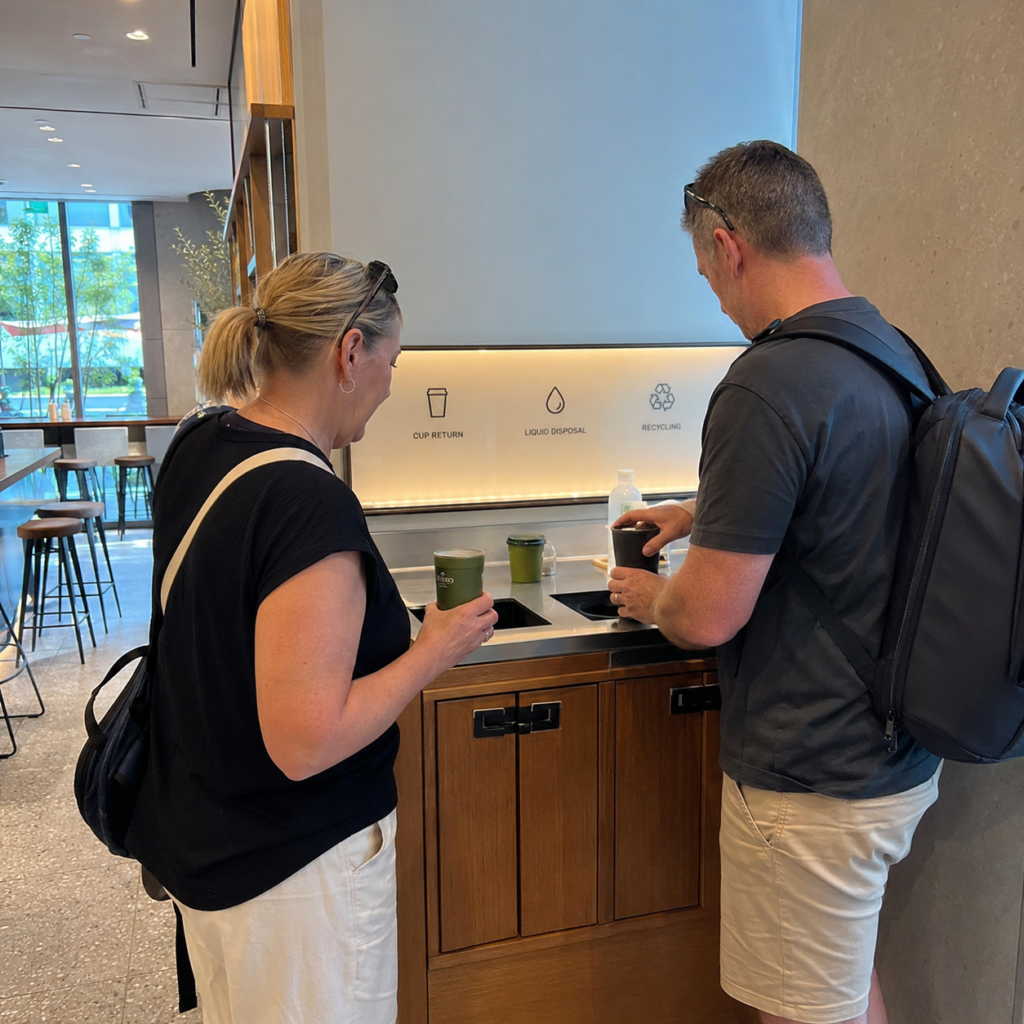
- Gather the items from your order. Put the cup, plate, utensils, napkins and packaging together without hiding small items underneath the tray.
- Find the designated return area. Check near the pickup counter, exit, water station or customer waste area.
- Read the labels before separating anything. Do not assume that another cafe’s sorting system applies here.
- Handle leftover drinks carefully. Empty liquid only when the cafe provides a clearly marked container, drain or opening for it.
- Separate items only when requested. Follow the categories provided for reusable dishes, cups, lids, general waste or recycling.
- Do not force items into a full or unclear section. Leave the tray safely at the marked return area or ask staff.
- Check your table before leaving. Take your phone, wallet, bags and other personal items with you.
In a typical customer-return setup, your role usually ends with gathering the items from your order and placing them in the designated return area. Washing dishes and full table cleaning remain staff tasks unless the cafe clearly says otherwise.
What to Do with Leftover Drinks and Recycling
Do not pour coffee, tea, ice or other leftover liquid into an unmarked sink simply because it is near the return station. Use a drain or liquid container only when it is clearly provided for customer use.
If there is no marked place for leftover liquid, keep it in the cup and place the cup where the cafe instructs. Staff can handle the item according to that business’s system.
Korean waste systems commonly separate materials such as paper, metal, plastic and glass, but that does not mean customers should invent their own sorting method at a cafe. Follow only the categories shown on the cafe’s return station.
Reusable Cups May Have Their Own Return System
Not every cafe uses the same type of cup. You may receive a ceramic mug, washable plastic cup, disposable takeaway cup, customer tumbler or another reusable container.
Korea’s Ministry of Environment has worked with coffee shops and other businesses on voluntary programs to expand reusable-cup use and reduce disposable items. Those programs can involve cup-washing systems and business-specific return arrangements.
You can read the background in the Ministry of Environment’s reusable-cup initiative.
The important point for a traveler is that a reusable-cup program at one cafe does not establish the rules at another. Follow any deposit, machine or return instructions attached to the cup you actually received.
When Should You Leave the Tray on the Table?
Leave the items for staff when the cafe clearly provides table service or when no customer return area is visible and staff are actively clearing other tables.
Some cafes and tea houses provide table service and clear used items for customers. The business type alone is not enough to decide.
If no return point is visible:
- keep the cups and plates together
- place small wrappers or napkins neatly with your own order
- do not carry dishes behind the service counter
- observe whether staff are clearing nearby tables
- ask staff if you are still unsure
Returning a tray to the wrong place can create more work than simply leaving it neatly for staff, so do not treat self-return as a rule that must be followed everywhere.
A cafe’s return station is generally intended for cups, dishes and packaging connected with that business. Do not bring in a bag of street-food containers, convenience-store packaging or other unrelated waste and assume that the cafe must accept it.
If you need somewhere to dispose of travel waste after leaving the cafe, our guide to where to find public trash cans in Seoul explains which managed locations are worth checking and what to do when no suitable bin is available.
Take Important Belongings with You When Returning the Tray
The return station may be only a few steps from your table, but do not assume that leaving a laptop, passport, wallet or phone unattended is safe simply because other customers appear to do it.
If the return area is out of direct sight, take important belongings with you or have a trusted companion remain at the table. A busy or quiet cafe does not guarantee that an unattended item will remain secure.
For a more detailed checklist, see our guide to keeping your laptop and valuables secure in a Seoul cafe.
Common Mistakes to Avoid
- Do not assume every Korean cafe uses self-return.
- Do not leave without checking for an obvious return station.
- Do not pour leftover drinks into an unmarked sink or recycling opening.
- Do not mix every item together when the station clearly asks for separation.
- Do not dismantle or move equipment at an unfamiliar return station.
- Do not carry dishes into a staff-only area.
- Do not put unrelated outside trash into a small customer waste station.
- Do not leave passports, wallets, phones or valuable electronics unattended while returning the tray.
Frequently Asked Questions
Do I always have to return my tray at a Korean cafe?
No. Return it when the cafe clearly provides a return station or instructs customers to do so. If the business provides table service and no return area is visible, leave the items neatly for staff.
Is it rude to leave a tray on the table?
It can be inconsiderate when a cafe clearly operates a customer-return system. At a table-service cafe, however, leaving the tray for staff may be the correct procedure. Check the setup rather than applying one rule everywhere.
What does 반납대 mean?
반납대 means a return counter or shelf. 반납 means return, while 퇴식구 usually refers to an area or window for returning used dishes.
What should I do if the return station has no English?
Look for Korean labels, icons and the shape of the openings. You can also observe another customer or ask 여기 반납해요?, meaning “Do I return this here?” Do not guess with leftover liquids or an unclear waste opening.
Should I clean the table myself?
Usually, the customer-return step is limited to gathering the items used for the order and placing them in the designated return area. Staff still handle washing, full table cleaning, spills and other cleaning tasks. If you make a large spill or break something, tell a staff member.
Final Takeaway
Returning trays and cups is common in many self-service Korean cafes, but it is not a universal rule for every business. The cafe’s return station, signs and service style tell you what to do.
Look for 반납, 반납대 or 퇴식구, follow the categories shown at that location and empty leftover liquid only into a clearly marked place. When no return station is visible and staff provide table service, leave the items neatly together.
The useful habit is not memorizing one rule for every Korean cafe. It is spending a few seconds checking how the cafe in front of you actually works.