
Forgot to tap out of the Seoul subway? Since March 7, 2026, passengers using an applicable prepaid or postpaid transportation card can face an additional base fare on their next subway entry after leaving a subway-only journey without recording an exit tap.
For adults, the extra charge is KRW 1,550. The additional fares are KRW 900 for teenagers and KRW 550 for children. These amounts are separate from the normal fare for the next journey.
The confusing part is that the extra charge may not appear when you leave the original station. You might only notice it when you use your transportation card again.
Important for tourists: Ordinary T-money cards and Climate Card short-term passes have different rules. Seoul Metropolitan Government confirmed in its October 1, 2026 FAQ that Climate Card short-term passes are exempt from the missed-exit-tap penalty.
If you notice an unexpected charge during your trip, here is how to check your card, understand the additional fare, and ask station staff for help.
Why Does Seoul Subway Charge Extra for a Missing Exit Tap?
Seoul’s metropolitan subway fare system uses transportation card entry and exit records to calculate fares, including applicable distance-based charges.
On March 7, 2026, Seoul Metro introduced an additional-fare rule for passengers who complete a subway-only journey without properly recording their exit.
Under this rule, the missing exit record is stored in the transportation card system. When an applicable card is next used to enter the subway, an additional base fare is automatically collected.
The policy covers the Seoul metropolitan urban railway network, including participating subway sections outside Seoul city limits.
Important: This new subway-only missed-exit rule is different from existing fare penalties or lost transfer discounts involving buses and subways. If your journey included a bus transfer, other fare conditions may apply.
Source: Seoul Metropolitan Government’s official March 2026 announcement.
How Much Is the Extra Subway Fare in 2026?
The additional charge depends on the passenger’s registered fare category.
| Passenger category | Additional base fare |
|---|---|
| Adult | KRW 1,550 |
| Teenager | KRW 900 |
| Child | KRW 550 |
These amounts are the additional base fares specified in the March 2026 policy, not the total cost of every subway journey.
Example: Why Your Next Subway Ride May Cost KRW 3,100
Suppose you used an ordinary adult T-money card for a subway journey but left without a valid recorded exit tap.
When you next enter the subway with that card, the system may collect both the normal fare for the new journey and the additional KRW 1,550 associated with the earlier missed exit.
If the new journey starts with the standard adult base fare of KRW 1,550, these two components would total KRW 3,100 before any other applicable fare adjustments.
This is an illustrative calculation, not a fixed charge for every missed exit.
A longer journey, an unsuccessful transfer, or another fare condition can also explain an unexpectedly high charge.
Step 1. Check Which Transportation Card You Used
Not every subway ticket or transportation pass follows the same missed-exit additional-fare rule.
| Card or ticket | Missed-exit rule |
|---|---|
| Ordinary prepaid T-money | Additional fare applies |
| Applicable postpaid transportation card | Additional fare applies |
| Single-journey subway ticket | Excluded from this rule |
| Commuter pass | Excluded from this rule |
| Concession ticket | Excluded from this rule |
| Climate Card short-term pass | Missed-exit penalty does not apply |
If you loaded a stored balance onto an ordinary T-money card and pay separately for each trip, the additional-fare rule may apply.
If you purchased a Climate Card short-term pass for your visit, the rules are different.
Are Climate Card Short-Term Passes Penalized for Missing an Exit Tap?
No. Seoul Metropolitan Government’s official FAQ updated on October 1, 2026 states that Climate Card short-term passes are exempt from the missed-exit-tap penalty.
This distinction matters for international visitors because a short-term Climate Card pass is not treated in the same way as an ordinary pay-as-you-go T-money card.
The older prepaid 30-day Climate Card product ended operation in September 2026, while short-term Climate Card passes continue to operate.
From October 1, 2026, previously issued postpaid Climate Cards can be used as ordinary transportation cards without the former Climate Card benefits. Travelers should therefore check the actual card product and fare arrangement instead of relying only on the card’s printed name.
Even though short-term Climate Card passes are exempt from the missed-exit penalty, passengers should still tap their cards when leaving the subway to record their journeys correctly.
Official references:
- Seoul Metropolitan Government – Short-Term Pass Missed Exit Penalty FAQ
- Seoul Metropolitan Government – Climate Card Operation Changes
- Seoul Metropolitan Government – Postpaid Climate Card Changes
Step 2. Check Your Previous Subway Journey
Before assuming that an unexpected charge is a penalty, try to reconstruct the journey you completed before noticing it.
- Identify the station where you last entered the subway.
- Remember where you finished that journey.
- Check whether you tapped your transportation card at an exit reader.
- Think about whether the gate displayed an error or failed to confirm your card.
- Confirm that you used the same transportation card on both journeys.
- Compare the unexpected amount with the published additional base fare for your passenger category.
A higher charge does not automatically prove that you missed an exit tap. Distance-based fares, unsuccessful transfers, and other fare conditions may also affect the amount collected.
If you are unsure what happened, do not repeatedly tap your card at different gates in an attempt to clear the earlier journey.
Repeated tapping is not an officially documented method for cancelling a missed-exit charge.
If the amount still appears incorrect, ask a station employee to check the relevant travel record.
Step 3. Ask Subway Station Staff to Check the Charge
If you believe the additional fare was charged incorrectly, take your transportation card to a staffed subway station office and explain the problem.
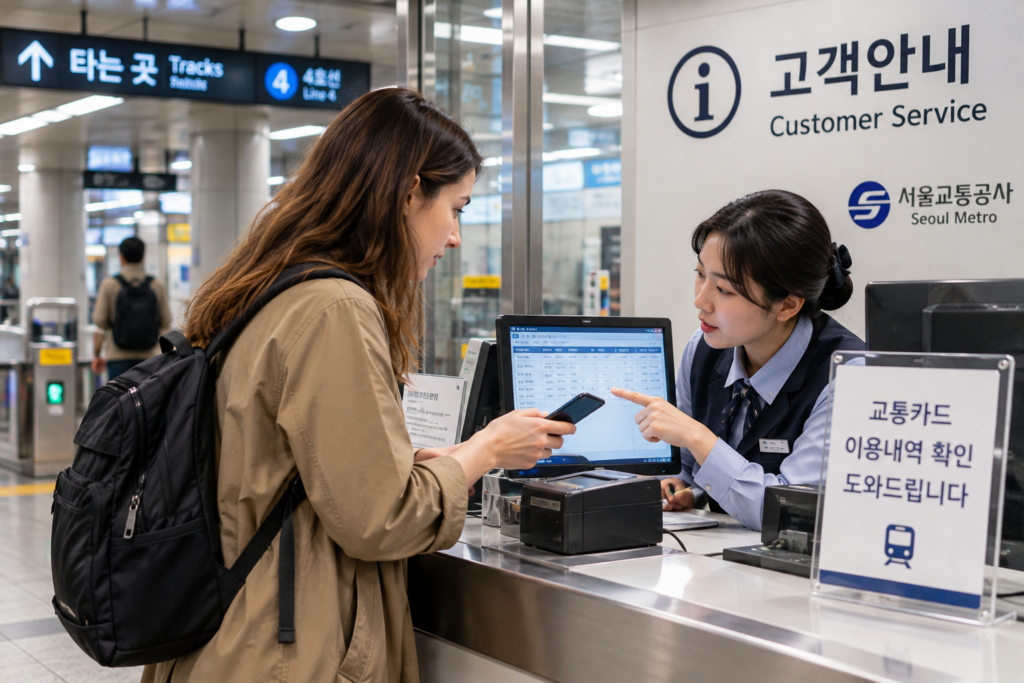
Look for a station office or customer assistance area near the fare gates. At a larger interchange station, ask an employee where you can get help with a transportation card fare.
Prepare the following information:
- The transportation card used for the journey
- The approximate date and time of travel
- Your departure station
- Your destination or exit station
- The unexpected fare amount, if known
Useful Korean Sentences for Station Staff
If you know you forgot to tap out, show the following sentence on your phone:
지하철 하차 태그를 못 했어요. 다음 승차 때 추가 요금이 나왔는데, 확인해 주실 수 있나요?
I forgot to tap out of the subway. An extra fare appeared on my next trip. Could you check it, please?
If you are not sure whether your exit was recorded, use this sentence instead:
하차 태그를 했는지 확실하지 않아요. 교통카드 이용 내역을 확인하고 싶어요.
I’m not sure whether I tapped out. I’d like to check my transit card’s travel history.
Station staff may explain the relevant fare rule or direct you to the appropriate railway operator or transportation card customer service channel.
Refund warning: A genuine missed exit tap does not automatically qualify for a refund. Seoul Metro’s published policy explains how the additional fare is assessed but does not guarantee cancellation of a valid charge.
If you believe your exit was recorded correctly or that the additional charge resulted from a system error, ask for your specific journey to be reviewed.
What If You Do Not Have a Korean Phone Number?
International visitors sometimes worry that resolving a transportation card problem requires a Korean mobile phone number, domestic bank account, or Korean-language transportation app.
For an initial question about an unexpected subway fare, visiting a staffed station office is a practical option.
You can show an employee the Korean sentences above and explain which station you traveled from and approximately when you arrived.
This allows you to request assistance without first relying on a Korean phone number or a domestic banking service.
If the issue involves the transportation card itself, staff may direct you to the card issuer’s customer service.
The appropriate procedure depends on the type of card and the railway operator involved.
Is This the Same as Seoul’s 15-Minute Subway Re-Entry Rule?
No. Seoul’s 15-minute re-entry rule and the missed-exit additional-fare policy address different situations.
On eligible subway sections, qualifying passengers who properly tap out and re-enter through the same station and line within 15 minutes can avoid paying another basic fare.
That rule applies to an eligible, properly recorded exit followed by re-entry.
It does not automatically erase an earlier missed exit record or cancel an additional fare from a previous journey.
If you left a station because you needed a restroom, chose the wrong direction, or had to change platforms, read our separate Seoul subway 15-minute re-entry guide for the specific conditions and exclusions.
How to Avoid Another Missed Exit Tap
The simplest way to avoid an unexpected additional charge is to treat the exit tap as the final step of every subway journey.
- Keep the transportation card you used to enter the subway accessible.
- Approach the correct exit gate and locate the card reader.
- Place the card directly over the reader.
- Wait until the reader and gate confirm a successful exit.
- Pay attention to any error message or unusual gate response.
- If the reader appears to malfunction, ask station staff for assistance before leaving.
Avoid holding an entire wallet containing several contactless cards against the reader. Separating your transportation card can help prevent confusion about which card is being used.
Always use the same card for entry and exit. Switching between two transportation cards can create a different problem because the system may not be able to match the entry and exit records.
If you are unfamiliar with Seoul’s normal subway entry, exit, and transfer procedures, our beginner’s guide to using a T-money card in Seoul explains the basic steps.
Frequently Asked Questions
Will My T-money Card Stop Working If I Forget to Tap Out?
Not necessarily. Under the March 2026 policy, a missing exit record can result in an additional base fare when the same applicable transportation card is next used for subway entry.
If the gate rejects your card, ask station staff to check the actual reason rather than assuming the missed exit caused the rejection.
Will I Always Pay an Extra KRW 1,550?
No. KRW 1,550 is the additional adult base fare under the March 2026 policy.
The additional amounts are KRW 900 for teenagers and KRW 550 for children. Some ticket and pass types are excluded from the rule.
The total cost of the next subway journey may also include the normal fare and other applicable adjustments.
Can Tourists Get the Extra Fare Refunded?
A refund is not automatic or guaranteed.
If you believe your exit was recorded correctly or the additional fare was assessed in error, ask station staff or the relevant operator to review your travel record and explain the available procedures.
Does the Rule Apply Outside Seoul?
Yes. Seoul Metro announced that the March 2026 missed-exit additional-fare policy applies across the Seoul metropolitan urban railway network, including participating subway sections outside Seoul city limits.
The exact operator responsible for reviewing an individual charge may depend on the stations and railway lines involved.
Is a Climate Card Short-Term Pass Treated the Same as an Ordinary T-money Card?
No. Climate Card short-term passes are exempt from the missed-exit-tap penalty according to Seoul Metropolitan Government’s FAQ updated on October 1, 2026.
Ordinary prepaid and applicable postpaid transportation cards follow the separate additional-fare rule.
Travelers should check their specific card or pass type, particularly if they are using a card originally issued as a postpaid Climate Card.
Can the 15-Minute Re-Entry Rule Cancel a Missing Exit Charge?
No. The 15-minute re-entry rule concerns an eligible exit that was properly recorded, followed by re-entry at the same station and line.
It is not an automatic cancellation method for a missing exit record from a previous subway journey.
Quick Checklist Before Your Next Subway Ride
- Confirm whether you used ordinary T-money, another transportation card, or a Climate Card short-term pass.
- Remember whether you tapped out on your previous subway journey.
- Check whether the unexpected amount matches the published additional base fare.
- If something appears incorrect, ask station staff to review the journey.
- Always use the same transportation card for entry and exit.
- Wait for confirmation before leaving through a subway fare gate.
For most international visitors, the key lesson is straightforward: forgetting to record an exit from a qualifying Seoul metropolitan subway journey can create an unexpected additional charge when you next enter the subway.
However, the result depends on your transportation card type. Ordinary T-money cards and Climate Card short-term passes are not subject to identical missed-exit rules.
Checking your card type, reviewing your previous journey, and asking station staff for assistance when necessary can help you understand an unexpected charge without confusing it with other subway fare policies.
Official Sources
- Seoul Metropolitan Government – March 2026 Subway Missed Exit Tap Policy
- Seoul Metropolitan Government – Climate Card Short-Term Pass Missed Exit FAQ (October 2026)
- Seoul Metropolitan Government – Climate Card Operation Changes
- Seoul Metropolitan Government – Postpaid Climate Card Changes
- Seoul Metropolitan Government – English Subway Information
Last checked: October 11, 2026. Transportation fares, card conditions, and railway operator policies may change. This guide reflects the official information available on the date above.