
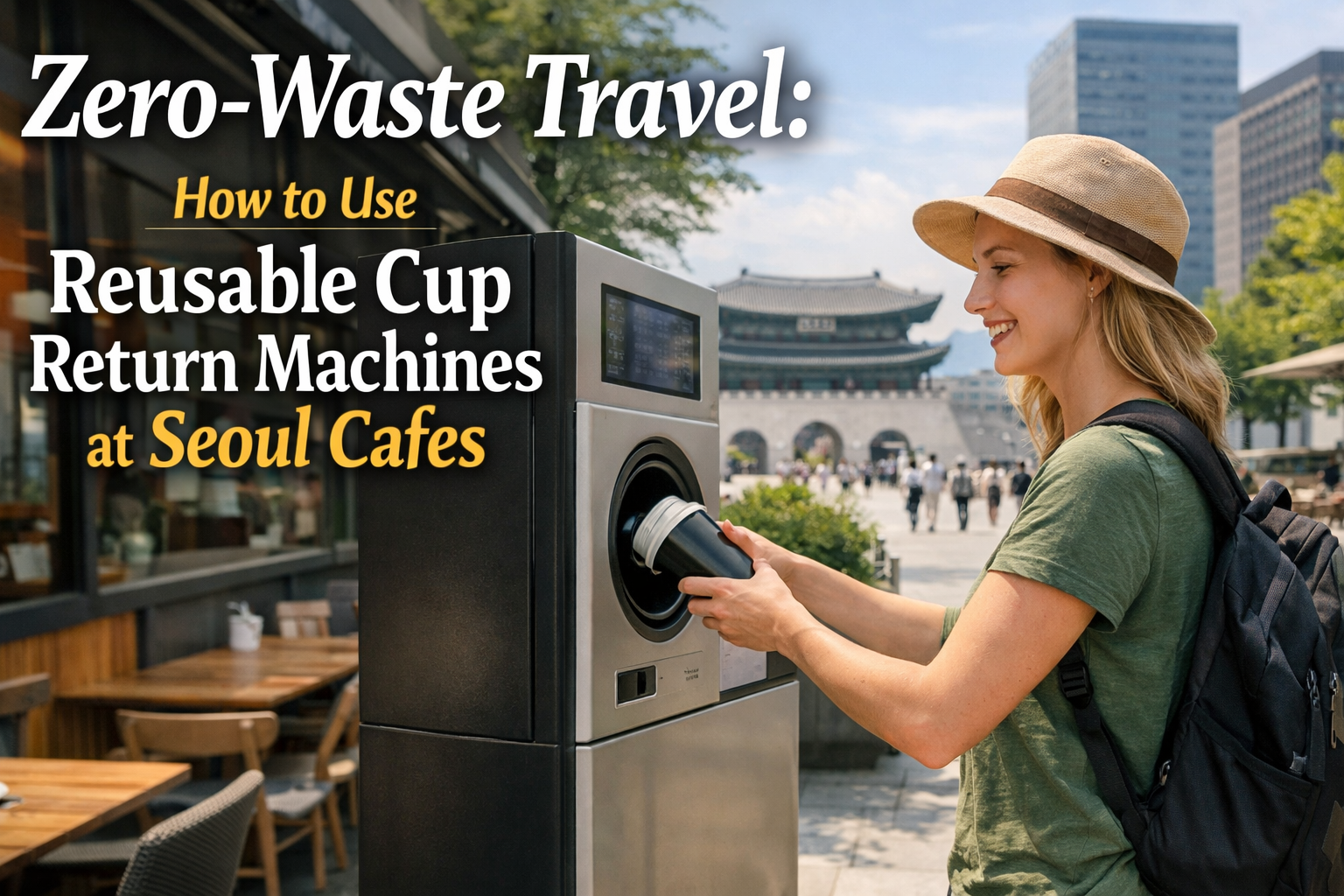
Trying to travel more sustainably in Seoul sounds easy. In real life, it can feel confusing. You walk into a café, order a drink, and suddenly see a reusable cup option, a deposit notice, or a return machine near the door. If you are visiting Korea for the first time, it is normal to wonder: How does this work, and will I get my money back?
I had the same question the first time I used one in central Seoul. The good news is this: once you understand the system, it is one of the easiest zero-waste habits to add to your trip. You do not need to carry a tumbler all day. You just need to know how to order, where to return the cup, and what small mistakes to avoid.
In this guide, I will show you exactly how to use reusable cup return machines in Seoul cafés, what to check before you order, and how to make the process smooth even if you do not speak much Korean.
💡 5 Key Things to Check Before Choosing a Reusable Cup
Before you say yes to a reusable cup in Seoul, check these five things. This is the fastest way to avoid confusion later.
1. Is the café part of a reusable cup program?
Not every café in Seoul uses the same system. Some chain stores participate in reusable-cup campaigns, while many independent cafés do not. The safest move is to ask staff directly: “Can I return this cup at a machine?” or “Is there a deposit?”
My tip: I always ask this before paying. It saves me from carrying a cup around longer than planned.
2. How much is the deposit?
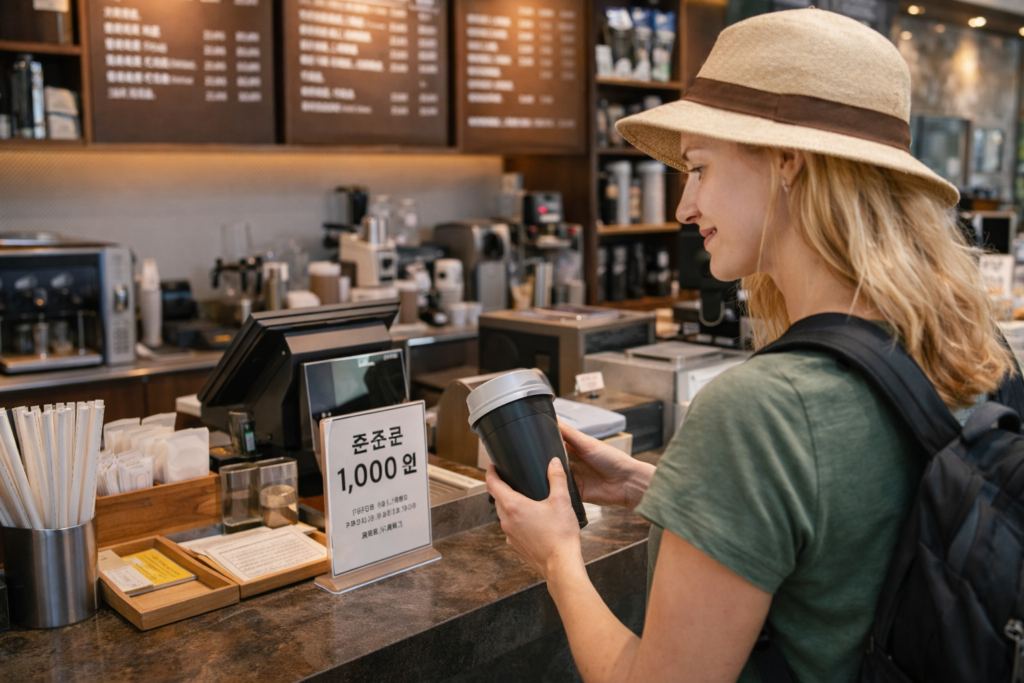
In many Seoul reusable-cup programs, customers pay a refundable KRW 1,000 deposit. This is not an extra fee if you return the cup properly. Think of it as a temporary hold that encourages returns.
3. Where can you return it?
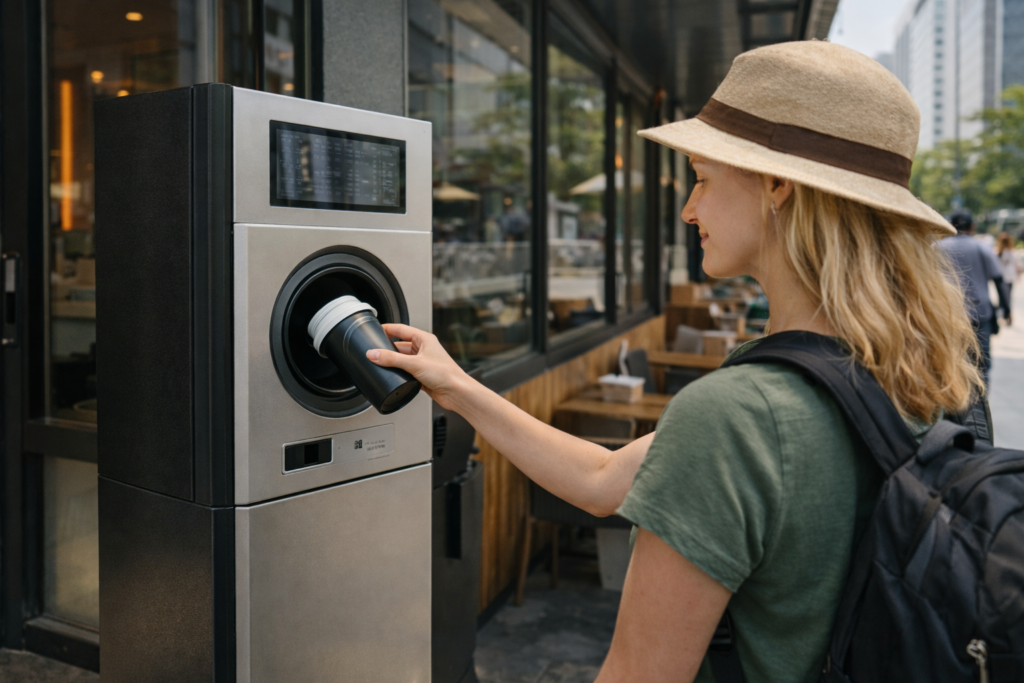
This is the biggest detail. Some stores have an unmanned return machine inside or nearby. Others may accept returns at the counter. Availability can change by branch and neighborhood, so always check before you leave with your drink.
4. Do you need an app?
Some reusable-cup systems in Korea use the Happy Habit app to show participating cafés and return machine locations. Even if you do not want to install another app while traveling, knowing the name helps when asking staff for help.
5. Does the cup match your travel style that day?
If you are rushing between palaces, shopping streets, and subway transfers, a reusable cup is still a good option. But only if you know where you will return it. If you are heading out of the area immediately, your personal tumbler may be more practical.
My tip: Reusable cups work best on slower city days. Think Insadong, Gwanghwamun, or City Hall, not airport-transfer mornings.
For policy context, Seoul has promoted reusable-cup use in central ecozones and encouraged both personal cups and reusable-cup circulation. You can naturally link this section to an official source like Seoul’s reusable cup campaign in the Gwanghwamun Ecozone.
📊 How Reusable Cup Return Machines Work at Seoul Cafés
Here is the simple step-by-step version most travelers need.
Case 1. Chain café in central Seoul
You order a takeaway drink and choose the reusable cup option. The staff serves your drink in a reusable cup and adds the deposit. After finishing your drink, you return the cup to a participating machine or return point. Once the system recognizes the cup, your deposit is refunded according to that service’s method.
Case 2. Café near an office district or ecozone
In areas such as Gwanghwamun, City Hall, and nearby business zones, reusable-cup programs have been part of Seoul’s wider zero-waste efforts. These locations are easier for travelers because foot traffic is high and return infrastructure is more likely to exist.
Case 3. Tourist using the Happy Habit map
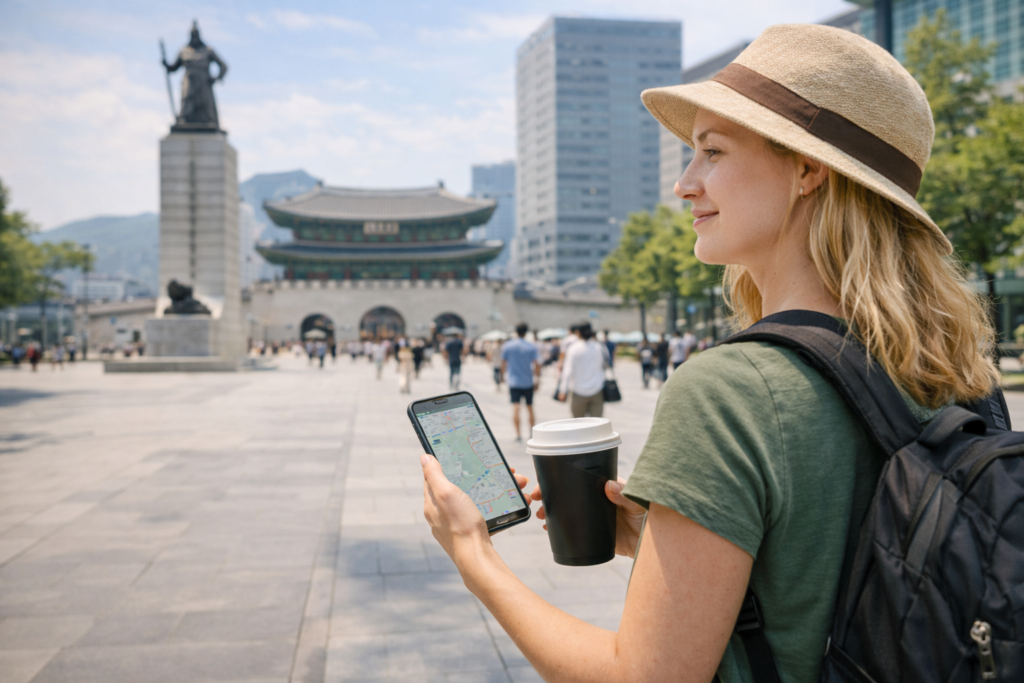
If you prefer to plan ahead, use the app or ask staff to check whether a return machine is available nearby. This is especially useful if you are spending the day walking between attractions and want a guaranteed return point before you order.
Case 4. When the machine does not seem obvious
Do not panic. In Korea, many useful facilities are easy to miss because they are placed near exits, side walls, or shared building lobbies. If you cannot see the machine, ask: “Reusable cup return machine?” Most staff will understand enough to point you in the right direction.
My tip: I look near the entrance first. In Seoul cafés, practical machines are often placed where people leave, not where they order.
Case 5. What if you cannot return it right away?
Keep the cup clean and return it as soon as possible at a participating point. Do not assume every random café can accept it. The system works best when you stay inside the same participating network.
For a broader sustainability angle inside the article, this is also a natural place to add an external authority link such as UNEP guidance on reducing single-use plastics.
📌 Practical Zero-Waste Travel Tips for First-Time Users
These are the strategies I recommend to make the experience easy, even on a busy Seoul itinerary.
Choose reusable cups in the right neighborhoods
Start in central areas where sustainability campaigns are more visible. Gwanghwamun, City Hall, and major business districts are easier than tiny neighborhood cafés when you are learning the system.
Ask two questions before paying
Use this simple checklist:
- “Is there a deposit?”
- “Where can I return the cup?”
Those two questions solve almost everything.
Take a photo of the machine or store name
This sounds small, but it helps a lot. If you get distracted while sightseeing, you will remember where you planned to return the cup.
Pair your coffee stop with your route
Buy the drink when you know you will remain in the area for at least 20 to 60 minutes. That gives you time to enjoy the drink and return the cup naturally.
Use your own tumbler on transfer-heavy days
On days with KTX, airport bus, or long subway transfers, your own cup is often better. On relaxed city-walk days, Seoul’s reusable cup systems are ideal.
My tip: My best routine is coffee after arriving at a sightseeing district, not before boarding transport. That one change makes returns much easier.
Do not overcomplicate the language issue
You do not need perfect Korean. A few words work well: “da-hoe-yong keop” (reusable cup), “bo-jeung-geum” (deposit), and “ban-nap” (return). Even showing these words on your phone can help.
📋 Quick Comparison Table
| Option | Best For | Main Advantage | Main Drawback | Cost Impact |
|---|---|---|---|---|
| Reusable cup + return machine | Central Seoul sightseeing days | No need to carry your own cup all day | You must return it correctly | KRW 1,000 deposit refunded after return |
| Personal tumbler | Long travel days and commuters | Most flexible zero-waste option | You need to carry and clean it | Possible café discounts in some stores |
| Disposable cup | Last-minute convenience only | Fast and familiar | Creates more waste | No sustainability benefit |
💰 Real Benefits, Savings, and Environmental Impact
Let’s make this practical.
1. Your direct financial risk is low.
If the deposit is KRW 1,000 and you return the cup properly, your net extra cost is basically 0 won.
2. You reduce single-use waste immediately.
One traveler buying one coffee a day for a 5-day Seoul trip can avoid 5 disposable cups. That sounds small, but citywide systems scale because many people make the same small choice.
3. It is easier than buying a new tumbler on the spot.
A good tumbler may cost anywhere from KRW 10,000 to KRW 40,000+. Reusable cup systems let short-term travelers join zero-waste behavior without that upfront cost.
4. It saves mental energy once you learn it.
This matters more than people think. When sustainable behavior feels convenient, you repeat it. That is why return machines are powerful. They remove friction.
5. The city-level impact can be meaningful.
Large reusable-cup programs in Korea have already reported millions of disposable cups avoided. That turns a tiny personal habit into a visible urban sustainability practice.
My tip: For travelers, the real win is not just money. It is being able to make a better choice without carrying extra gear all day.
✅ Final Thoughts
If you want an easy entry point into zero-waste travel in Seoul, reusable cup return machines are one of the best habits to try. The learning curve is small. The environmental upside is real. And once you understand the deposit-and-return logic, the whole system feels surprisingly traveler-friendly.
My simple recommendation is this: start in a central Seoul café, ask where the return point is before you order, and treat your first reusable-cup purchase like a test run. After one successful return, the process becomes second nature.
❓ FAQ
1. Do all cafés in Seoul have reusable cup return machines?
No. Participation depends on the café, brand, and neighborhood. Always ask staff or check the app before ordering.
2. How much is the reusable cup deposit in Seoul?
Many participating programs have used a KRW 1,000 refundable deposit. Still, confirm at the specific café because programs can change.
3. Can tourists use the system without speaking Korean?
Yes. Most travelers can manage with a few simple English questions, a translation app, or by showing the words “reusable cup” and “return machine” on their phone.
4. Is a reusable cup better than bringing my own tumbler?
It depends on your day. A personal tumbler is best for full flexibility. A reusable rental-style cup is great when you want a low-effort zero-waste option without carrying extra items.
5. What is the best area to try this for the first time?
Central districts such as Gwanghwamun, City Hall, and nearby office zones are some of the easiest places to start because reusable-cup campaigns have been more visible there.