
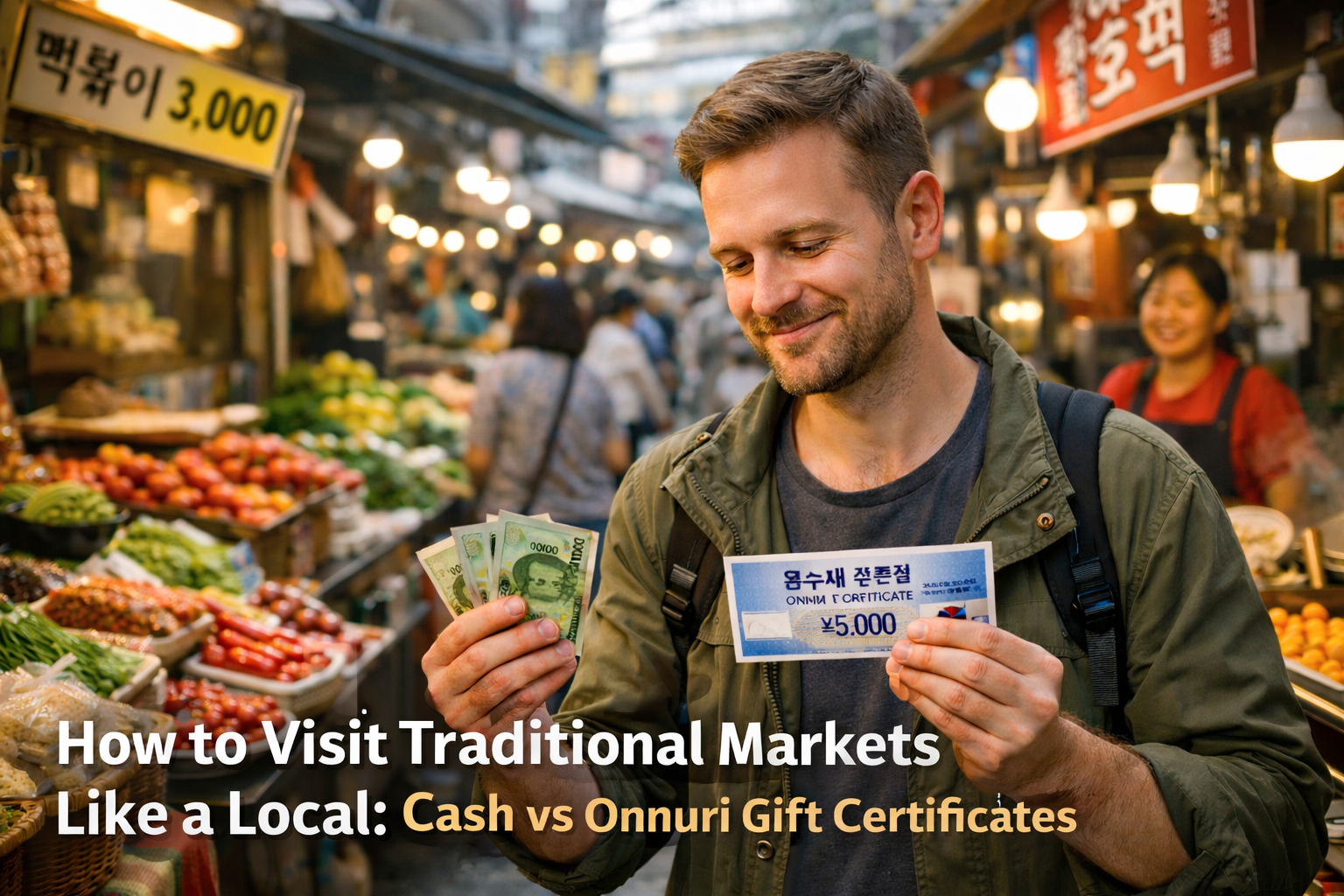
Walking into a Korean traditional market for the first time can feel exciting and a little confusing. You see fresh produce, sizzling street food, tiny family-run shops, and handwritten price signs everywhere. Then comes the practical question: Should you pay with cash, or use Onnuri Gift Certificates?
If you want a smoother, more local-style market experience in Korea, this guide will help. I have visited traditional markets in Seoul and other cities many times, and one thing I learned quickly is this: the best payment method depends on what you are buying, where you are shopping, and how flexible you want to be.
In this article, I will break down the real difference between cash and Onnuri Gift Certificates, show when each option works best, and share practical tips to help you shop with more confidence.
💡 1) Key Criteria: 5 Things to Check Before You Choose
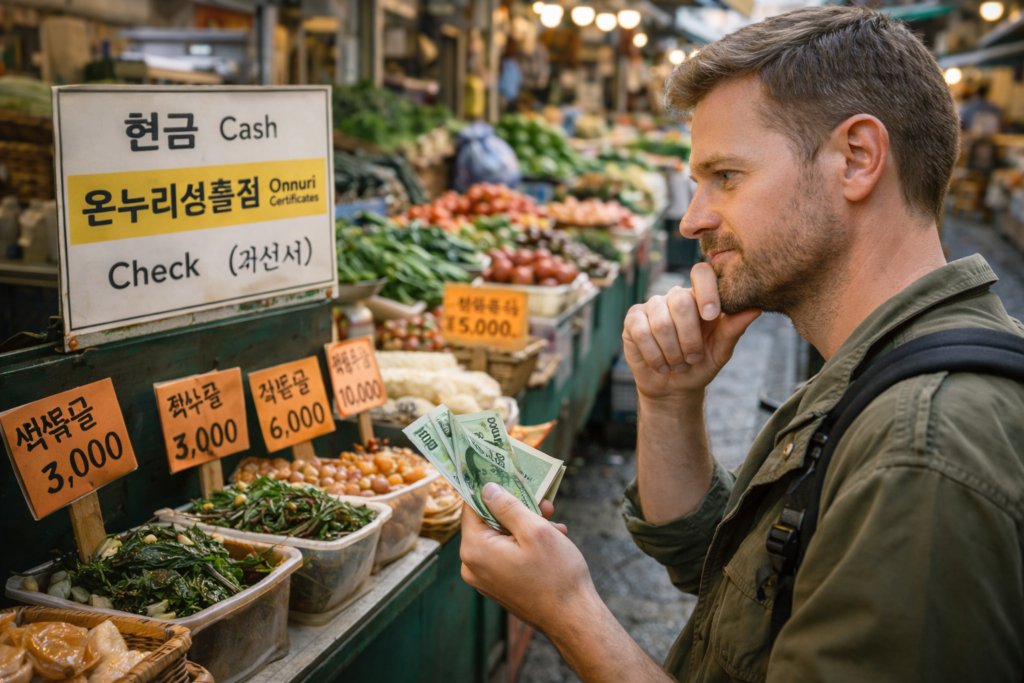
1. Is the store an affiliated Onnuri merchant?
Not every stall inside a market accepts Onnuri. Many do, but some do not. This matters most in older markets with many independent vendors. Before you line up to pay, look for an affiliated-store sign or ask a simple question like, “Onnuri dwaeyo?”
2. Are you buying snacks, produce, or a bigger grocery haul?
For quick street food, cash is often the fastest option. For a larger grocery run, Onnuri can be more budget-friendly because of the discount you may get when buying it in advance.
3. Do you need change?
This is where many travelers get stuck. Cash is simple. Onnuri paper certificates are a bit different, because change is usually given only after you spend a certain portion of the voucher amount. If you are making very small purchases, cash is often easier.
4. Are you trying to save money or maximize convenience?
If your goal is pure convenience, carry cash. If your goal is savings on a planned market trip, Onnuri often gives better value. Locals who shop regularly usually think about both.
5. Are you comfortable using digital payment tools in Korea?
Digital Onnuri can be useful, but not every visitor wants to deal with app setup during a short trip. In that case, cash remains the least stressful backup.
My own rule is simple: I never enter a traditional market with only one payment method. A mix of small cash bills plus one planned budget tool always works better.
For trustworthy trip-planning context, link this section to the official Korea shopping guide for payment options and market shopping.
📊 2) Cash vs Onnuri Gift Certificates: What Actually Works Better?
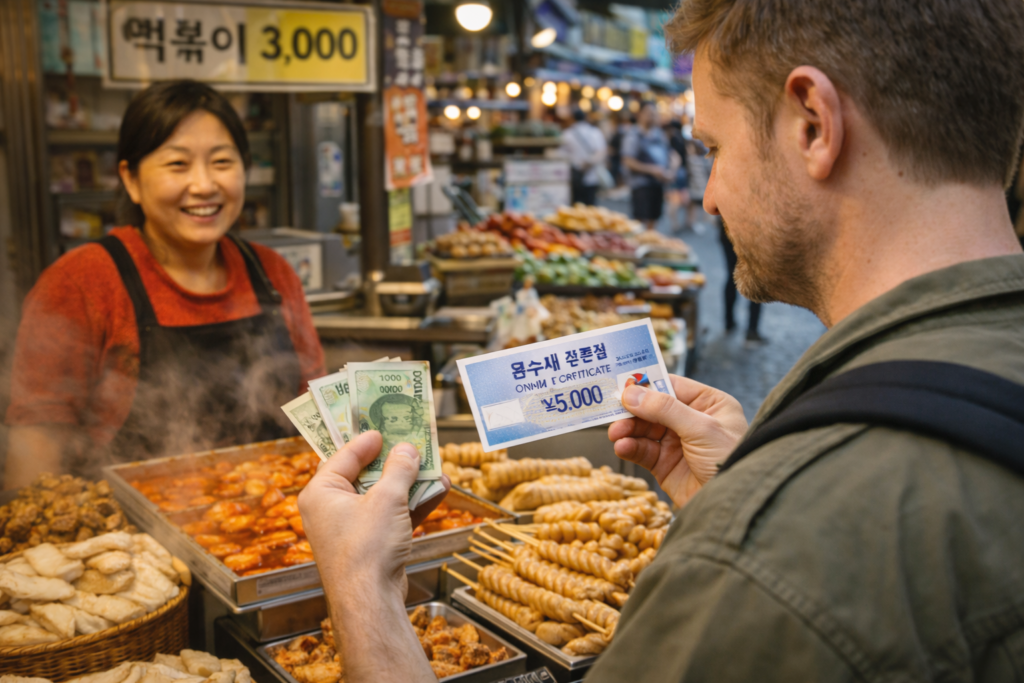
Option 1: Cash
Cash is still the easiest choice in many Korean traditional markets. It is fast. It is familiar. It works well for low-cost items like tteokbokki, hotteok, dumplings, fruit cups, fish cakes, and vegetables.
I especially recommend cash when you are hopping between many stalls and buying small items under KRW 10,000. Some stalls move quickly during peak lunch or weekend hours, and cash keeps the line moving.
Option 2: Paper Onnuri Gift Certificates
Paper Onnuri feels very local because many Korean shoppers use it intentionally to save money at traditional markets. It is best for planned shopping, such as meat, side dishes, seasonal fruit, dried seafood, or larger purchases for a meal at home.
The main advantage is budgeting. Once you set your market budget in voucher form, it becomes harder to overspend. The downside is reduced flexibility for tiny purchases.
Option 3: Digital Onnuri
Digital Onnuri can be more convenient than paper for repeat users, especially domestic shoppers who already understand the app ecosystem. But for first-time visitors, it may feel less intuitive than simply using cash. I usually see digital Onnuri as a better fit for long-stay travelers, students, or frequent Korea visitors.
Option 4: Mixed Strategy
This is the method I recommend most. Use Onnuri for your planned larger purchases. Use cash for quick snacks, tiny add-ons, or stalls where payment options are unclear. This feels the closest to how practical locals shop.
When I shop for both lunch and groceries, I use cash first for street food and save the voucher for bigger items later. That avoids awkward change issues.
Small bills matter. In traditional markets, KRW 1,000, 5,000, and 10,000 notes are much more useful than carrying one big bill.
For authority and trust, place a contextual link here to the official Onnuri Gift Certificate official information and merchant search.
📌 3) Practical Local Strategies That Make Market Shopping Easier
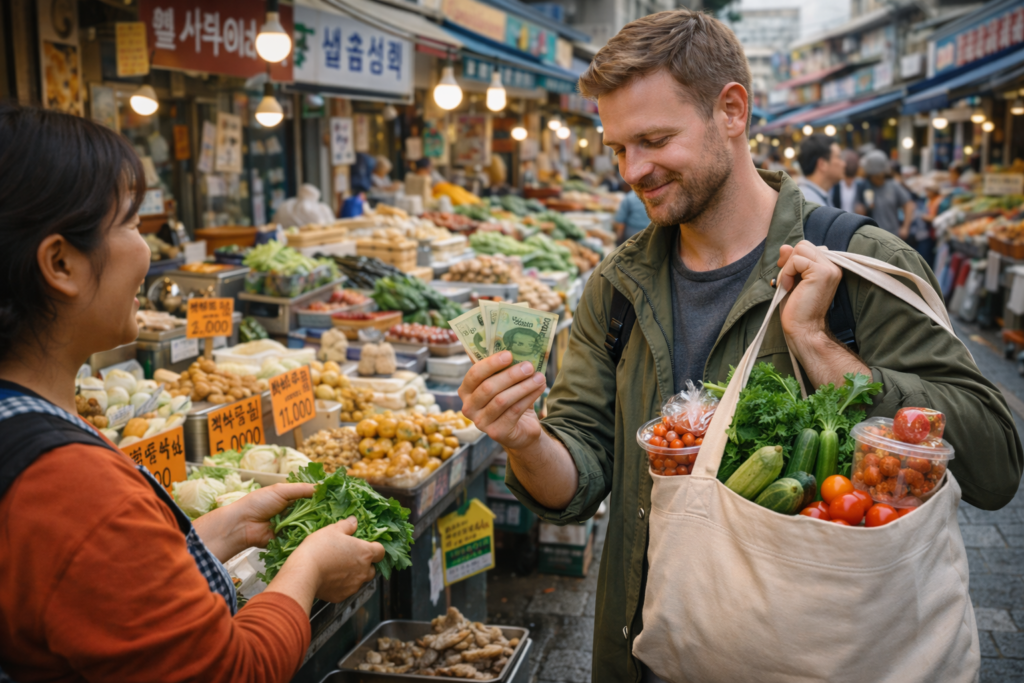
Arrive before the busiest rush
Late morning or early afternoon is a sweet spot. You get fresh food, shorter lines, and more time to ask questions without pressure.
Use cash for “instant decisions”
Traditional markets are full of impulse buys. Fresh strawberries. One skewer. One pancake. One bag of nuts. Cash is perfect for these quick moments.
Use Onnuri for “planned baskets”
If you already know you want to spend KRW 30,000 to KRW 70,000 on produce, fish, meat, or side dishes, Onnuri gives structure. It feels more deliberate and can lower your effective cost when purchased at a discount.
Check acceptance before ordering food
This sounds obvious, but it saves stress. Some food stalls are busy and move very fast. Ask first, especially when you are using vouchers.
Keep one backup option ready
Even if you want to shop “like a local,” the smartest local habit is not loyalty to one payment method. It is flexibility.
One of my best market habits is deciding my “snack budget” and “grocery budget” separately. It keeps the fun part fun, and the practical part under control.
📋 4) Quick Comparison Table
| Payment Method | Best For | Pros | Cons |
|---|---|---|---|
| Cash | Street food, small purchases, fast shopping | Fast, simple, widely accepted | No built-in discount, easy to overspend casually |
| Paper Onnuri | Planned grocery shopping, bigger purchases | Budget-friendly, local feel, useful for market runs | Less flexible for tiny purchases, change rules matter |
| Digital Onnuri | Frequent users, long-stay visitors | Convenient for repeat shopping, can offer discount benefits | May require setup and is less tourist-friendly at first |
| Mixed Method | Most travelers and practical shoppers | Flexible, efficient, best balance of savings and ease | Requires small planning before shopping |
💰 5) Real Savings and Cost Analysis
Let’s make this practical.
- If you spend KRW 50,000 at a market using cash, your total cost is still KRW 50,000.
- If you buy digital Onnuri at a 7% discount, your effective out-of-pocket cost for KRW 50,000 in spending is about KRW 46,500.
- That means you save about KRW 3,500 on one market run.
- At KRW 100,000 in market spending, the same 7% discount becomes about KRW 7,000 in savings.
Now think beyond one visit. If you shop at traditional markets four times during a longer stay and spend around KRW 50,000 each time, you could save roughly KRW 14,000 with the right Onnuri strategy. That may cover extra snacks, coffee, or transportation.
So the real answer is not “cash or Onnuri?” It is this:
Use cash for speed. Use Onnuri for savings. Use both for the smartest result.
✅ Final Thoughts
If you want to visit a Korean traditional market like a local, do not overcomplicate it. Bring small cash for flexibility. Use Onnuri Gift Certificates for larger planned purchases when possible. And always check payment acceptance before ordering.
That combination gives you the best of both worlds: convenience, confidence, and better value.
In my experience, travelers enjoy traditional markets much more when they stop worrying about the “perfect” payment method and instead focus on having two solid options ready. That is what practical local shopping really looks like.
❓ FAQ
Can foreigners use Onnuri Gift Certificates in Korea?
In practice, availability and ease of use depend on the format and purchase method. For short-term travelers, cash is usually simpler, while long-stay visitors may find Onnuri easier to manage.
Is cash still necessary in Korean traditional markets?
Yes. Many market shops accept modern payment methods, but cash is still very useful for small stalls, snack vendors, and quick transactions.
Are Onnuri Gift Certificates accepted at every stall in a traditional market?
No. Acceptance depends on whether the seller is an affiliated merchant. Always check before buying.
Which is better for street food: cash or Onnuri?
Cash is usually better for street food because it is faster and more flexible for low-cost items.
What is the best payment strategy for first-time visitors?
The best beginner-friendly method is simple: carry small cash bills and use Onnuri only for larger, planned purchases at confirmed participating shops.