
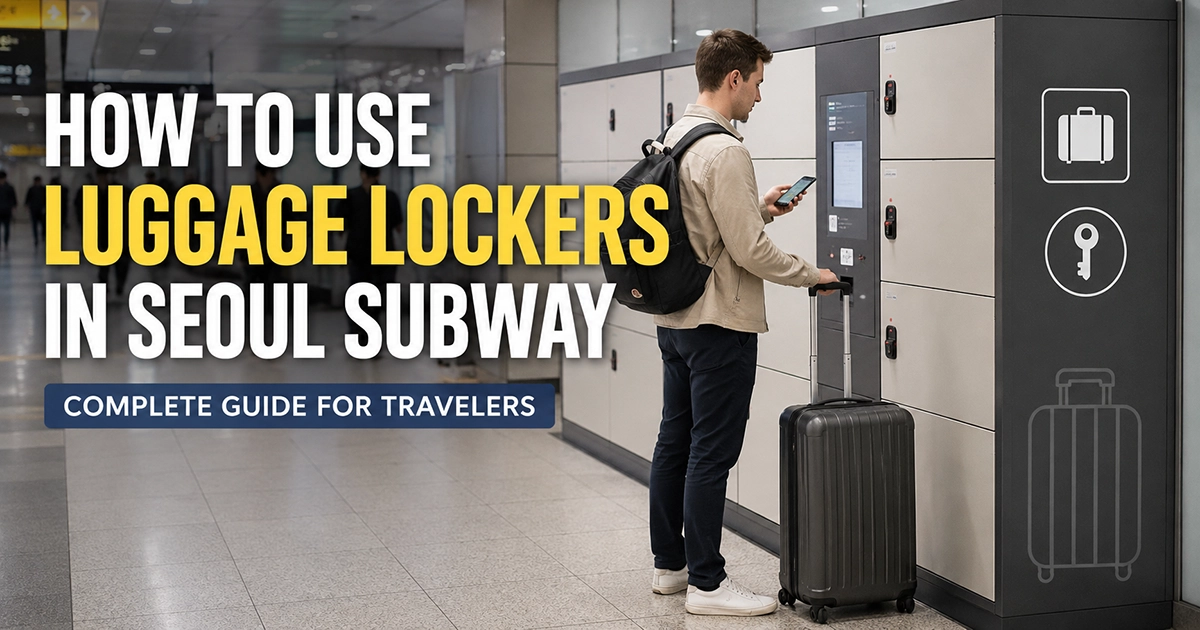
Yes. Foreign visitors can use Seoul Metro’s T-Locker hourly luggage lockers. Seoul currently lists 5,557 T-Lockers at 336 locations across 273 subway stations, and you do not need to be a Korean resident simply to store a suitcase.
The part that can be confusing is the interface. Seoul’s official storage page still documents app-based use for T-Locker and says instructions can vary by locker, while the current T-Locker operator website promotes a QR-based no-app process with one-time-password retrieval. Check the instructions on the exact locker in front of you before downloading an app or starting payment.
Check the Locker Size, Price and Hours Before Paying
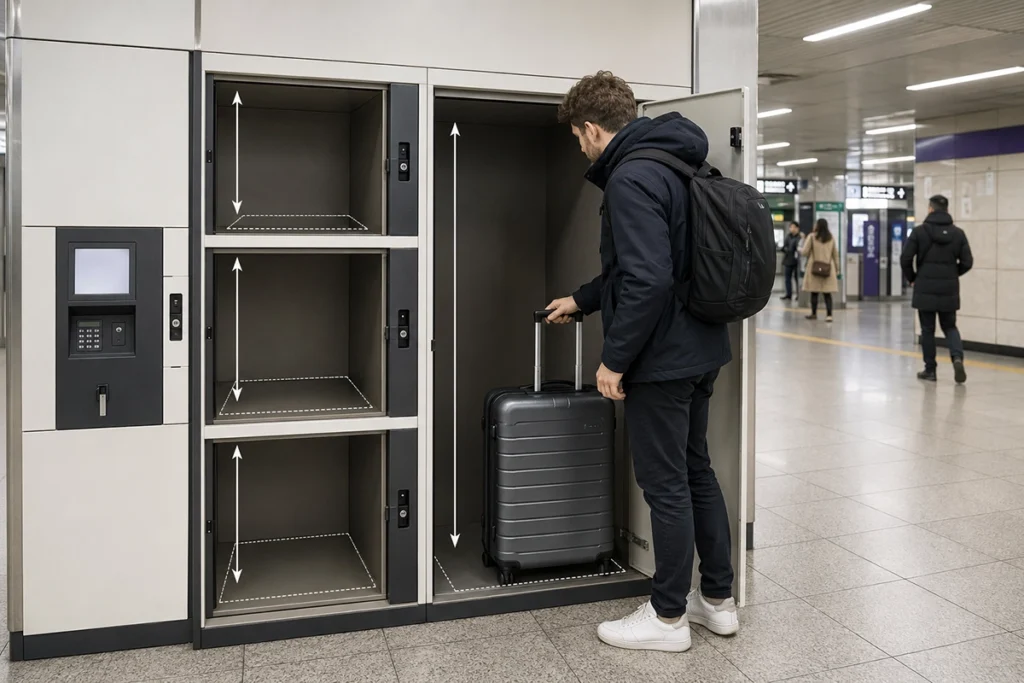
T-Locker has small, medium and large compartments. Do not choose only by a suitcase label such as “24-inch” or “28-inch.” Wheels, handles and an expanded hard shell can make the actual external dimensions larger than the advertised size.
| Size | Compartment dimensions | Current fee |
|---|---|---|
| Small | 50 × 30 × 60 cm | Weekday ₩2,200; weekend ₩3,100; +₩500 per extra hour |
| Medium | 50 × 45 × 60 cm | Weekday ₩3,300; weekend ₩4,600; +₩800 per extra hour |
| Large | 50 × 90 × 60 cm | Weekday ₩4,400; weekend ₩6,100; +₩1,000 per extra hour |
These are the rates currently published by the Seoul Metropolitan Government’s subway storage guide. The base rate covers four hours. Prices can change, so recheck the official page if your trip is well after this article’s update date.
A large locker provides considerably more space, but it is still a fixed compartment. For an oversized suitcase, stroller, sports equipment or several bags, compare the actual dimensions before starting payment.
T-Locker storage and retrieval currently operate from 5:00 AM to midnight on weekdays, weekends and holidays. Do not treat the locker cutoff as the same thing as the last-train time: plan to be back at the locker before midnight even if the rest of your evening continues later.
How to Use a Seoul Subway T-Locker
The exact screen or mobile process can vary, so use the following steps as a practical framework while following the instructions displayed on your unit.
- Find the lockers and remember their location. Large interchange stations can have long corridors and several concourse areas. Save the station name and take a photo of the surrounding area if necessary.
- Read the instructions on the locker. If the unit provides a QR code for mobile use, scan it. If it specifically directs you to the T-Locker app, follow that route instead.
- Choose an available compartment. Make sure the complete bag fits without forcing the door.
- Check the payment options displayed by that unit. Do not assume that T-money, cash or a particular overseas credit card is universally supported.
- Place your luggage inside. Keep wheels, straps and handles completely inside the compartment.
- Close the door and confirm that it has locked. Do not leave just because the door appears to be shut.
- Save the retrieval information. Keep any locker number, reservation record or one-time password shown by the system. A screenshot can be useful if your mobile connection is unreliable later.
- Return before midnight. Follow the retrieval instructions and pay any additional time charge shown by the system before removing your belongings.
QR or Korean App? Follow the Locker in Front of You
Official information is not completely uniform as of August 19, 2026. The current T-Locker operator website promotes a QR-based process that does not require downloading an app and describes retrieval with a one-time password. Seoul’s municipal page, however, still documents the Korean-language T-Locker app and says instructions on lockers can vary.
For a foreign visitor, the practical answer is not to install an app in advance unless your locker tells you to. Start with the instructions printed or displayed on the unit you intend to use. If it offers a QR/web route, use that route; if it directs you to the app, expect a Korean-language interface.
If the station itself is difficult to navigate, KoreaEasyTrip’s Naver Map vs KakaoMap guide can help with station exits and local navigation.
What if a Foreign Credit Card Does Not Work?
Do not make one foreign-issued card your only plan. The official information reviewed does not provide a universal guarantee that every overseas Visa, Mastercard or other foreign-issued card will work through every T-Locker payment flow.
Use only the payment options actually shown on the locker or its payment page. A card that worked at a restaurant or convenience store in Korea can still fail at an unmanned payment terminal.
If payment fails, cancel the failed transaction cleanly before trying again. You can try another displayed payment option or a second card, but if the terminal keeps rejecting payment, switching to another locker or a staffed storage service is usually more practical than repeatedly submitting the same transaction.
KoreaEasyTrip’s foreign-card troubleshooting guide explains the next checks to make when a Korean payment terminal rejects an overseas card.
When T-Luggage Is the Better Backup
A locker is not always the best choice. Large compartments may be occupied, an oversized suitcase may not fit, or the unmanned interface may simply take more time than it is worth.
For larger luggage or when you prefer a staffed service, T-Luggage is a practical Seoul Metro alternative. Seoul currently lists T-Luggage locations at Seoul Station, Hongik University Station, Jamsil Station, Suseo Station, Myeong-dong Station, Gimpo International Airport Station and Jongno 3-ga Station.
T-Luggage provides luggage storage and delivery services. You can check current service information and rates on the official T-Luggage website. It can be a better option when your bag is too large for a fixed locker or when you want help from a staffed counter.
Common Locker Mistakes to Avoid
- Forgetting the locker location: Save the station name, locker number and a photo of the surrounding concourse.
- Assuming every T-Locker uses the same interface: Follow the instructions on the specific unit you are using.
- Choosing by suitcase inch rating alone: Compare full external dimensions, including wheels and handles.
- Depending on one overseas card: Keep another payment option or storage plan available.
- Returning too close to midnight: Allow time to reach the correct station concourse and complete retrieval.
- Leaving without checking the lock: Confirm that the compartment is actually secured.
Keep your passport, cash, essential medication and other items you cannot afford to lose with you rather than placing them in a public locker simply because they fit.
If you also need help with transfers, station exits or getting around Seoul with luggage, see the Seoul public transportation guide for first-time travelers.
FAQ
Do I need a Korean phone number to use a Seoul subway locker?
A Korean phone number should not be treated as a universal requirement for every T-Locker. The official sources reviewed do not describe one identical process for every unit. Check the instructions on the locker you plan to use; if that unit requires a setup you cannot complete, use another locker or a staffed storage option.
Will a 28-inch suitcase fit in a large T-Locker?
It may, but the “28-inch” label alone does not guarantee a fit. Seoul lists the large compartment at 50 × 90 × 60 cm, so compare those measurements with the suitcase’s full external dimensions, including wheels, handles and any expanded section.
For most travelers, the safest approach is simple: check the compartment dimensions first, follow the instructions on the actual locker rather than an old tutorial, save your retrieval information and return before the midnight T-Locker cutoff.