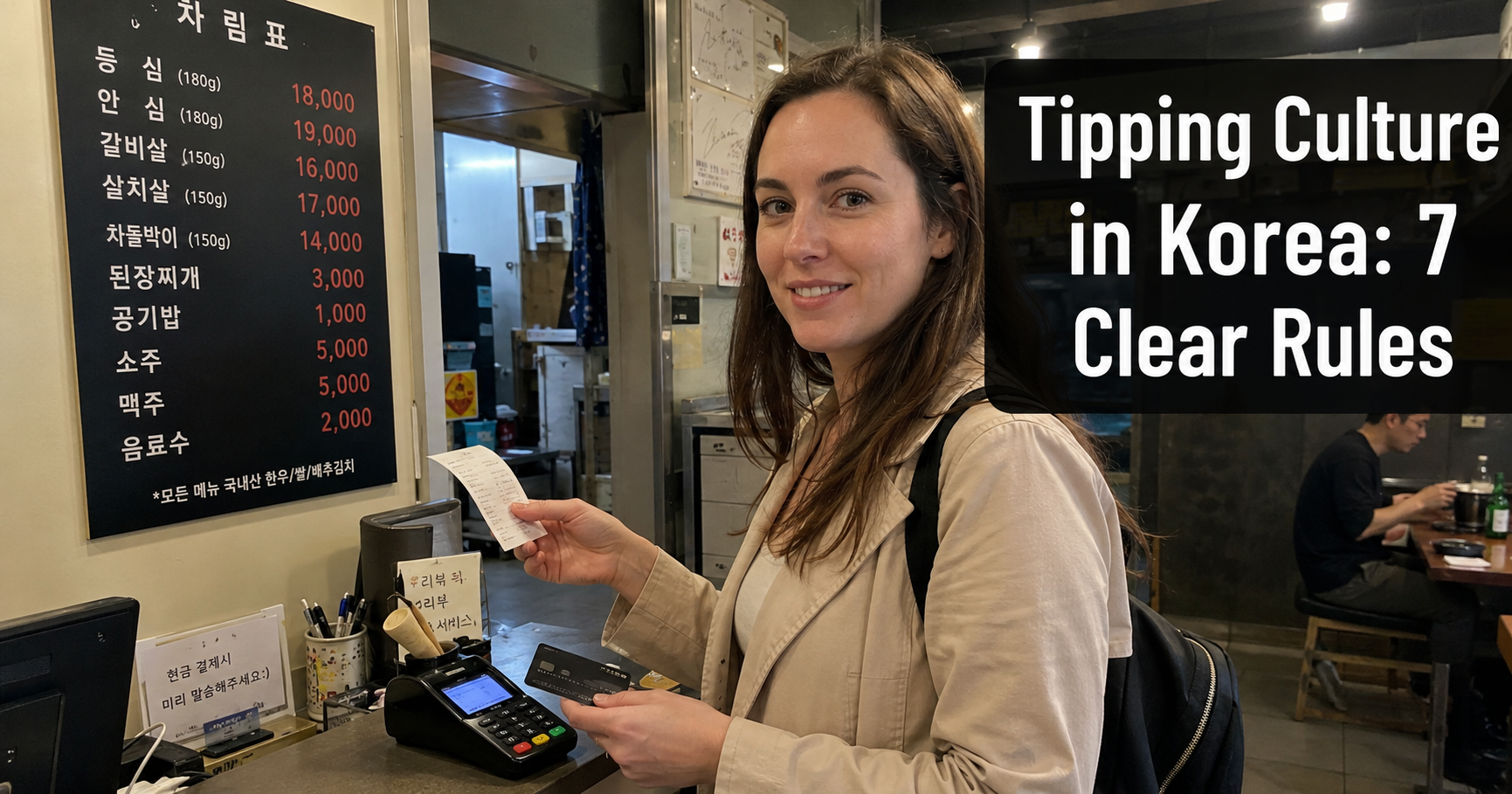
Last checked: August 2, 2026. Tipping customs can vary by individual business or tour company, but the general rule for travelers in Korea is simple: tipping is not normally expected.
At ordinary restaurants, cafés, taxis and everyday service businesses in Korea, you usually pay the listed or charged amount without adding a percentage. The official Visit Seoul guide describes tipping as not customary in Korea, while VISITKOREA specifically states that tipping is not required or expected at Korean restaurants.
The important distinction is that not tipping is normal, but offering a tip is not automatically offensive. Some people may accept an optional tip and others may refuse it. If someone declines, thank them and do not insist.
Quick answer: Do not automatically add 15% or 20% to bills in Korea. Pay the stated restaurant price, taxi fare or hotel charge. Check separately for any service charge already shown on the bill, and treat private-tour gratuities as optional unless the tour company gives a specific policy.
Do You Need to Tip in Korea?
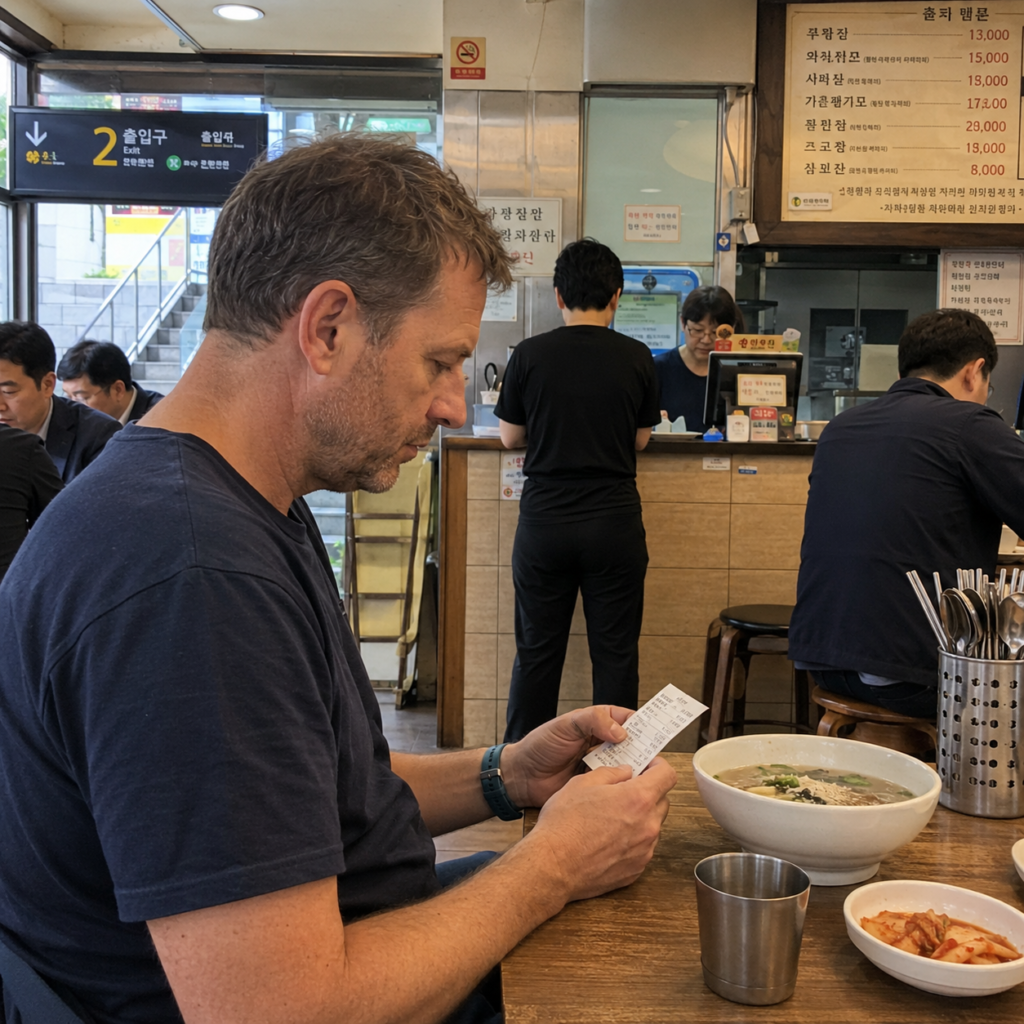
For most travelers, no. Korea does not use the same everyday tipping system found in countries where customers routinely calculate an extra percentage after meals, taxi rides or other services.
The official Visit Seoul money guide states that tipping is not a Korean custom and is not expected by service personnel. The official VISITKOREA restaurant guide likewise says that tipping is not required or expected at Korean restaurants.
This does not mean every employee or business reacts to an optional tip in exactly the same way. Seoul’s official etiquette guidance notes that some people may accept a tip while others may refuse one. The safest approach is therefore to avoid treating a tip as an obligation and to respect a refusal immediately.
7 Clear Tipping Rules for Travelers in Korea
1. Do Not Add a Tip at Ordinary Restaurants
At Korean restaurants, the normal approach is to pay the amount shown by the restaurant. You do not need to calculate an additional percentage because a server took your order, brought side dishes or helped at the table.
Service can also work differently from what some international travelers expect. Casual restaurants may use call bells, self-service stations, counter payment, kiosks or table-ordering screens instead of frequent server check-ins. If that system is unfamiliar, our guide to how Korean restaurant call bells and service work explains when to call staff and how payment is commonly handled.
At Korean BBQ, the same no-tip rule generally applies. Minimum orders, grill service and seating policies are separate restaurant rules rather than reasons to add a gratuity. Solo travelers can also check our solo Korean BBQ guide for ordering and etiquette details.
2. Taxi Drivers Do Not Expect a Tip
For a regular taxi ride, pay the metered, app-confirmed or otherwise authorized fare. The official Visit Seoul guide states that taxi drivers do not expect tips.
If you pay cash, allowing a driver to keep a small amount of change may be accepted, but it is optional. You do not need to round every fare up, and card or app payments can simply be completed for the exact amount charged.
A tip is also different from a fare dispute. If the amount does not match the meter or confirmed fare, or you believe you were charged improperly, do not solve the issue by paying extra. See what to do if you believe a taxi fare was unfair.
3. Normal Hotel Service Does Not Require a Tip
You do not need to add a tip for normal hotel services such as check-in, ordinary front-desk assistance, housekeeping or luggage storage simply because you are visiting from a country where hotel tipping is common.
Some major hotels may separately apply a service charge as part of their billing policy. Check the reservation conditions and final bill rather than assuming that a separate cash tip is required.
If you voluntarily offer money for unusual personal assistance, the employee may accept it or may decline it. Either response is possible. If it is refused, put the money away and continue with a simple thank-you.
4. Private Tour Tips Are Optional, Not a Korean Requirement
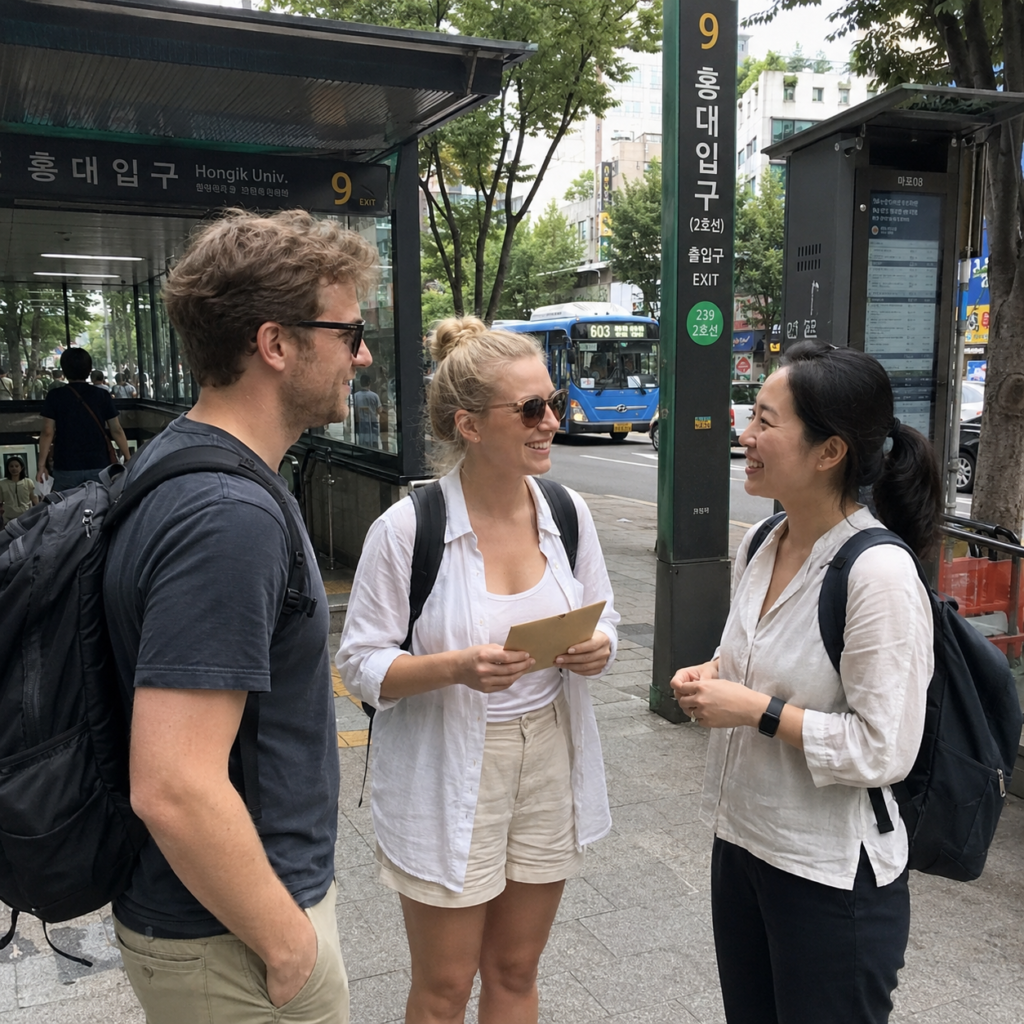
Private tours require a little more attention because international tour companies can set their own gratuity guidance. Read the booking page, voucher or tour terms before deciding what to do.
If the operator clearly states that gratuity is included, recommended or optional, follow that policy. If nothing is stated, there is no need to invent a 15% or 20% tip simply because that percentage is familiar in your home country.
There is no single nationwide tourist rule requiring a particular cash amount for a private guide. If you choose to offer an optional thank-you and the guide accepts it, keep the gesture simple. If it is declined, do not insist.
5. Cafés, Bakeries and Everyday Shops Normally Do Not Need Tips
At cafés, bakeries, convenience stores and similar everyday businesses, pay the displayed price. Staff helping with an order, heating food or answering a question does not normally create a separate tipping obligation.
The same principle applies when the ordering process feels unfamiliar. A kiosk, counter or table tablet may change how you order, but it does not automatically create a gratuity expectation.
6. Do Not Tip Because You Feel Bad About Not Speaking Korean
Language assistance is not something you need to compensate for with extra cash. If an employee helps you understand a menu or patiently waits while you use a translation app, a polite thank-you is enough.
If restaurant communication is the part you are worried about, our guide to how to order food in Korea without speaking Korean covers pointing at menus, kiosks, translation apps and basic phrases.
7. If Someone Refuses a Tip, Accept the Refusal
This is the easiest rule to remember. Do not turn an optional gesture into an argument.
If someone says no, returns the money or looks unsure about accepting it, take it back and say thank you. Seoul’s official etiquette guidance specifically recognizes that some people may accept tips while others may refuse them.
Service Charge and Tip Are Not the Same Thing
A service charge printed on a restaurant or hotel bill is a business charge, not a voluntary gratuity that you decide to add afterward.
The official Visit Seoul money guide notes that many major hotels and upscale restaurants may include a service charge on the bill. When a charge is clearly listed, check the total and the business’s billing policy. You do not need to assume that another tip must automatically be added on top.
| Situation | Normal approach | What to check |
|---|---|---|
| Ordinary restaurant | Do not add a tip | Pay the stated bill |
| Café or bakery | Do not add a tip | Pay the displayed price |
| Regular taxi | No tip expected | Pay the meter, app or authorized fare |
| Hotel | No tip required for normal service | Check for a listed service charge |
| Private tour | Optional unless the company states otherwise | Check booking and gratuity terms |
| Tip is refused | Stop offering it | Thank the person and take the money back |
Better Ways to Say Thank You in Korea
In everyday situations, a direct and polite thank-you is usually enough. The simplest phrase is 감사합니다 (gamsahamnida), meaning “thank you.”
After a meal, you may also hear or use 잘 먹었습니다 (jal meogeotseumnida), a common expression of appreciation after eating.
A detailed positive review can also be useful when you genuinely liked a restaurant, hotel or tour. Mention the service you appreciated instead of treating an extra cash payment as necessary.
What If a Payment Screen Asks for a Tip?
Do not assume that a digital gratuity option means tipping has become mandatory in Korea. Payment software can be configured in different ways, particularly at international or tourist-oriented businesses.
Read the screen carefully. If the gratuity is clearly optional, you can choose no tip and complete the payment. If the business has a mandatory service charge, it should be treated as part of the stated bill rather than as an optional tip.
If you are unsure what a charge represents, ask before confirming the payment instead of guessing.
Frequently Asked Questions
Is tipping rude in Korea?
Not automatically. The more accurate rule is that tipping is not customary or normally expected. Some people may accept an optional tip and others may refuse it. Insisting after a refusal is unnecessary and can make the interaction uncomfortable.
Do I need to tip at Korean restaurants?
No. VISITKOREA specifically states that tipping is not required or expected at Korean restaurants. Pay the amount charged by the restaurant and check separately for any clearly stated service charge.
Should I tip a taxi driver in Korea?
No tip is expected. Pay the official fare. If you are paying cash, letting the driver keep a small amount of change can be optional, but it is not a requirement.
Should I tip hotel staff in Korea?
Normal hotel service does not require a separate tip. Check whether the hotel already applies a service charge. An employee may accept or decline an optional gesture, so do not insist if it is refused.
How much should I tip a private tour guide in Korea?
There is no single Korea-wide percentage that travelers must follow. Check the individual tour company’s booking terms. If gratuity is described as optional, decide based on that policy rather than automatically applying the tipping percentage used in another country.
Final Takeaway
Tipping in Korea is simpler than many first-time visitors expect. At ordinary restaurants, cafés and taxis, do not automatically add a percentage to the bill. Pay the stated amount and follow any clearly displayed service-charge policy.
For hotels and private tours, check the individual business or booking conditions instead of assuming that an international tipping rule applies. If you choose to offer a voluntary tip and the person refuses it, accept the refusal immediately.
The most useful rule is simple: not tipping is normal in Korea. Pay correctly, communicate politely and treat gratuity as an exception rather than an obligation.