
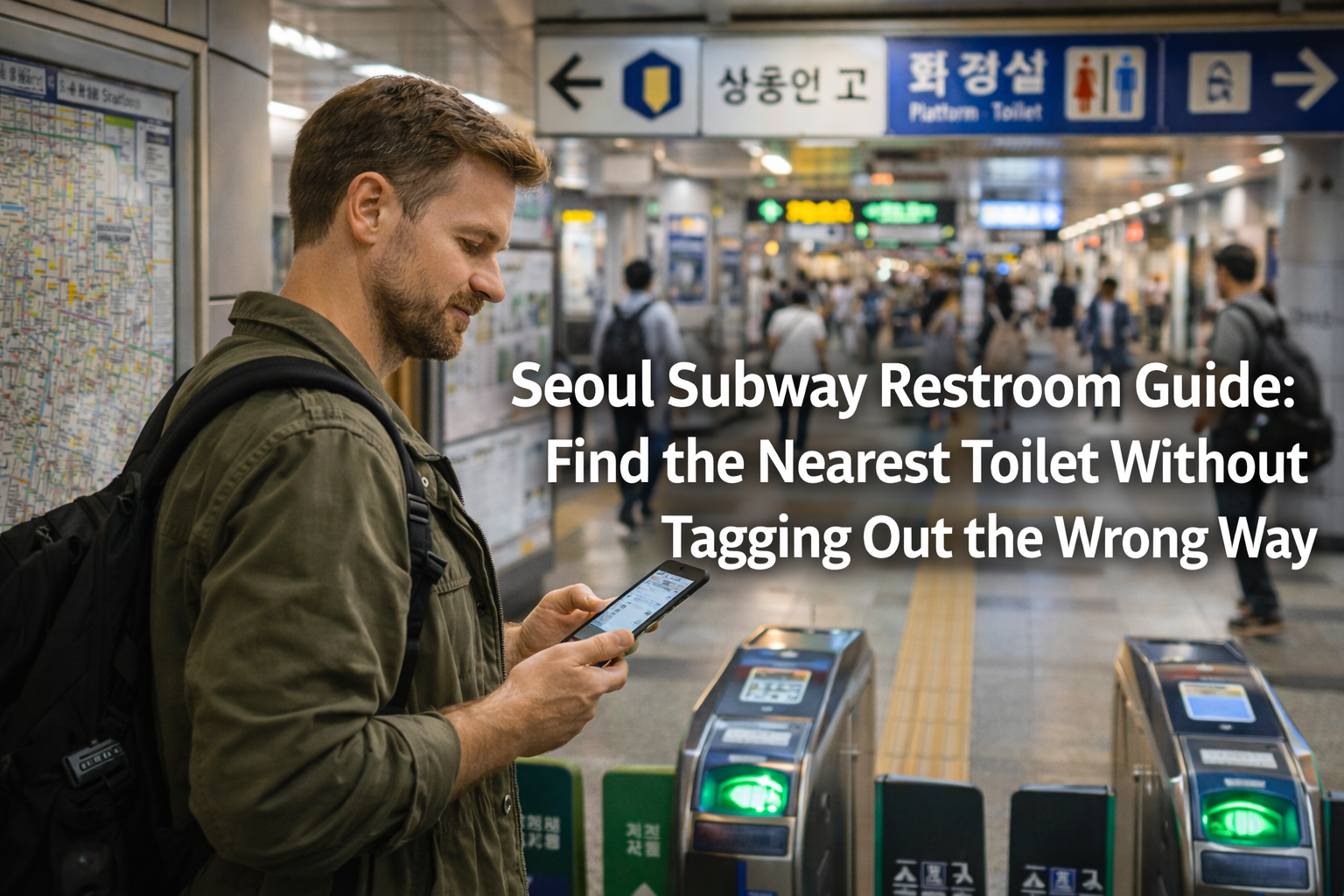
If you have ever been on the Seoul Subway and suddenly needed a restroom, you already know the problem. Many subway station restrooms in Seoul are not placed in the most obvious location. Some are inside the paid area. Some are outside the gate. And when you are in a hurry, the last thing you want is to make a mistake, leave the gate, and accidentally pay again.
I have had this exact panic moment while navigating busy transfer stations in Seoul. The good news is that there is a smarter way to handle it. If you understand how the 15-minute re-entry rule works and how to check for inside-gate toilets first, you can solve the problem like a local and avoid unnecessary stress.
This guide explains how to find the nearest restroom in the Seoul Subway system, when you can leave the gate without losing your fare flow, and what mistakes to avoid when you are in a real rush.
💡 1) Key Criteria: 5 Things to Check Before You Run for the Restroom
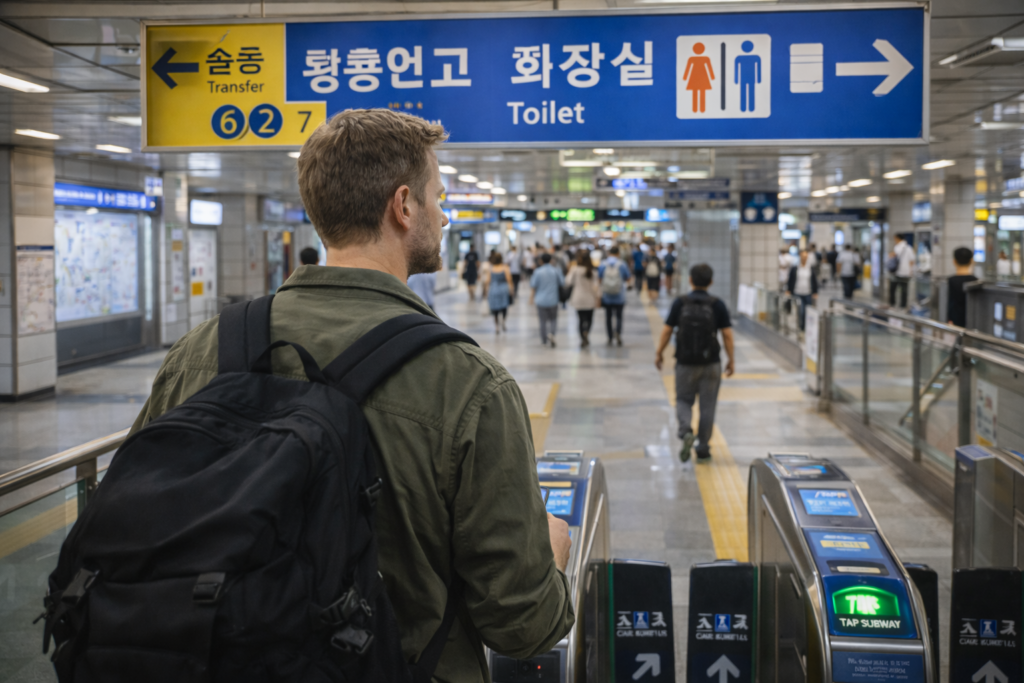
1. Is there an inside-gate restroom at your current station?
This is the first thing locals try to figure out. Some Seoul subway stations have toilets inside the gate, which means you do not need to exit the paid area at all. Seoul’s official Ttota Subway app includes facility information and can help you check whether a station has an inside-gate restroom.
2. If the restroom is outside the gate, can you use the 15-minute re-entry rule?
Yes, in many cases. Seoul officially allows riders to tag out and re-enter the same station within 15 minutes without paying the base fare again, as long as the trip qualifies under the transfer-style rule. This policy was introduced specifically for real-life cases such as urgent restroom use, missing your stop, or boarding the wrong direction.
3. Are you using a transit card or a single-use ticket?
This matters a lot. The re-entry benefit applies to riders using a transportation card, such as prepaid or postpaid transit cards. Official guidance says it does not apply to single-use tickets or commuter passes.
4. Are you re-entering the correct place?
The safest approach is to return through the same station. Seoul’s official policy describes re-entry at the same station after tagging out, and Korean guidance commonly emphasizes matching the station and line conditions correctly so the transfer logic works as intended.
5. Can you solve it faster by staying in the paid area and riding one more stop?
This is an underrated strategy. If the nearest restroom is hard to reach within the time limit, it may actually be smarter to continue to a station with an inside-gate restroom instead of exiting immediately.
My personal rule in Seoul is simple: first check if the current station has an inside-gate restroom, and only then think about tagging out.
For this section, a strong authority link is the official Seoul city explainer on the policy: Seoul Subway 15-minute turnstile re-entry policy.
📊 2) Best Ways to Find the Nearest Restroom Without Tagging Out the Wrong Way
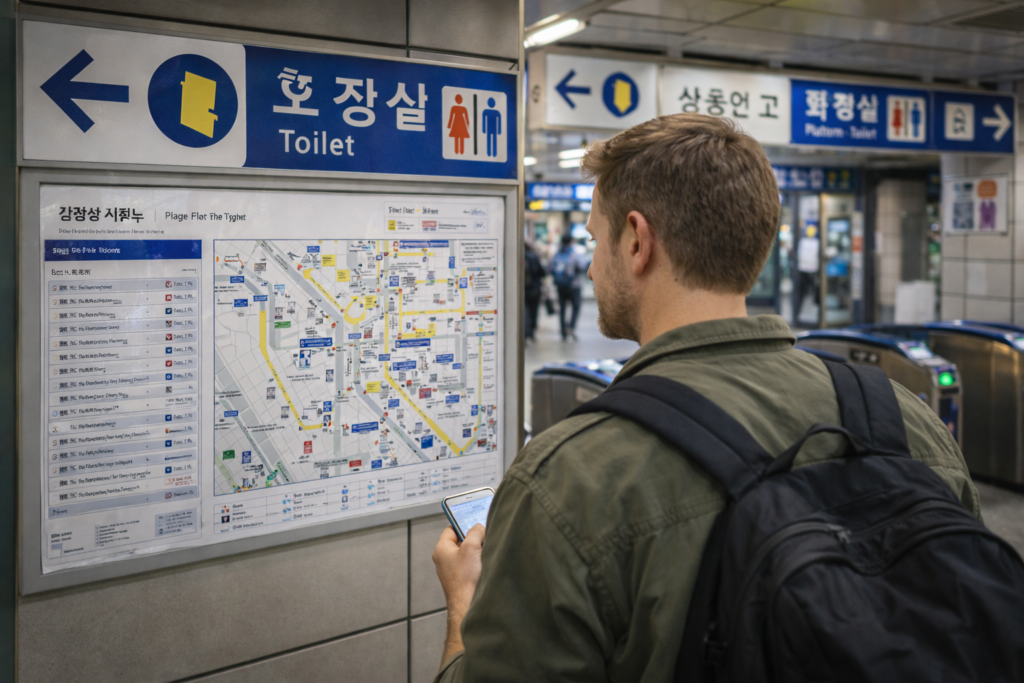
Option 1: Use an inside-gate restroom
This is the best-case scenario. It is the fastest, safest, and most traveler-friendly option. If your station has a restroom inside the fare gate, you do not need to worry about timing, re-entry, or line rules. Seoul’s official app highlights this exact type of facility information.
Option 2: Tag out and return within 15 minutes
If the restroom is outside the paid area, this is usually the most practical fallback. Seoul’s subway re-entry policy allows you to exit and re-enter without another base fare if you come back within 15 minutes under the official conditions. For urgent restroom situations, this is the local trick many riders rely on now.
Option 3: Ride to the next station with an inside-gate restroom
This sounds counterintuitive, but sometimes it is smarter. If you are at a station with only outside-gate facilities and confusing transfers, riding one stop farther can actually save time.
Option 4: Ask staff to point you to the nearest restroom
At larger stations, signage is not always enough when you are in a rush. Station staff can often direct you quickly, especially at transfer-heavy stations. This is not a formal “emergency toilet” program, but in practice it is one of the fastest local solutions when your phone is dead or the station layout is confusing.
Option 5: Avoid the mistake of tagging out too casually
The biggest risk is assuming any exit and re-entry will work. The official re-entry system has conditions. It is not a general free-exit pass for sightseeing, shopping, or long breaks. It is a limited transfer-style exception for short interruptions.
At busy Seoul stations, “nearest restroom” does not always mean “closest on the map.” It often means “the one you can reach without breaking your fare flow.”
If I am carrying luggage, I prefer an inside-gate restroom even if it means riding one extra stop. The reduced stress is worth it.
A useful second authority link in this section is the official Seoul article about the app’s convenience features: how to check inside-gate restrooms with the Ttota Subway app.
📌 3) Practical Local Strategies That Actually Work
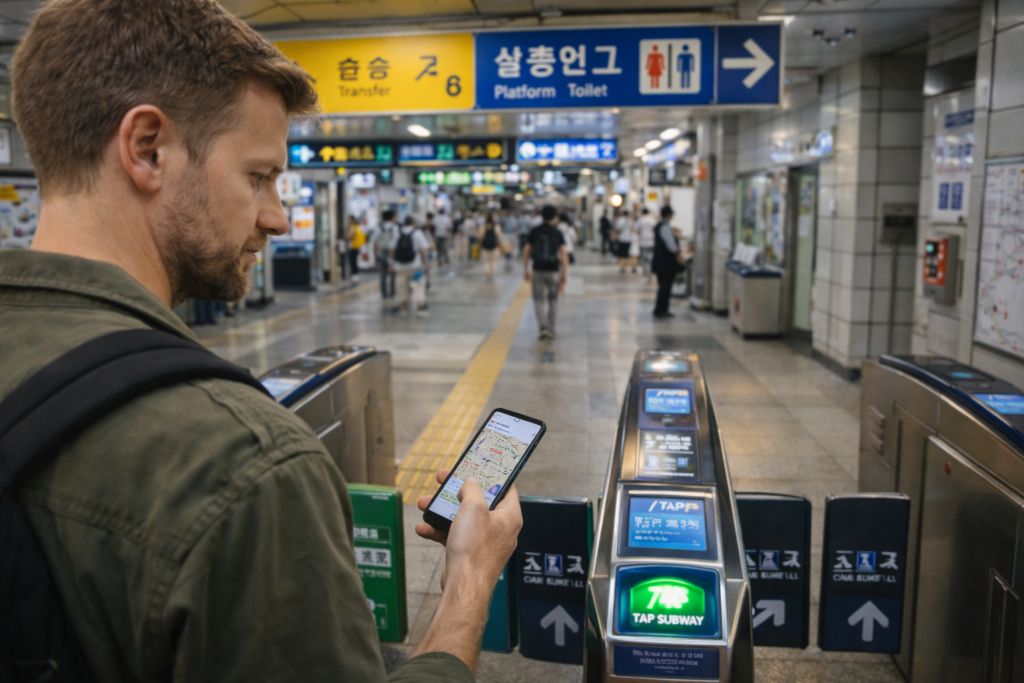
Check before you need it
If you know you have a long ride ahead, check the station layout or the app before the problem becomes urgent. This is especially helpful on long transfer chains or late-night rides.
Use the app for gate-inside restrooms first
The official Seoul Metro-linked app is not just for train times. It also helps you find station facilities, including whether toilets are located inside the gate. That single detail can save you both money and panic.
Use a transit card, not a single-use ticket
If you are a traveler in Seoul for more than a day, using a rechargeable transit card is smarter in general. It also matters here because the 15-minute re-entry rule depends on card-based tap-in and tap-out logic.
Watch the clock carefully
Fifteen minutes sounds generous, but large transfer stations can eat up time quickly. If the restroom is far from the gate, do not walk slowly. This is one reason many riders prefer inside-gate toilets when available.
Do not assume the rule works multiple times in one trip
Official guidance says the re-entry benefit is applied once during a subway trip. So use it when you really need it.
My best Seoul subway habit is choosing a restroom stop before I get desperate. It sounds small, but it makes long cross-city rides much easier.
📋 4) Quick Comparison Table
| Method | Best For | Pros | Cons |
|---|---|---|---|
| Inside-gate restroom | Fastest and simplest option | No need to exit, no fare confusion | Not available at every station |
| 15-minute tag-out and re-entry | Urgent restroom outside the gate | Avoids extra base fare if conditions are met | Time-limited and card-only |
| Ride to next station | When current station layout is inconvenient | May be easier than exiting and re-entering | Not ideal in a true emergency |
| Ask station staff | Confusing stations or dead phone | Human help can be fastest | Not always immediate during busy times |
💰 5) Time, Money, and Stress Analysis
Let’s look at the real benefit of doing this correctly.
- If you accidentally tag out for a restroom and re-enter under the official rule, you avoid paying another base subway fare.
- If you use an inside-gate restroom, you save even more time because you skip the whole exit-and-return process.
- If you use the official app to check restroom placement first, you reduce the chance of wrong turns inside a large transfer station.
Now think about this from a traveler’s perspective. One mistake at a busy station can cost you extra minutes, extra walking, and sometimes an unnecessary second fare if you do not meet the re-entry conditions. But with the right method, the cost can drop to almost zero.
The smartest subway restroom strategy in Seoul is simple: check for an inside-gate toilet first, use the 15-minute re-entry option only when needed, and always travel with a transit card.
✅ Final Thoughts
There is no separate official subway feature literally called an “Emergency Toilet” system. What locals actually use is a combination of two things: inside-gate restroom information and Seoul’s 15-minute re-entry rule for short urgent exits. That is the real trick.
If you understand that, you can handle Seoul Subway restrooms much more smoothly than most first-time visitors. In practice, the best move is not always to run outside. Sometimes the better move is to stay inside the paid area and head for the right station.
That is how you use Seoul Subway restrooms like a local: not by guessing, but by knowing which option protects your time, your route, and your fare.
❓ FAQ
Can I use the restroom in Seoul Subway without paying again?
Yes, often. If you exit and re-enter the same station within 15 minutes under the official conditions, Seoul applies the re-entry benefit so you do not pay the base fare again.
Does the 15-minute rule work with single-use subway tickets?
No. Official guidance says the re-entry policy applies to prepaid or postpaid transportation cards, not single-use tickets or commuter passes.
How can I find out whether a station has a restroom inside the gate?
The official Ttota Subway app includes facility information and can help you identify stations with inside-gate restrooms.
Can I leave one station and re-enter at another station for the restroom rule?
The official policy is framed around tagging out and re-entering at the same station within the time limit. Do not assume different-station re-entry will qualify.
What is the safest strategy for travelers?
Use a transit card, check for an inside-gate toilet first, and treat the 15-minute re-entry rule as your backup plan.