

If your foreign credit card appears to have been charged twice in Korea, don’t rush to dispute both transactions. First, check whether the two entries are completed charges or whether one is still a pending authorization.
A Korean store, restaurant, hotel, or ticketing website may trigger a payment notification before the transaction is fully processed. An unsuccessful or repeated payment attempt can sometimes leave a temporary authorization alongside a completed charge. In other cases, the same purchase really has been processed twice.
Quick answer: Check whether each transaction is pending or posted, save your receipt, and ask the Korean merchant to investigate. If two separate charges have posted for one purchase and the merchant cannot resolve the problem, contact the bank that issued your card about a duplicate-transaction dispute.
Here is how to identify the problem, request a correction in Korea, and protect your right to dispute an incorrect charge after returning home.
First, Check Whether You Were Actually Charged Twice
Two payment notifications do not always mean two completed charges. The first step is to distinguish a pending authorization from a posted transaction.
According to Capital One’s explanation of pending transactions, an authorization can temporarily reduce your available credit before a merchant finishes processing the payment. The pending amount may later change, post, or disappear.
| What Your Banking App Shows | Possible Explanation | What to Do |
|---|---|---|
| One posted charge and one pending charge | The pending entry may be a temporary authorization. | Confirm the merchant’s records and monitor the pending entry. |
| Two posted charges for one purchase | The purchase may have been processed twice. | Ask the merchant to investigate and correct the duplicate. |
| Two pending transactions | Repeated payment attempts may have created separate authorizations. | Stop retrying and verify whether a purchase succeeded. |
| An unfamiliar charge you did not authorize | This may be unauthorized card use rather than a duplicate payment. | Contact your card issuer’s fraud team immediately. |
Example: Two KRW 45,000 Entries After One Meal
Suppose you pay KRW 45,000 at a restaurant in Seoul. Your banking app displays one completed KRW 45,000 charge and another KRW 45,000 entry marked pending.
That does not necessarily mean the restaurant has collected KRW 90,000. One entry may be an authorization that will eventually disappear.
However, if both entries become separate completed charges for the same meal, you have a stronger reason to investigate duplicate processing.
Compare the merchant name, original Korean-won amount, transaction date, and payment status. Exchange-rate differences in your home currency alone do not establish that you were charged twice.
Important: A pending entry is not proof of an extra payment, but it should not be ignored indefinitely. Check the time frame supplied by your card issuer and follow up if the transaction remains unresolved.
Step 1: Save Your Receipt and Both Transaction Records
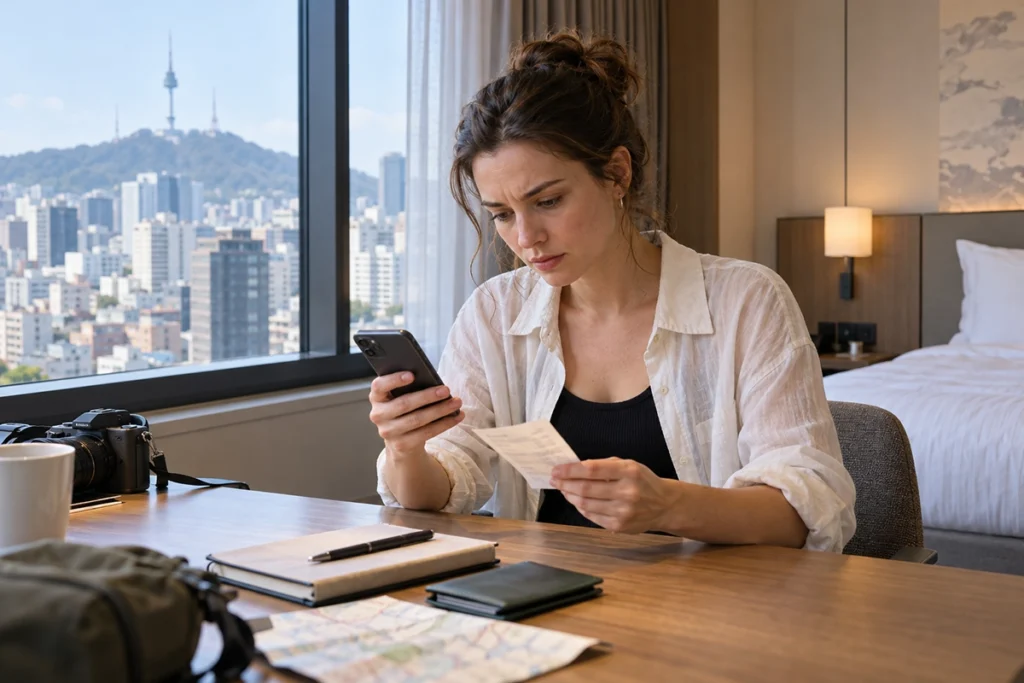
Before contacting the Korean store or your card issuer, gather the details needed to identify the payment.
- The Korean merchant’s name and location
- The date and approximate time of the purchase
- The original amount charged in Korean won
- Screenshots showing both transactions and their payment statuses
- The original receipt, if available
- The last four digits of the card used
- Any transaction reference or authorization number available
If you paid through a booking or ticketing website, also save the order number, reservation confirmation, payment confirmation email, and order history.
A pending card authorization does not necessarily prove that the merchant created a valid booking or ticket.
Keep your card information secure. You do not need to give a shop employee your full card number, security code, online banking password, or one-time verification code.
When contacting your issuer, use its official banking app, website, or verified support channel rather than a phone number received in an unexpected message.
Step 2: Ask the Korean Merchant to Check and Cancel the Duplicate
If you are still close to the original store, restaurant, or hotel, returning to the payment counter may be the simplest first step.
Explain that you made one purchase but your foreign card shows two entries. Ask the employee to check the store’s transaction records and payment terminal.
Do not immediately insist that one transaction be canceled if the merchant can identify only one completed payment. In that situation, ask your card issuer to investigate whether the other entry is a pending authorization.
Useful Korean Phrases for a Duplicate Card Charge
You can show these sentences to the cashier on your phone.
카드가 두 번 결제된 것 같아요.
I think my card was charged twice.
한 번만 구매했는데 결제 내역이 두 개 있어요.
I made only one purchase, but there are two payment entries.
중복 결제인지 확인해 주실 수 있나요?
Could you check whether this was a duplicate payment?
중복 결제라면 한 건 취소해 주세요.
If the payment was processed twice, please cancel the extra transaction.
취소 영수증을 받을 수 있을까요?
Could I get a cancellation receipt?
The Korean term 결제 취소 means payment cancellation. You may also hear 승인 취소, which refers to canceling a payment authorization.
What Should the Store Do If It Finds Two Payments?
If the merchant confirms that the same purchase was processed twice, request a correction of the extra transaction.
Visa’s official merchant dispute guidelines identify duplicate processing as a payment dispute category and advise merchants to reverse duplicate transactions.
Ask the business to provide a cancellation receipt or written confirmation showing the amount and cancellation date.
Where supported, the correction should be processed through the original payment method. A merchant refund, a reversal of a pending authorization, and a card issuer’s dispute process are not necessarily the same operation.
Do not assume the cancellation will immediately appear in your foreign banking app. The posting and reversal process depends on the merchant’s payment processor and your card issuer.
Step 3: Contact Your Foreign Card Issuer If the Store Cannot Resolve It
You do not have to remain in South Korea to investigate a duplicate payment.
If you have already returned home, contact the merchant through an official customer-service channel where practical. Save any reply or cancellation confirmation.
If the merchant cannot find the payment, refuses to correct a confirmed duplicate, or does not respond, contact your card issuer promptly.
Visa advises cardholders to contact the bank or financial institution that issued their card when disputing a transaction. You can check the guidance on Visa Consumer Support.
Tell your issuer that you authorized one purchase at a merchant in South Korea, but your account may show two charges for that single purchase.
Message You Can Send to Your Card Issuer
I made one purchase at a merchant in South Korea, but my account shows two transactions for the same payment. Please confirm whether both charges have posted or whether one is still a pending authorization.
I can provide the purchase receipt, screenshots, transaction dates, and the merchant’s response. If both charges were processed, please advise me how to dispute the duplicate transaction.
If the Korean merchant has already canceled one transaction, tell the issuer and provide the cancellation confirmation.
The issuer may be able to trace the credit or explain whether you should wait for the cancellation to appear before submitting a formal dispute.
Avoid seeking two separate refunds for the same overpayment without informing the parties involved.
Step 4: File a Duplicate Transaction Dispute When Appropriate
If two completed charges appear for one authorized purchase and the extra payment remains unresolved, your issuer may allow a formal transaction dispute, sometimes called a chargeback.
This differs from requesting an ordinary refund from a Korean merchant.
In a payment dispute, the issuing bank reviews the case and may request evidence through the card payment network.
Visa’s official explanation of chargebacks describes duplicate processing as one possible reason for a payment dispute.
What Evidence Should You Submit?
- The original purchase receipt or booking confirmation
- Both transaction records, including their completed statuses
- Evidence that only one purchase or reservation was made
- Relevant messages exchanged with the merchant
- A payment cancellation receipt, if one was issued
- The date and details of your attempts to resolve the problem
Explain that you authorized one purchase but believe it was processed twice.
Do not report an ordinary merchant processing error as unauthorized card fraud. If you genuinely did not recognize or authorize a transaction, contact the issuer using its fraud-reporting procedure instead.
How Long Do You Have to Dispute a Duplicate Charge?
There is no single dispute deadline that applies to every foreign-issued credit or debit card.
The applicable procedure depends on the card issuer, card network, country of issuance, payment type, and consumer protection rules.
For example, the U.S. Consumer Financial Protection Bureau explains that, under applicable U.S. credit-card billing-error protections, consumers generally need to send a written notice within 60 days after the statement containing the error was sent.
Calling customer service or submitting an online inquiry may not replace the written notice needed to preserve those particular legal rights.
See the CFPB’s official billing-error guidance for the U.S. procedure.
The U.S. 60-day rule is not a universal deadline. Cards issued in the United Kingdom, Australia, Canada, Singapore, or other countries may be subject to different procedures and deadlines.
Contact your own issuing bank promptly. Ask whether a written dispute is required, where it must be submitted, and what deadline applies. Do not allow the deadline to expire while waiting for the Korean merchant.
What If the Duplicate Charge Is Still Pending?
If one entry is posted and the other remains pending, ask the merchant whether it completed only one payment.
A pending authorization may disappear without a separate refund transaction. However, it can temporarily reduce your available credit or affect the funds available in a debit-card account.
Capital One explains that pending transactions commonly post within several days, although the timing varies. Its guidance also distinguishes pending transactions from completed charges that can enter the normal dispute process.
Do not treat that timing as a guarantee for your own card or a Korean merchant. Your issuer can explain the expected authorization period for your transaction.
If the hold is causing an immediate problem, contact your issuer and ask whether the merchant can submit an authorization reversal or whether another investigation is possible.
If the entry remains pending beyond the period specified by your issuer, follow up with the original transaction reference.
Be Especially Careful After a Failed Korean Online Payment
Duplicate-looking transactions can also occur when a traveler retries a payment on a Korean booking or ticketing website.
For example, the website might display an error after your bank has authorized a payment. Submitting the same payment again before checking the booking status could create another authorization or even a second purchase.
Before retrying, follow these steps:
- Check the website’s order or reservation history.
- Look for a confirmed booking number and confirmation email.
- Review the pending and completed entries in your banking app.
- Contact the booking platform if the reservation and payment statuses do not match.
- Only attempt another payment after confirming what happened to the earlier transaction.
If the problem happened while buying an event ticket, our guide to foreign credit card payments failing on Korean ticketing websites explains booking verification, card authentication, and when to stop retrying.
If your card is being declined at multiple Korean shops rather than charged twice, see our separate guide to fixing a credit card that is not working in Korea.
Where to Get Help in Korea If You Cannot Explain the Problem
If a language barrier prevents you from communicating with a Korean merchant, you can contact the Korea Tourism Organization’s 1330 Korea Travel Helpline.
The service provides multilingual tourism information and interpretation assistance, including English-language support.
- From within South Korea: 1330
- From overseas: +82-2-1330
- Online support: Check the official website for available chat and calling options
Visit the official VISITKOREA 1330 Travel Helpline page for current contact methods.
Can You File a Tourist Complaint About a Payment Problem?
The Korea Tourism Organization also operates a Tourist Complaint Center.
It accepts certain complaints involving tourism-related businesses, facilities, and services. A dispute involving a Korean tourism business may fall within its scope, depending on the circumstances.
However, not every payment dispute is eligible. Complaints involving foreign companies, certain private disputes, or matters already under legal proceedings may be excluded.
The center cannot directly remove a card authorization, force a foreign issuing bank to approve a chargeback, or guarantee that a refund will be issued.
For the actual card transaction, your merchant and issuing bank remain the primary contacts.
Frequently Asked Questions
Do I Need a Korean Bank Account to Receive a Duplicate Card-Payment Refund?
Usually not when the merchant can reverse or refund the payment to the original foreign-issued card.
The exact process depends on the payment system and card issuer. Ask the merchant to correct the transaction through the original payment method where supported, rather than assuming you need a Korean bank account.
Can I Dispute a Duplicate Charge After Leaving South Korea?
Yes. Being outside Korea does not, by itself, prevent you from asking your issuing bank to investigate a duplicate payment.
Keep the receipt, transaction records, and merchant correspondence. Contact the issuer before the applicable dispute deadline and follow its documentation requirements.
What If the Store Gives Me a Cancellation Receipt but the Charge Still Appears?
A payment cancellation may take time to appear in your card account, and the banking app may show a separate credit rather than deleting the original transaction.
Keep the cancellation receipt and check the posting time with your issuer. If the credit does not appear within the period provided by the bank, ask it to trace the cancellation using the merchant’s confirmation details.
What If the Merchant Says It Charged My Card Only Once?
Ask whether the merchant can confirm the transaction amount, date, and payment reference.
If the merchant records show one completed payment but your account shows two entries, contact your card issuer to determine whether one entry is a pending authorization or a separate completed charge.
Do not assume that either the merchant or the bank has made an error until the transaction statuses are verified.
Final Checklist: What to Remember Before Paying Again
Seeing two transactions from a Korean merchant does not automatically mean you have paid twice.
Before taking further action, confirm these points:
- Are both entries posted, or is one still pending?
- Do the merchant names, dates, and original KRW amounts match?
- Did you receive confirmation of only one purchase?
- Has the Korean merchant checked its transaction records?
- If a cancellation was issued, do you have proof?
- Have you contacted your issuer about an unresolved duplicate?
- Do you know the applicable dispute deadline?
If both payments were completed for one purchase, request a documented correction from the merchant and involve your issuing bank when necessary.
If one entry is only pending, confirm what happened and monitor its status rather than assuming the money has been collected twice.
The most useful precautions are to keep the purchase receipt, verify the transaction status, and avoid submitting another payment until you know whether the first attempt succeeded.
Last checked: October 9, 2026. Payment authorization periods, refunds, chargeback eligibility, consumer protection rules, and dispute deadlines vary by card issuer, network, payment type, and country of issuance. Always confirm the procedure for your own card.