

Last checked: August 2, 2026. Washing machine controls, payment systems and detergent setups vary by laundromat and machine model, so follow the instructions posted at the location when they differ from this guide.
Korean washing machine buttons can look intimidating when you are standing in a self-service laundromat with no staff nearby. The useful part is that you do not need to translate every word on the panel to understand the basic workflow.
Common terms include 세탁기 for washing machine, 건조기 for dryer, 표준 for a standard or normal cycle, 헹굼 for rinse, 탈수 for spin and 시작 or 동작/일시정지 for start or start/pause. Exact wording and available cycles still vary by machine.
Quick answer: First check the clothing care label, then identify whether the machine is a washer or dryer, confirm the machine number and payment method, and check whether detergent is automatically included. If a normal wash is suitable for your clothes, 표준 usually means a standard cycle. Follow the order shown on the specific machine or payment kiosk rather than assuming every laundromat works the same way.
Why Korean Coin Laundries Can Feel Confusing
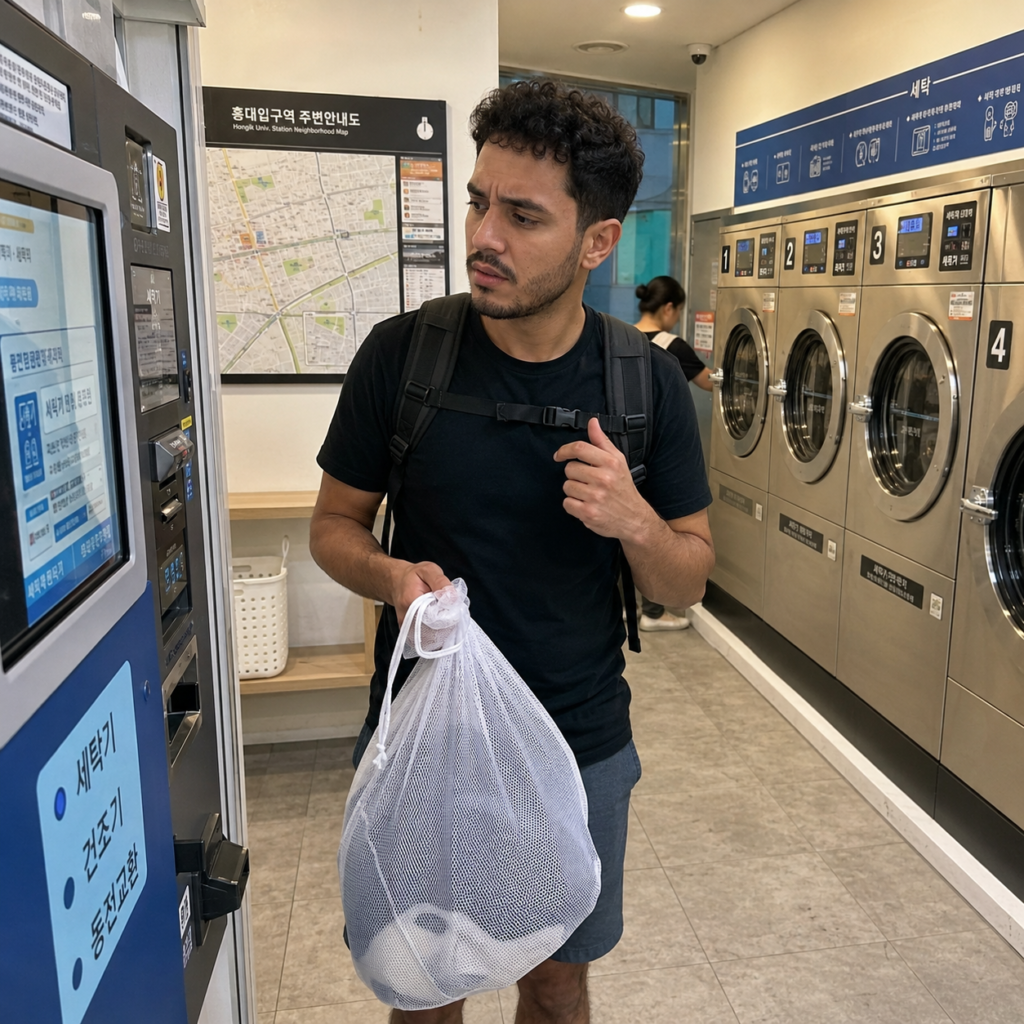
A self-service laundromat in Korea may use a combination of numbered machines, separate washers and dryers, wall instructions and payment terminals. Some locations place most controls on the washer or dryer itself, while others ask you to select a machine through a central kiosk.
The term “coin laundry” also does not guarantee that every machine literally uses coins. The accepted payment method depends on the shop and terminal, so check the payment screen before loading your clothes.
If you are searching for a laundromat nearby, try Korean search terms such as 셀프빨래방 or 코인빨래방 in a local map app. Our Naver Map vs KakaoMap guide explains how to compare Korean place names, locations and current business listings.
Essential Korean Washing Machine Buttons
The table below covers common Korean terms rather than one universal washing-machine layout. Exact cycles and icons vary by model.
| Korean | Meaning | What Travelers Should Know |
|---|---|---|
| 세탁기 | Washing machine | Useful when choosing between a washer and dryer at a kiosk |
| 건조기 | Dryer | Use only for clothing whose care label allows machine drying |
| 표준 | Standard / normal | A common general cycle; check the garment label before using it |
| 쾌속 | Quick / express | Usually a shorter cycle; the intended load varies by machine |
| 강력 | Strong / intensive | A stronger setting; check the machine description before selecting it |
| 헹굼 | Rinse | Used for rinse settings or an additional rinse function |
| 탈수 | Spin | Removes water by spinning rather than drying with heat |
| 냉수 / 찬물 | Cold water | A water-temperature option when the machine allows temperature selection |
| 온수 | Warm / hot water | Check the displayed temperature and the clothing care label before selecting it |
| 시작 | Start | Starts the selected operation on machines using this label |
| 동작/일시정지 | Start / pause | A common combined start-pause button |
| 문잠김 | Door locked | Do not force the door open while the lock is active |
Samsung’s current Korean washer page, for example, uses labels including 표준세탁, 쾌속세탁, 헹굼+탈수, 탈수단독, 세탁온도, 시작/일시정지 and 문잠김. This does not mean every commercial laundromat uses the same control panel.
You can also review Samsung’s official washing-machine symbol guide, which notes that icons and controls vary by model.
Check the Clothing Care Label Before the Machine
The Korean button is only one part of the decision. The care label inside your clothing should determine whether an item can be machine washed, what water temperature is suitable and whether tumble drying is allowed.
Samsung’s official support guidance explains that the wash-tub symbol on a clothing label provides washing and temperature guidance, while the square symbol relates to drying methods. A circle generally indicates professional cleaning or dry-cleaning instructions.
Do not put an item into a coin-laundry washer or dryer simply because a “normal” or “low heat” setting is available. Separate or avoid machine washing and drying for items whose labels require special care.
Before You Put Clothes in the Machine
1. Check Whether It Is a Washer or Dryer
Look for 세탁기 for the washer and 건조기 for the dryer. At some locations, washers and dryers may look similar from a distance, especially when they are stacked or arranged in the same row.
2. Check the Machine Number
If the laundromat uses a central kiosk, note the machine number before paying. Machines may be identified with numbers or letters, and selecting the wrong one can send your payment to a different washer or dryer.
Taking a quick photo of the machine number before walking to the kiosk is an easy way to avoid confusion.
3. Confirm the Payment Method
Check the payment terminal before loading your clothes. The accepted method can vary by laundromat, and an overseas-issued card may not work on every unattended terminal even if the same card works elsewhere in Korea.
If a payment terminal rejects your card, avoid repeating the same attempt many times. Try another clearly accepted method and read our guide on what to do if your credit card does not work in Korea if the problem continues.
4. Check Whether Detergent Is Included
Look for 세제, which means detergent, and 섬유유연제, which means fabric softener.
If a sign clearly says 세제 자동 투입, it means the system automatically dispenses detergent. Automatic dispensing is a real feature used in Korean washing machines, but the amount and operation vary by model.
Do not add extra detergent simply because you cannot see detergent entering the drum. Follow the laundromat’s posted instructions. If the shop tells you to add your own detergent, use the specified compartment or method rather than guessing.
LG’s official automatic-detergent guide is one example of how automatic detergent and fabric-softener settings can vary by machine and cycle.
How to Use a Korean Coin Laundry Washer
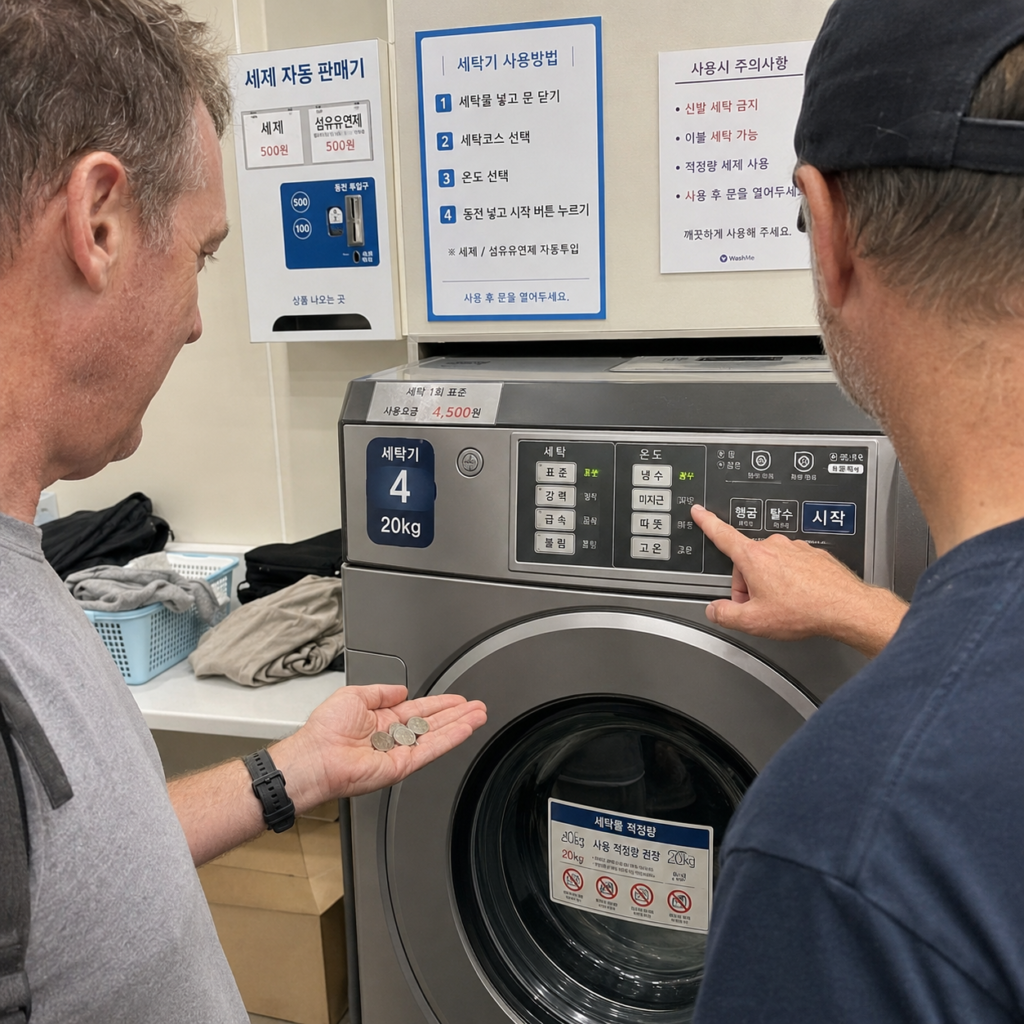
The exact order depends on the laundromat, so use the steps below as a checklist rather than a universal button sequence.
- Check the clothing care labels and remove items that should not be machine washed.
- Choose an available machine marked 세탁기.
- Check the machine number and the maximum load information.
- Confirm the payment method and whether detergent is automatically included.
- Put the washable clothes inside and close the door fully.
- Follow the kiosk or machine instructions for selecting the machine and cycle.
- If a normal wash is appropriate, 표준 usually means the standard cycle.
- If a water-temperature option is shown, follow the garment care label rather than choosing a temperature only by habit.
- Complete payment in the order requested by that system.
- Press 시작 or 동작/일시정지 if the machine requires a separate start command.
If the washer does not start, first look at the screen rather than repeatedly pressing buttons. Check whether the door is fully closed, whether payment was completed for the correct machine and whether the display is showing an instruction or error code.
Practical tip: Set a phone timer close to the displayed finishing time. Removing your clothes soon after the cycle ends avoids leaving a finished machine occupied while other customers are waiting.
How to Use the Dryer Without Damaging Clothes
Before using a dryer, check the clothing care label to confirm that tumble drying is allowed. A lower dryer temperature is not a substitute for a label that says the item should not be tumble dried.
| Korean | Meaning |
|---|---|
| 고온 | High temperature |
| 중온 | Medium temperature |
| 저온 | Low temperature |
| 시간 | Time |
| 추가 | Add / additional |
| 필터 | Filter |
If machine drying is allowed but you are unsure about the amount of heat an item can tolerate, avoid automatically selecting the highest setting. Follow the care label and the machine’s own temperature description.
Some laundromats sell drying time in separate increments. If so, check how much time you are purchasing before payment. Thick areas such as waistbands, pockets and seams can remain damp even when the outside of a garment feels dry.
If the display asks you to check a filter, follow the instructions on that specific dryer. Do not remove covers or parts that are not clearly intended for customer access.
What Does 문잠김 Mean?
문잠김 means the door is locked. It commonly appears while a washing cycle is running or while the machine considers the door unsafe to open.
Do not pull harder on the door. Samsung’s official support information explains that a padlock or key icon can indicate that the door is locked during a cycle or while opening the machine would be unsafe.
If the cycle appears finished but the door remains locked, wait and follow the instructions shown on that machine. Unlock timing and procedures can differ by model.
Common Error and Status Words
| Korean | Meaning |
|---|---|
| 에러 | Error |
| 확인 | Check / confirm |
| 문 | Door |
| 결제 | Payment |
| 고장 | Malfunction / out of order |
| 사용중 | In use |
| 사용금지 | Do not use |
Do not assume that the Korean word alone tells you the exact cause of a problem. Modern washing machines can display model-specific letters, numbers and error codes.
If the problem continues, photograph the full display and machine number. Look for a contact number or help information near the entrance or payment terminal.
A short translated message can be useful when requesting help. For example: “Machine 5 shows an error after payment.”
Useful Korean Phrases at a Laundromat
| Korean | English |
|---|---|
| 세탁기 어디에 있어요? | Where is the washing machine? |
| 건조기 사용할 수 있어요? | Can I use the dryer? |
| 세제 포함인가요? | Is detergent included? |
| 카드 결제 돼요? | Can I pay by card? |
| 동전 교환기 있어요? | Is there a coin changer? |
| 몇 번 세탁기예요? | Which washing machine number is it? |
| 결제했는데 작동하지 않아요. | I paid, but the machine is not working. |
If you need help, showing a photo of the machine number and display can be more useful than trying to describe the appliance from memory.
When a Coin Laundry May Not Be the Best Option
A self-service laundromat is convenient for clothing that the care label allows you to machine wash and dry. It is not automatically appropriate for every item in your suitcase.
For garments that require professional cleaning or special handling, look for 세탁소, a Korean term commonly used for a laundry or dry-cleaning shop. Show the garment and its care label instead of assuming that a coin-laundry cycle will be suitable.
Your accommodation may also be easier. Some Korean hotels and long-stay properties list a laundry room or coin laundromat among their facilities, but availability and fees differ by property. Check your accommodation’s current facility information before walking to another laundromat.
Coin Laundry Checklist for Travelers
- Check the clothing care label first.
- Confirm whether the machine is a washer or dryer.
- Check the exact machine number before using a central kiosk.
- Confirm the accepted payment method before loading clothes.
- Check whether detergent and fabric softener are automatically included.
- Do not assume a standard cycle is suitable for every garment.
- Do not use a dryer if the care label prohibits tumble drying.
- Photograph the full display if an error appears.
- Set a timer so you can collect the load promptly.
- Follow the instructions at that laundromat when they differ from general advice online.
Frequently Asked Questions
What does 표준 mean on a Korean washing machine?
표준 means standard or normal. It is a common washing-cycle label, but it should not be treated as the correct cycle for every garment. Check the clothing care label and the machine’s own instructions first.
Does a Korean coin laundry automatically include detergent?
Some do and some do not. Look for instructions near the washer or payment kiosk. If the shop clearly states 세제 자동 투입, detergent is automatically dispensed according to that system. Do not add extra detergent unless the posted instructions tell you to.
Can I use a foreign credit card at a Korean laundromat?
It depends on the laundromat and payment terminal. A card that works at one Korean business may still fail at a particular unattended kiosk. Check the accepted payment symbols before loading your clothes and keep another accepted payment method available.
Are Korean coin laundries open 24 hours?
Some are, but not all. Operating hours can depend on the business or the building where it is located. Check the entrance sign or a current map listing before going, especially late at night.
What should I do if the washer door says 문잠김?
문잠김 means the door is locked. Do not force it open. Wait for the machine to reach a safe point and follow the instructions on that model if the lock remains after the cycle appears to finish.
Final Takeaway
You do not need to memorize an entire Korean washing-machine panel to use a coin laundry. Start with a few useful words: 세탁기 for washer, 건조기 for dryer, 표준 for standard, 헹굼 for rinse, 탈수 for spin and 시작 or 동작/일시정지 for start.
The more important rule is to avoid treating those words as a universal laundry recipe. Check the clothing care label, confirm the machine number, payment method and detergent setup, and follow the instructions posted on the actual machine.
For drying, make sure machine drying is allowed before choosing a temperature. For payment or machine errors, photograph the display and machine number instead of repeatedly pressing buttons or forcing a locked door.
Those habits make a Korean self-service laundromat much easier to use without depending on perfect Korean or risking your clothes because of one misunderstood button.