

Last checked: August 2, 2026. Seoul transportation fares, ticket payment methods, and pass rules can change, so check the linked official sources if your trip is still several months away.
For most first-time visitors, Seoul is easiest to explore by combining the subway and buses. Start with a transportation card, install a local map app, and use taxis mainly when luggage, weather, late-night timing, or an inconvenient final walk makes public transportation less practical.
Quick answer: Use the subway for most longer trips across Seoul, buses for shorter neighborhood connections, and a taxi when door-to-door travel is worth the extra cost. For ordinary public transportation, a charged T-money card is still one of the simplest options for visitors.
Choose the Right Transportation Card or Ticket
For repeated subway and bus rides, an ordinary T-money card is a practical choice. It can be used on Seoul subways and city buses and is also accepted by participating taxis and merchants.
The price of the physical card is separate from the transportation balance, so make sure you add money before your first ride. Participating convenience stores are common places to buy and reload a physical card.
Carry Korean-won cash as a reliable backup when reloading an ordinary physical T-money card. Do not assume that an international credit card will work for a standard T-money balance at every subway machine or convenience store.
For step-by-step information about reloads, subway gates, bus taps, transfers, airport trains, refunds, and card errors, read our detailed guide to using a T-money card in Seoul.
What Changed for International Cards in 2026?
Seoul introduced international-card support at hundreds of new ticket vending machines on Subway Lines 1–8 in March 2026. At supported machines, eligible international credit or debit cards can be used for specific products including Climate Card short-term passes and single-journey subway tickets.
This is different from reloading an ordinary physical T-money balance. International-card support for a ticket machine, a transportation pass, and direct contactless payment at a subway gate are separate functions.
You can review the current rules in the Seoul Metropolitan Government announcement on international-card ticket machines.
T-money, Single-Journey Ticket, or Climate Card?
| Option | Best for | What to know |
|---|---|---|
| T-money | Most visitors making ordinary subway and bus trips | Rechargeable and flexible; keep Korean-won cash available for standard physical-card reloads |
| Single-journey ticket | One subway ride or very occasional subway use | Subway only; supported new machines can accept eligible international cards |
| Climate Card short-term pass | Visitors expecting frequent rides within eligible coverage | Compare the pass period and transport coverage with your itinerary before buying |
The Climate Card is not automatically the cheapest choice for every tourist. Check how many eligible trips you expect to make and whether your planned routes are included. Current coverage and pass rules are listed on the official Seoul Climate Card guide.
How to Use the Seoul Subway
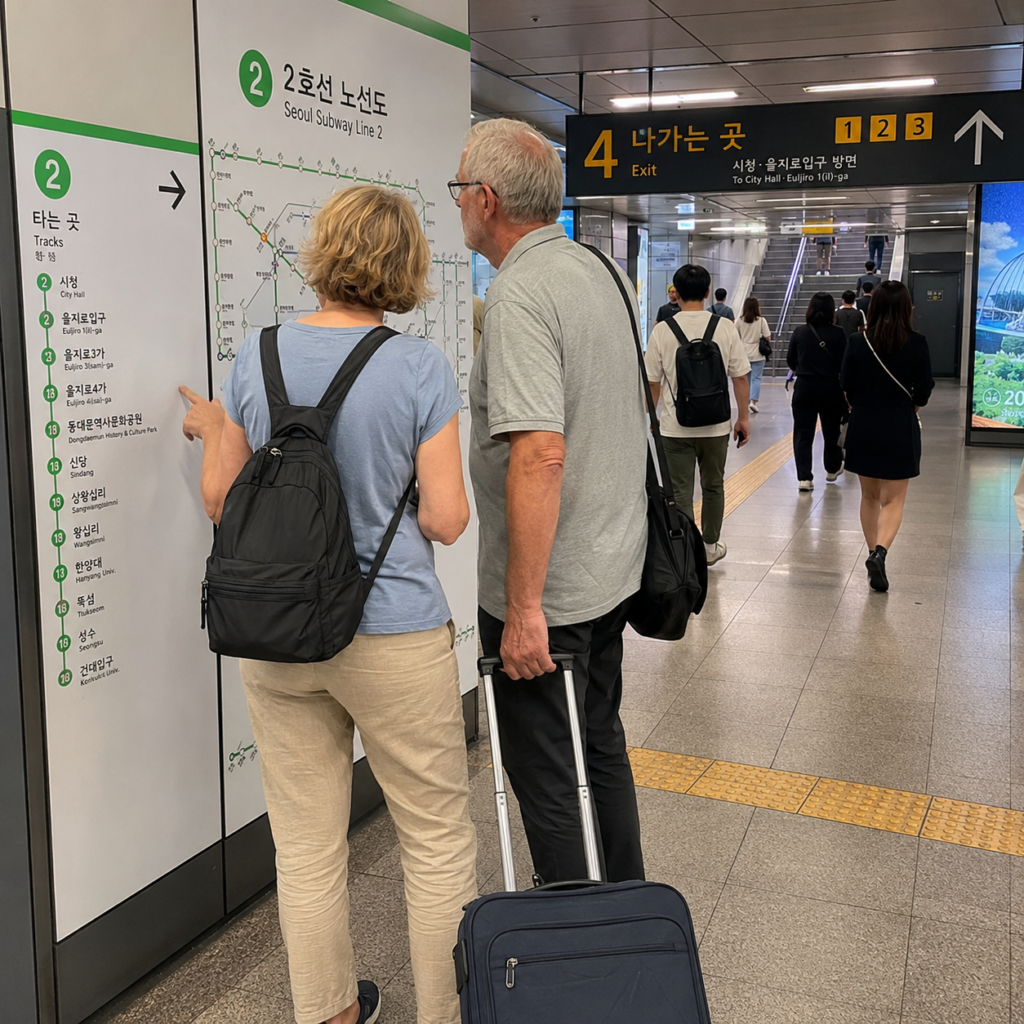
The subway is usually the easiest way to travel between major districts such as Myeongdong, Hongdae, Gangnam, Jamsil, Jongno, Dongdaemun, and Seoul Station. Station signs include Korean and English, and major transfer routes are clearly marked inside stations.
- Check the station name, line number or color, and direction before entering the gate.
- Tap your transportation card at the entrance gate or use a valid single-journey ticket.
- Follow the signs for your line and destination direction.
- For transfers, follow the signs to the connecting line without leaving the paid area unless instructed otherwise.
- At your destination, tap the same card at the exit gate.
- Before walking outside, confirm the correct exit number for your destination.
Exit numbers matter more than many first-time visitors expect. At a large interchange station, two exits from the same station can put you on opposite sides of a wide road or several minutes apart on foot.
Transfer stations can also involve long underground walks. If you are carrying large luggage, allow extra time rather than assuming a transfer shown as one stop on a map will be physically short.
Current Subway and Bus Fares
As of the Seoul Metropolitan Government fare schedule effective June 28, 2025, the adult subway base fare is KRW 1,550 with a transportation card and KRW 1,650 for a single-journey ticket. Longer journeys can cost more because additional distance charges apply.
For the latest fare table before your trip, check the official Seoul subway fare information.
Standard Seoul trunk and branch buses currently charge an adult card base fare of KRW 1,500. Rapid, night, local, and other bus types can use different fares, so the route type matters.
The current bus fare table and transfer conditions are available on the Seoul Metropolitan Government bus guide.
How Transfers Work
Seoul uses an integrated fare system for eligible bus and subway transfers. The simplest rule for visitors is to keep using the same transportation card throughout a connected journey and remember to tap when getting off a bus.
Eligible transfers generally need to begin within the official transfer window after the previous ride. A transfer does not always mean the next ride is completely free because differences in base fare and additional distance charges can still apply.
How to Use Seoul Buses
Buses are especially useful when your destination is between subway stations, on a hill, or a short distance from the nearest station. You do not need to memorize every bus color before your first ride; checking the exact route number, stop, direction, and destination is more important.
- Use a map app to confirm the correct stop and direction.
- Check that your bus number is listed at that stop.
- Move where the approaching driver can see that you intend to board.
- Board through the designated entrance and tap your transportation card.
- Press the stop bell before your destination.
- Tap the card again when getting off.
If several routes use the same stop, do not wait far inside the shelter while looking at your phone. Face the approaching bus and make your intention visible. If you have already experienced a bus passing your stop, see our guide to what to do when a Korean bus skips your stop.
The exit tap is important because it records the end of the bus journey and is used for eligible transfers and distance-based fare calculation.
Getting From Incheon Airport to Seoul
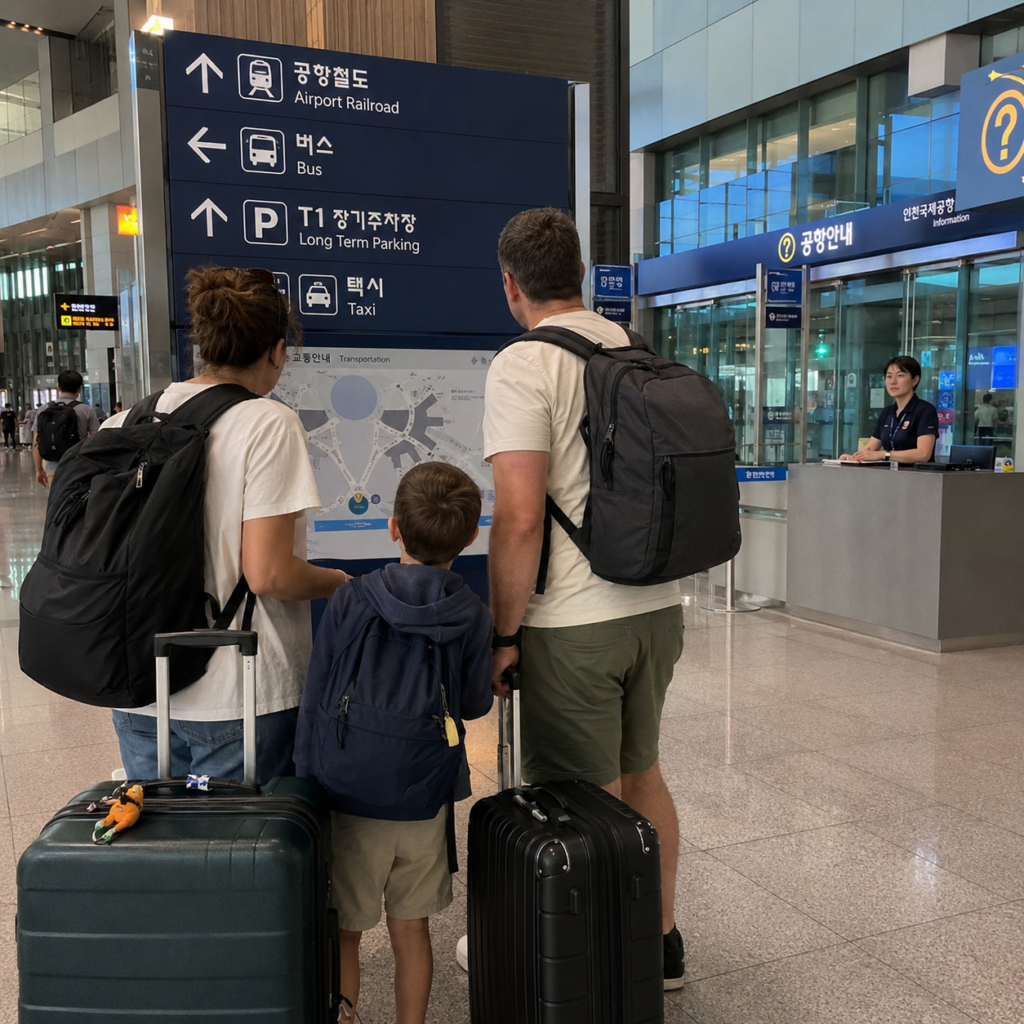
From Incheon International Airport, the most practical choices for many travelers are the Airport Railroad, an airport limousine bus, or a taxi. The best option depends more on your final destination and luggage than on finding one universally “best” method.
Airport Railroad
The AREX All-Stop Train is useful when your accommodation is convenient to stations such as Hongik University, Gongdeok, or Seoul Station. Compatible prepaid transportation cards can be used for the All-Stop Train gates.
The AREX Express Train is a different service and requires its own ticket, so do not assume that an ordinary T-money tap covers every airport rail option.
Airport Limousine Bus
An airport limousine bus can be convenient when it stops close to your hotel and you want to avoid transferring through a large station with suitcases. The trade-off is that road travel is affected by traffic.
Taxi
A taxi provides direct door-to-door transportation and can be useful for late arrivals, difficult final connections, or groups with luggage. Check the vehicle size before assuming that several passengers and large suitcases will fit comfortably.
If your group needs more luggage space than a regular sedan provides, see our guide to how to book a large taxi in Seoul.
Map Apps and Subway Exit Numbers
A local map app makes Seoul transportation much easier to understand. Naver Map and KakaoMap can help with public transportation routes, bus stops, station exits, walking directions, and transfers.
If you want to choose one before your flight, our Naver Map vs KakaoMap guide for Korea travel compares the two from a visitor’s perspective.
When searching for a hotel, restaurant, or attraction, check that the place name and address match your booking or official listing. If an English search gives an uncertain result, searching the Korean place name can help you confirm the correct location.
Before leaving a subway station, look at the exit number shown in your route. Treat the exit as part of the journey rather than something to decide after you reach street level.
When a Taxi Makes More Sense
Seoul’s subway and buses handle most sightseeing routes well, but a taxi can still be the practical option in the right situation.
- You are carrying several large bags.
- Your destination requires a long uphill walk from public transportation.
- You are traveling after the last useful subway connection.
- Heavy rain or extreme weather makes transfers inconvenient.
- A group can travel more comfortably in a suitable vehicle.
Surface traffic can make a taxi less predictable than the subway during busy periods, especially around major business districts and river crossings. Check the estimated route before deciding that a taxi will automatically be faster.
Common First-Time Mistakes
1. Assuming Every T-money Reload Accepts a Foreign Card
International-card support has improved, but the payment method depends on the product and machine. Keep Korean-won cash available for a standard physical T-money reload unless you have confirmed another supported method.
2. Confusing International-Card Ticket Purchase With Direct Gate Payment
Buying a supported ticket with an international card does not automatically mean the same card can be tapped directly at every subway gate or bus reader. Treat those as separate payment functions.
3. Forgetting to Tap When Leaving a Bus
Tap your transportation card when getting off. This records the end of the ride and is important for correct fare calculation and eligible transfers.
4. Using the Wrong Subway Exit
Check the exit number before leaving the paid area. Correcting a mistake after reaching street level can mean crossing a major intersection or walking around a large station complex.
5. Waiting Until the Last Train to Check Your Route
Seoul subway service does not operate all night, and last-train times vary by station, direction, and day. Check the return route before staying out late rather than relying on one fixed citywide closing time.
For ordinary subway travel, each passenger should use an individual transportation card so the entry and exit records match correctly. This is also the simplest arrangement when a group later transfers to buses or splits up.
A Simple Learning Strategy for Your First Few Days
On your first day, using the subway for most longer journeys can help you understand Seoul’s main districts without learning bus routes at the same time. Focus on station direction, transfer signs, and exit numbers.
Once the subway feels familiar, add buses for shorter neighborhood connections and destinations located between stations. By then, checking route numbers and stop directions in a map app should feel much easier.
After that, choose between subway, bus, and taxi based on the actual route rather than committing to one type of transportation for the entire trip. Distance, luggage, weather, walking time, and the final destination all matter.
Frequently Asked Questions
Can two people use one T-money card on the Seoul subway?
For normal subway travel, each passenger should use an individual card. Each person needs a matching entry and exit record, and separate cards also make bus-subway transfers much simpler.
Can I use a foreign Visa or Mastercard directly at Seoul subway gates?
Do not depend on direct overseas-card tapping as your only payment method across the entire Seoul system. International-card support at selected ticket machines is different from direct contactless payment at a gate or bus reader.
Can I buy subway tickets with an international credit card?
Yes, at supported new vending machines on Seoul Subway Lines 1–8, eligible international cards can be used for single-journey tickets and certain Climate Card short-term products. Availability depends on the machine and product.
Is the Climate Card better than T-money for tourists?
It depends on your itinerary. A Climate Card can be worth comparing if you expect frequent eligible rides during the pass period, while T-money is more flexible for travelers who make fewer rides or use transportation outside the pass coverage.
Does the Seoul subway run all night?
No. Last-train times vary by station, direction, line, and day, so check the specific return route in a current transit app before staying out late.
Final Takeaway
You do not need to master Seoul’s entire transportation network before your first ride. Prepare a suitable transportation card or ticket, check your route in a local map app, confirm the subway exit number, and remember to tap when leaving a bus.
The most important 2026 payment detail is to keep different systems separate: an ordinary T-money balance, a Climate Card, a single-journey ticket, and direct foreign-card payment are not the same thing. Check the relevant official information when payment rules or fares matter to your trip.