
Last checked: August 3, 2026. Pharmacy hours, language support, medicine availability, late-night schedules and public services can change. Confirm time-sensitive information before making a special trip to a pharmacy.
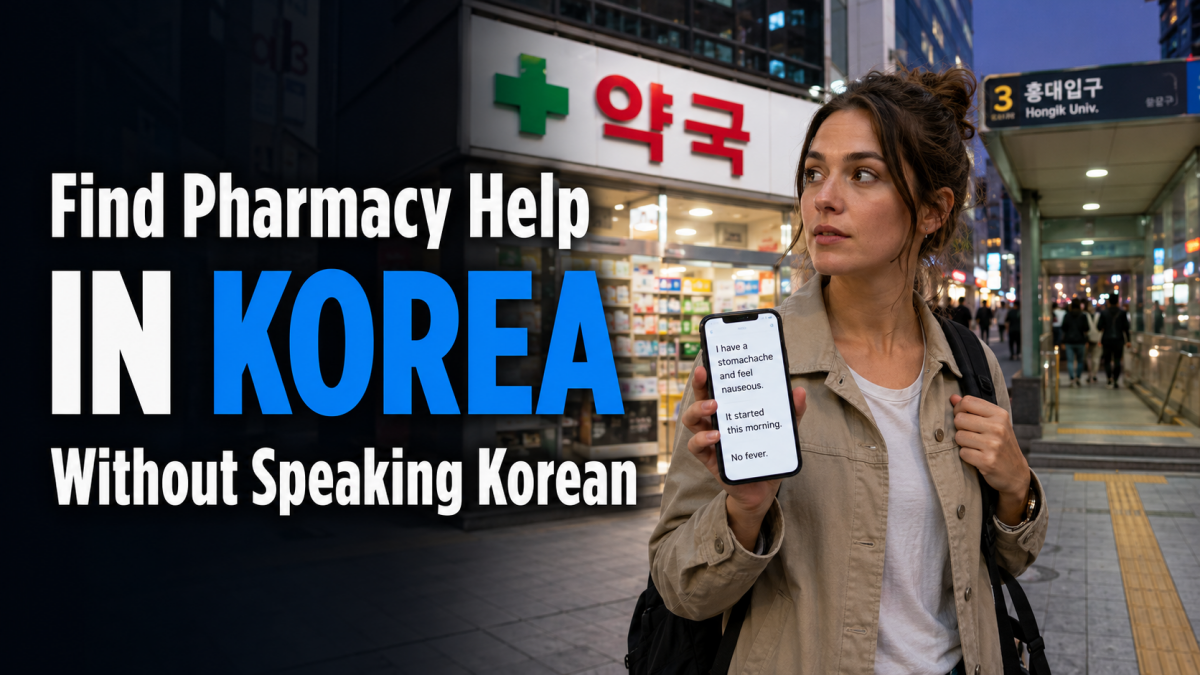
If you need an English-friendly pharmacy in Korea, finding a pharmacy is usually easier than confirming that an English-speaking pharmacist is available at that exact time. Search for 약국, check the current listing and prepare your symptoms, allergies and medication information in writing before you go.
Do not rely only on an English-language review that says a pharmacist spoke English. Staff schedules change, and language support that was available to another traveler may not be available during your visit.
Quick answer: Search 약국 in Naver Map, confirm the address and current hours, and prepare a short translated note about your symptoms, allergies and medicines already taken. For nights, Sundays and holidays, use E-Gen or Seoul’s current public late-night pharmacy information. Use 1330 only for available tourist information or interpretation assistance, and call 119 for a serious medical emergency.
Why “English-Speaking Pharmacy” Is Not Always the Best Search
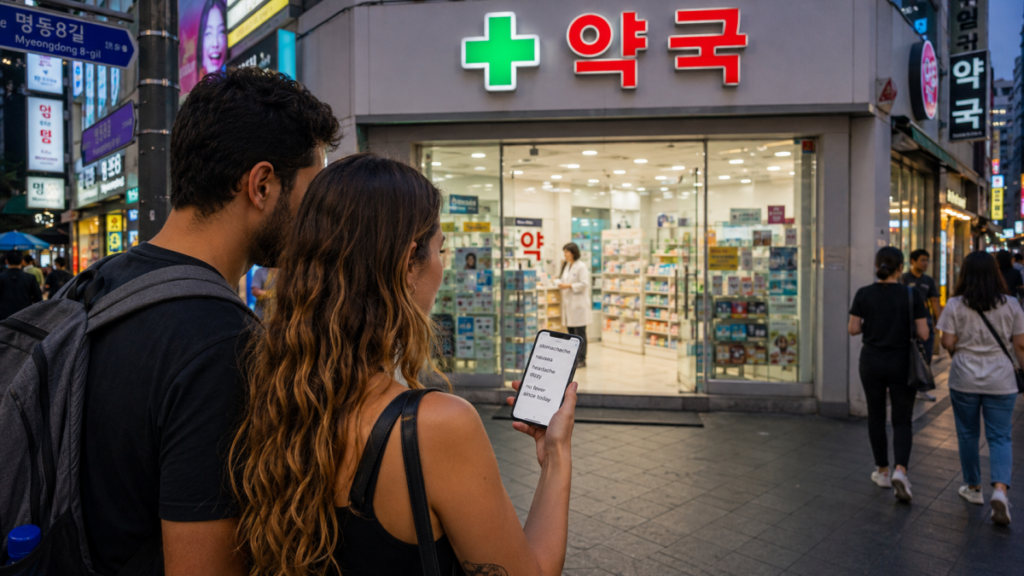
Korean pharmacies are generally recognizable by signs containing 약 or 약국. The harder part for an international traveler is often communicating exactly what is wrong and avoiding misunderstandings about allergies, other medicines or an existing prescription.
An English review is useful as a clue, but it is not a guarantee that an English-speaking pharmacist will be working when you arrive. A better goal is to find a legitimate pharmacy that is easy to reach and reduce communication risk before entering.
The official VISITKOREA pharmacy guide recommends using a translation app and showing a photo or clear information about the medicine you need. It also suggests explaining symptoms and allergies and notes that some pharmacies in areas frequented by international visitors display language-assistance information.
Where to Start Looking
Start near your accommodation, a major subway station, hospital, clinic or area with many international visitors. These locations can be convenient places to search, but their location does not guarantee English service.
If a Korean clinic has just issued your prescription, a nearby pharmacy can be a practical first choice because pharmacies often operate around clinic and hospital areas.
Do not choose a pharmacy based only on walking distance. A pharmacy with a clear storefront and confirmed current hours may be easier to use than a slightly closer business hidden inside an office building, underground arcade or shopping complex.
Step-by-Step: Finding a Pharmacy Near You
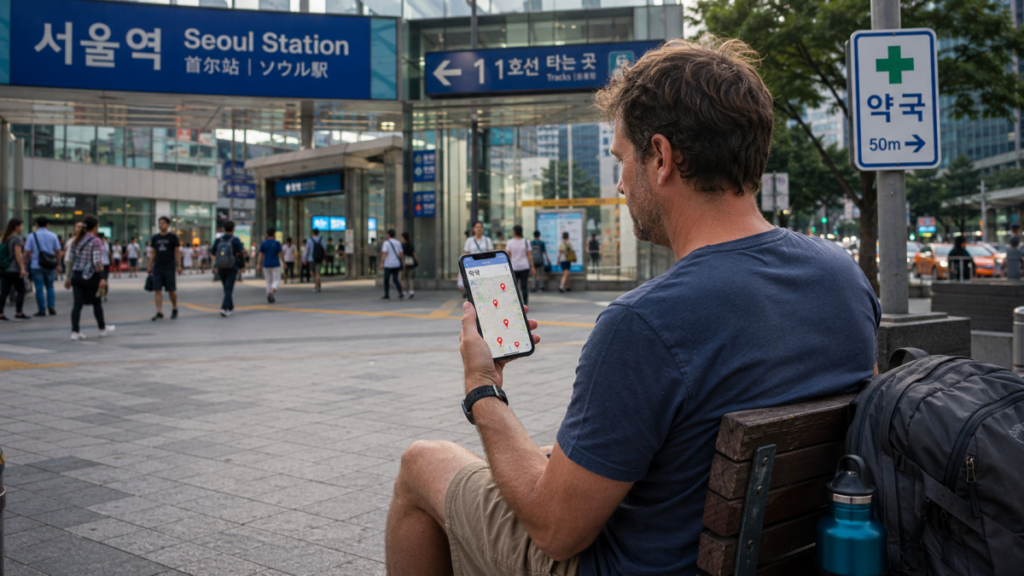
1. Search in English and Korean
Search both pharmacy and 약국 in Naver Map. Korean place listings may be easier to identify by their Korean name or road address.
If you need help comparing local map apps, our Naver Map vs KakaoMap guide explains Korean place-name searches, addresses, station exits and conflicting map results.
2. Check the Listing Carefully
Look for the full address, storefront photo, recent opening hours, phone number and recent reviews. If the pharmacy has several branches or is inside a large building, confirm the exact location before leaving.
Treat English-language reviews as a useful clue rather than proof of current language support.
3. Confirm Before Making a Long Trip
If English communication is essential, call before traveling across the city and ask whether someone who can communicate in English is available at that time.
If making the call is difficult, your hotel reception or another trusted local contact may be able to help confirm the pharmacy name and opening hours.
The 1330 Korea Travel Helpline & Complaint Center provides tourist information and tourist interpretation services by phone and real-time chat. It is not a substitute for a pharmacist, doctor or emergency medical service.
4. Save a Backup Pharmacy
Save one pharmacy near your accommodation and one after-hours option before you need them. This is particularly useful on arrival day, weekends and public holidays.
Late-Night, Sunday and Holiday Pharmacies
For nights, Sundays and public holidays, use the official E-Gen medical and pharmacy search. Some fields are in Korean, so browser translation may help.
E-Gen explicitly warns that opening times can change and recommends calling before visiting. Do not travel a long distance based only on a displayed schedule.
As of Seoul’s February 4, 2026 announcement, 39 designated public late-night pharmacies operate across all 25 districts, generally from 10 PM to 1 AM, with 28 locations operating year-round.
Check the current Seoul public late-night pharmacy information and confirm the individual pharmacy before leaving because schedules and temporary closures can change.
| Situation | Best First Step | Important Check |
|---|---|---|
| Minor symptom or OTC medicine question | Search for 약국 nearby | Explain symptoms, allergies and medicines already taken |
| You need language assistance | Prepare a translated note and ask about current language support | Do not rely on an old English review |
| Night, Sunday or holiday | Check E-Gen or Seoul’s public late-night pharmacy information | Call before traveling |
| You need a prescription refill | Prepare your foreign medical documents and plan for a Korean doctor visit | Do not expect a foreign prescription to be filled directly |
| Serious or rapidly worsening emergency | Call 119 or seek urgent medical care | Do not delay emergency help while searching for a pharmacy |
What to Prepare Before You Walk In
A pharmacist can help more safely when the information you provide is short and specific. Write down the important details before entering rather than trying to remember everything while using a translation app.
- Main symptom: What is bothering you and where?
- Timing: When did it begin, and is it getting better or worse?
- Medicine already taken: Active ingredient, dose and when you last took it.
- Medication allergies: Write the ingredient name clearly.
- Other medicines: Include prescription drugs, OTC medicines and supplements that may matter.
- Important health information: Tell the pharmacist about pregnancy, breastfeeding or a relevant medical condition when it could affect medication choice.
- Supporting documents: Bring the medicine package, prescription label, active ingredient name, diagnosis record or doctor’s note when relevant.
A photo of the medicine package can help identify what you normally use, but do not assume a familiar foreign brand has the same name, ingredients or formulation in Korea.
Useful Korean Phrases to Show the Pharmacist
You do not need perfect pronunciation. Showing the Korean sentence on your phone can be clearer than trying to pronounce unfamiliar medical vocabulary.
| Korean | Meaning |
|---|---|
| 영어 가능한 분 계신가요? | Is there someone who can speak English? |
| 이 증상에 맞는 일반의약품을 찾고 있어요. | I am looking for an over-the-counter medicine for these symptoms. |
| 알레르기가 있어요. | I have an allergy. |
| 오늘 이미 이 약을 먹었어요. | I already took this medicine today. |
| 처방전이 필요한 약인가요? | Does this medicine require a prescription? |
| 복용 방법을 적어 주실 수 있나요? | Could you write down how to take it? |
| 이 약과 같이 먹어도 되나요? | Can I take this with my other medicine? |
Foreign Prescriptions in Korea
Do not treat a prescription issued in another country as something you can simply hand to a Korean pharmacy for a refill. Bring it as medical documentation so a Korean clinician can see the medication name, active ingredient, dosage and reason for treatment.
Asan Medical Center’s international patient FAQ states that pharmacists cannot fill a foreign prescription and that a doctor visit is required for a prescription refill.
You can review the Asan Medical Center international patient FAQ.
Korea’s current Pharmaceutical Affairs Act also states that prescription medicines are dispensed by pharmacies based on a prescription from a doctor or dentist, while OTC medicines may be sold by pharmacies without a prescription.
If you may need a refill during your trip, bring the original prescription, medicine packaging, active ingredient, dosage information and relevant medical records. Do not change or combine prescription medicines on your own while trying to find a local equivalent.
Can You Buy Medicine at a Convenience Store?
Some registered 24-hour retail stores, including participating convenience stores, can sell a limited list of designated 안전상비의약품, or safety medicines intended for relatively minor symptoms.
This does not mean every convenience store sells medicine or that the store carries the full range of products available at a pharmacy. A convenience store also does not provide pharmacist consultation.
Under Korea’s Pharmaceutical Affairs Act, a non-pharmacy seller of designated safety medicines must be registered, and the registration system applies to stores meeting requirements that include 24-hour, year-round operation.
For broader convenience-store differences between branches, see our Korean convenience store guide.
If you have a medication allergy, chronic condition, possible drug interaction, prescription question or uncertainty about what medicine is appropriate, speak with a pharmacist or clinician rather than relying on a convenience-store purchase.
When a Pharmacy Is Not Enough
A pharmacy is not a replacement for emergency medical care. Call 119 when someone needs an ambulance or urgent emergency response.
Do not spend time searching for an English-speaking pharmacy when someone has severe breathing difficulty, is unconscious, has severe bleeding, shows stroke-like symptoms, has a seizure, has a serious allergic reaction or otherwise appears to need immediate emergency help.
If you do not speak Korean during a 119 call, keep your explanation short and give your location first. A hotel name, Korean address, building, floor, subway exit or nearby landmark can help identify where you are.
Also keep 1339 separate from 119. 1339 is the Korea Disease Control and Prevention Agency call center for infectious-disease, vaccination, prevention and related public-health guidance; it is not Korea’s general ambulance number or a replacement for emergency medical care.
Our guide to how to use 119 and 1339 in Korea explains which number to use and what information to prepare.
Seek medical care rather than relying only on a pharmacy when symptoms persist, worsen, return repeatedly, involve a high-risk health condition or may require a prescription medicine. Ask a pharmacist or clinician before combining medicines when you are unsure about an interaction.
Frequently Asked Questions
How can I find an English-speaking pharmacy in Korea?
Search for 약국 near your location and check recent listings and reviews, but do not treat an English review as a guarantee. Call ahead when English communication is essential, or prepare a translated symptom and medication note.
Can a Korean pharmacy fill my foreign prescription?
Do not expect it to be filled directly. Bring the foreign prescription and medication information as medical documentation and plan to see a Korean doctor for a prescription refill when required.
What should I do if I need a pharmacy late at night?
Use E-Gen or Seoul’s current public late-night pharmacy information and call the pharmacy before traveling. Opening hours and holiday schedules can change.
Can I buy medicine at a Korean convenience store?
Some registered 24-hour stores sell a limited list of designated safety medicines, but not every convenience store participates or carries every product. A convenience store is not a substitute for pharmacist consultation.
Should I look for a pharmacy or call 119?
Use a pharmacy for non-emergency medication questions when the person is stable. Call 119 when someone needs urgent medical assessment, ambulance transport or emergency assistance.
Final Takeaway
The best way to find pharmacy help in Korea is not to search endlessly for a guaranteed English-speaking pharmacist. Search 약국, confirm the current location and hours, prepare a short written symptom and medication summary and use official late-night pharmacy tools when normal pharmacies are closed.
Use a foreign prescription as medical documentation rather than assuming it can be filled directly, and keep convenience-store safety medicines separate from full pharmacy services.
Most importantly, do not let a search for a pharmacy delay urgent care. Use 119 for serious medical emergencies and follow current official guidance when symptoms persist or worsen.
This article provides general travel and health information and does not replace diagnosis, treatment, emergency care or advice from a pharmacist or qualified healthcare professional. Seek medical care if symptoms persist or worsen.