
Last checked: August 3, 2026. Card-terminal interfaces, installment eligibility, merchant settings, card-network support and issuer policies can change. For an unusual or high-value transaction, confirm the final payment status with the merchant and your card issuer.
If a Korean cashier or card terminal asks about installments, most short-term visitors using a foreign-issued card should choose 일시불. It means the merchant submits the full purchase as a single-payment transaction rather than dividing it into a Korean merchant installment plan.
Do not choose 2, 3, 6, 12 or another month option simply because it appears on the terminal. Seeing installment choices does not prove that your foreign-issued card is eligible for that Korean merchant installment program.
Quick answer: Say or select 일시불. A useful full phrase is 일시불로 해주세요, meaning “Please process it as a one-time payment.” If a separate screen later asks whether to pay in KRW or your home currency, that is a different currency-conversion question.
Credit cards are widely accepted at many Korean hotels, department stores and general shops, according to the official VISITKOREA currency and credit-card guide. Approval can still depend on the merchant, terminal, card network, transaction type and your card issuer.
Why Korean Card Terminals Ask About Installments
Installment purchases are part of Korea’s domestic credit-card system. Korean cardholders may be able to divide an eligible purchase over several months depending on the card issuer, merchant, purchase amount and current terms.
BC Card’s English card terms describe installment transactions at domestic merchants authorized by the bank or BC Card. You can review the current BC Card English card terms for the domestic-card context.
Because installment fields are built into many Korean payment flows, the cashier or terminal may still present the question when you hand over a card issued outside Korea. The presence of the prompt does not establish that your card can use the installment option.
What 일시불 Actually Means
일시불 means that the purchase is processed as one full-payment transaction instead of being divided into merchant installments.
It does not necessarily mean that the money leaves your bank account at that exact moment. If you are using a credit card, your issuer still determines when the transaction appears on your statement and when your card balance is due. If you are using a debit or prepaid card, the timing of the debit or hold follows that card’s own rules.
Your home-country issuer may also offer a separate service that lets you convert a completed purchase into installments after it posts. That is an issuer-side feature and is different from selecting a Korean merchant installment period at checkout.
The Korean Words You May See or Hear
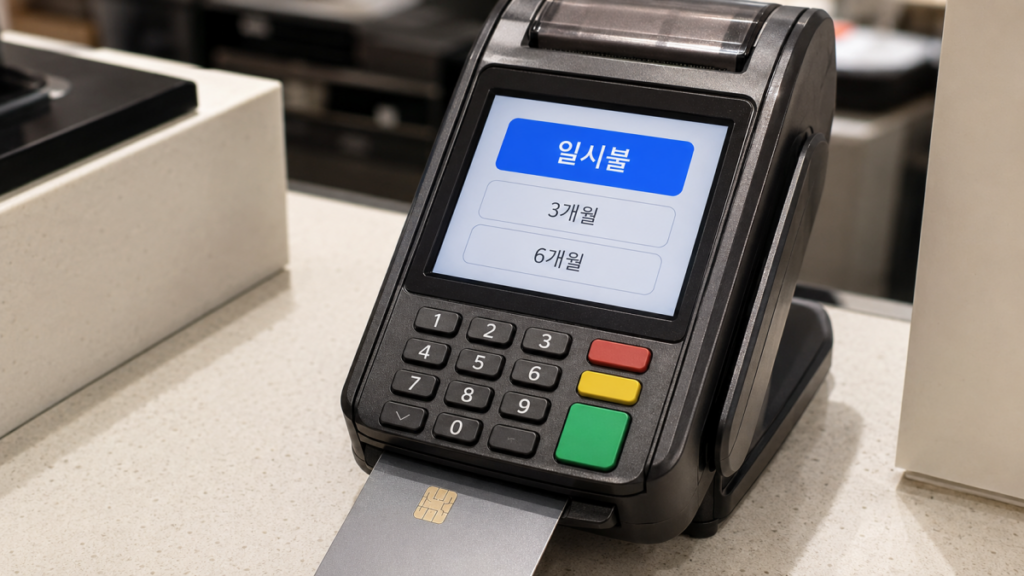
The most useful word to recognize is 일시불, pronounced approximately “il-shi-bul.” You may also see 할부, meaning installment payment, or a number followed by 개월, meaning a number of months.
| What You See or Hear | Meaning | What Most Foreign Travelers Should Do |
|---|---|---|
| 일시불 | One-time payment / pay in full | Choose this unless you know your card supports another arrangement |
| 할부 | Installment payment | Do not assume your foreign card is eligible |
| 몇 개월? | How many months? | Answer 일시불 |
| 3개월 | Three months | Do not select for an ordinary foreign-card purchase unless eligibility is confirmed |
| 6개월 | Six months | Do not select for an ordinary foreign-card purchase unless eligibility is confirmed |
If the cashier does not understand “pay in full,” show 일시불 on your phone. The phrase 일시불로 해주세요 is also useful.
How to Answer at the Counter
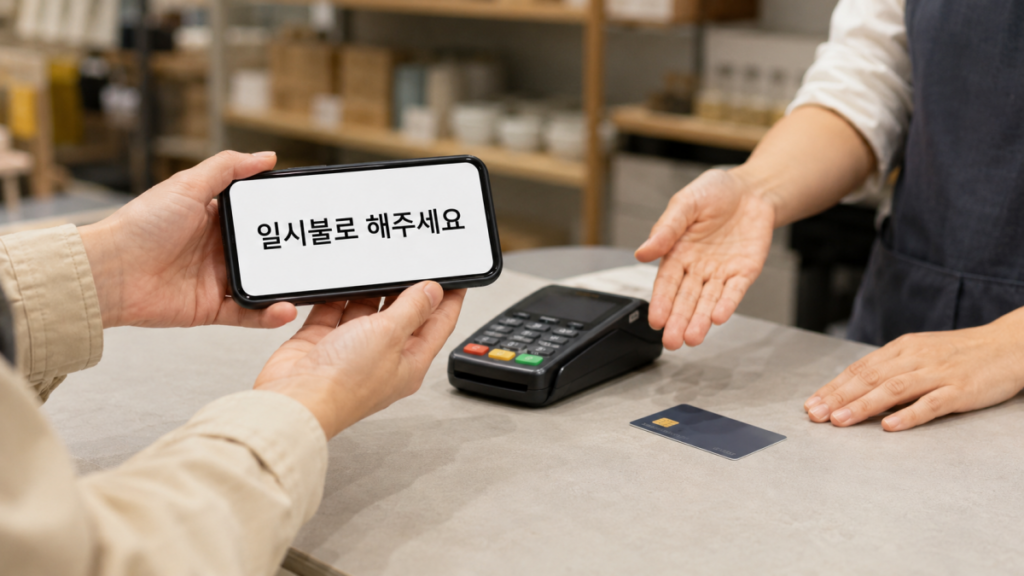
The simplest answer is 일시불이요 or 일시불로 해주세요. Both communicate that you want the purchase processed without a Korean merchant installment period.
If the cashier asks 몇 개월?, do not answer with a month number unless you intentionally want an installment transaction and already know that your card is eligible.
At a self-service kiosk, select English when available. If the Korean screen shows month numbers and you are unsure what they mean, do not guess. Cancel that step and ask a staff member or move to a staffed checkout.
- Check the total amount in Korean won.
- Select or say 일시불.
- Use the physical chip card if a contactless attempt fails and the terminal supports chip insertion.
- Review the final amount before confirming.
- Keep the receipt for a large purchase, return, tax refund or payment problem.
What If You Selected an Installment Period by Mistake?
Do not immediately tap or insert the card again. First determine whether the original transaction actually completed.
- Ask the cashier whether the first transaction was approved.
- Check the terminal result and any printed receipt.
- If the receipt displays the payment type, look for 일시불, 할부 or a month count.
- If an unwanted installment transaction completed, ask the merchant whether it can be canceled.
- Keep the cancellation receipt or other confirmation when one is provided.
- Only after the first transaction is canceled or confirmed unsuccessful should you process the purchase once as 일시불.
A canceled attempt can remain visible temporarily as a pending authorization in your card app. A pending transaction is not always a completed charge, and only your card issuer can confirm its final posting status.
If two completed charges eventually appear, contact the merchant and your issuer with the receipts and transaction details. For broader decline, chip, contactless, DCC and issuer problems, see our guide to what to do if your credit card does not work in Korea.
Installments and Currency Choice Are Different
The installment question is separate from Dynamic Currency Conversion, or DCC.
| Question | What It Controls |
|---|---|
| 일시불 or 할부? | Whether the merchant transaction is submitted as full payment or an installment transaction |
| KRW or your home currency? | Which currency-conversion route is used when DCC is offered |
Selecting 일시불 answers the payment-type question. It does not answer a later currency question.
If a separate DCC screen clearly offers Korean won and your home currency, choosing KRW generally leaves the purchase in the local transaction currency rather than accepting the merchant or terminal provider’s home-currency conversion.
Visa explains that a DCC offer should disclose the transaction amounts, exchange rate and any additional fees or markup and allow the cardholder to accept or decline the conversion. Review Visa’s Dynamic Currency Conversion guide for the current explanation.
Your own issuer may still charge foreign-transaction or currency-conversion fees even when the purchase stays in KRW. Check the terms of your card before traveling.
Easy reminder: Choose 일시불 for the payment type. If a separate DCC screen appears, evaluate the currency choice separately. They are not the same decision.
What About a Foreign Debit or Prepaid Card?
A Korean checkout can show the same installment-related interface even when the card you present is not a Korean credit card. Do not treat the presence of month buttons as proof that a foreign debit or prepaid card can use a Korean installment program.
If the checkout requires a payment-type selection, 일시불 is the non-installment option. Whether the card itself is ultimately approved still depends on the card network, merchant and issuer.
What to Prepare Before Paying in Korea
- A physical card: Keep one available in case a contactless or mobile-wallet payment does not complete.
- A second card: A different issuer or network gives you a more independent backup.
- A modest amount of Korean won: Useful for small purchases, transportation-card reloads and unexpected payment failures.
- Your issuer’s app: Make sure you can check overseas-payment settings, fraud alerts and transaction status.
- An appropriate spending limit: Check it before a high-value purchase.
- The Korean word 일시불: Saving it on your phone can make a confusing checkout much easier.
Apple Pay can be useful at compatible contactless terminals, but it should not be your only payment method. Our Apple Pay in Korea guide explains contactless compatibility, physical-card backups and transportation-payment differences.
Frequently Asked Questions
Can a foreign card use Korean installments?
Do not assume that it can. Eligibility depends on the card, issuer, network, merchant and installment program. Most short-term visitors should choose 일시불 unless their issuer has specifically confirmed that their card can use the relevant Korean merchant installment arrangement.
Does 일시불 mean the money leaves my bank account immediately?
Not necessarily. 일시불 describes the merchant transaction as a full-payment rather than installment purchase. Your card issuer or bank still determines statement billing, account settlement, debit timing and any temporary authorization holds.
What should I say if the cashier asks 몇 개월?
Say 일시불이요 or 일시불로 해주세요. That tells the cashier that you want the transaction processed without a merchant installment period.
What should I do if I accidentally selected three or six months?
Check whether the first transaction actually completed before trying again. If an unwanted transaction was approved, ask the merchant about cancellation, keep the cancellation confirmation and reprocess the purchase only after the first attempt’s status is clear.
Is choosing 일시불 the same as choosing KRW?
No. 일시불 controls the payment type, while KRW is a currency choice that may appear in a separate DCC prompt. Treat them as two different questions.
Final Takeaway
If a Korean card terminal asks about installments, most short-term visitors using a normal foreign-issued card should choose 일시불. It tells the merchant to process the full purchase as one transaction instead of selecting a Korean merchant installment period.
Do not confuse that choice with when your home issuer collects the money, and do not confuse it with a separate KRW-versus-home-currency DCC screen.
If you accidentally choose a month option, check whether the first transaction was approved before paying again. Confirm any cancellation, keep the receipt and then process the purchase once as 일시불 when necessary.