
Last checked: August 2, 2026. Restaurant ordering systems, kiosk interfaces and travel apps can change, so follow the current instructions displayed at the restaurant when they differ from general guidance.
You can order at many Korean restaurants without speaking Korean by identifying how the restaurant takes orders, choosing the exact dish before the staff arrives, pointing to the menu item, confirming the quantity and keeping a translation tool ready for follow-up questions.
The system varies by restaurant. You may order from a server, at a counter, through a kiosk, with a QR code, on a table tablet or at a self-service station. The goal is not to understand every Korean sentence. It is to handle one decision at a time.
Quick answer: Choose a restaurant with a clear menu, translate the dish before ordering, point to the exact item, confirm the number of portions, keep a few short Korean phrases ready, check kiosks and QR menus carefully, understand any minimum-order rules, treat allergy questions separately from ordinary customization, and look for self-service instructions after ordering.
1. Choose an Easy Restaurant Format First
Picture menus, numbered menu boards, food displays, food courts, bakeries and casual restaurants with clearly displayed prices are usually easier to navigate when you do not speak Korean.
Before ordering, identify the restaurant’s system. Check whether customers order at the table, at a counter, through a kiosk, with a QR code or on a tablet. Watching one customer complete the process can often show you where to order and when to pay.
A crowd outside does not always mean that standing in the crowd puts you on the waiting list. Busy restaurants may use a tablet, kiosk, QR code, numbered ticket or app. If you are unsure, read our guide to how to join a Korean restaurant waitlist without speaking Korean.
2. Translate the Menu Before the Staff Arrives
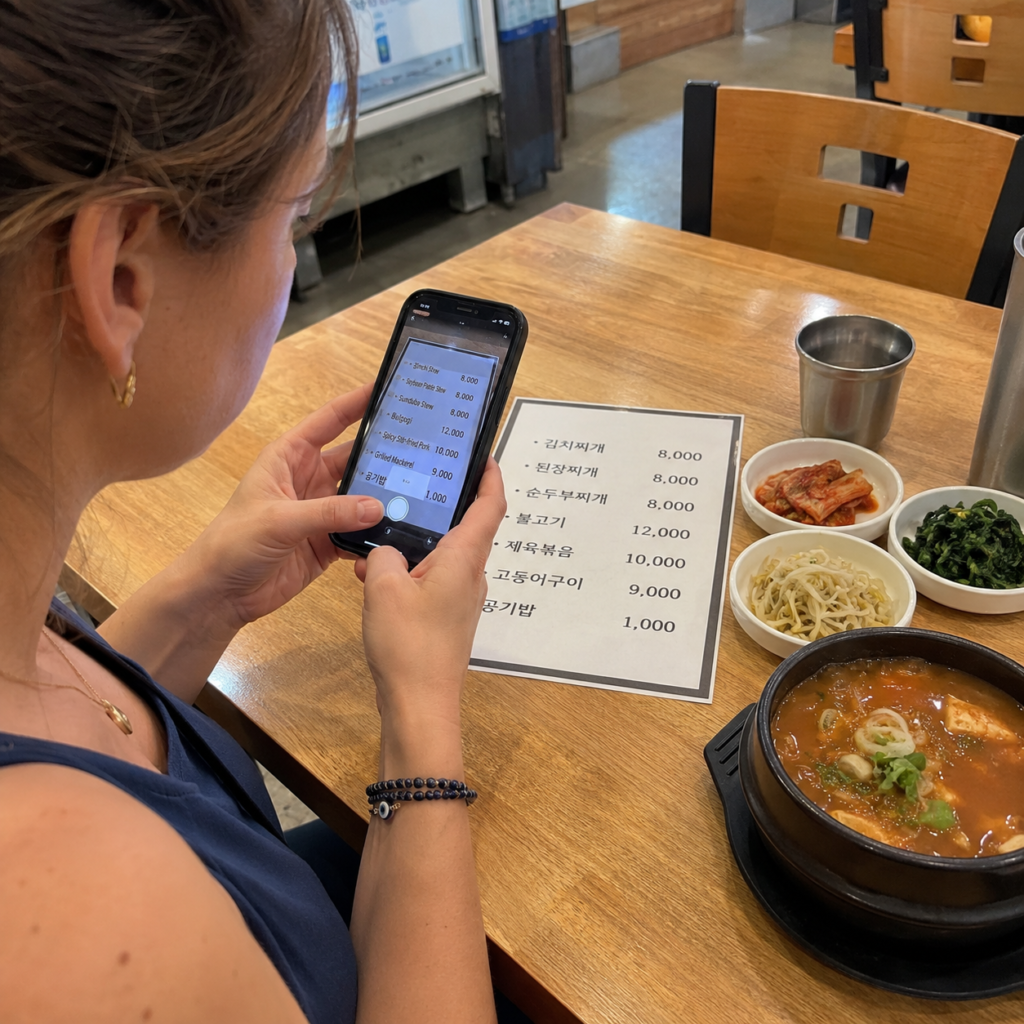
Open your translation app while waiting outside, sitting at the table or standing away from a busy counter. Scan the menu and choose a first option and a backup option before the staff asks for your order.
The official VISITKOREA Helpful Apps & Resources guide lists Papago as a translation service that can recognize text from images, handwriting, webpages and spoken words. It can also retrieve information for some Korean food names scanned as images.
Camera translation is useful for dish names, prices and short descriptions, but it should not be treated as proof of ingredients or preparation methods. A menu name may not describe every broth, sauce, garnish or cooking ingredient.
3. Point to the Dish and Confirm the Quantity
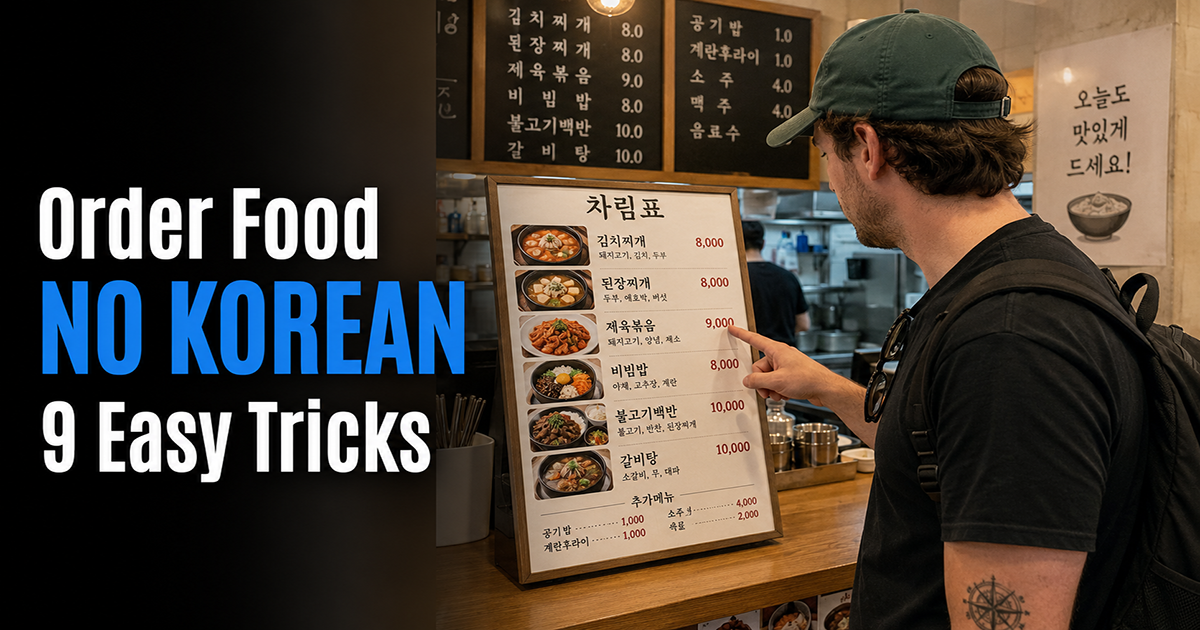
Pointing to a specific menu item, photo or menu number is a practical way to communicate in a casual restaurant when speaking is difficult. Point clearly, show the number of portions if necessary and wait for the staff to repeat or confirm the order.
When the menu uses item numbers, pointing to the number can be clearer than attempting an unfamiliar dish name. Keep the interaction short when the restaurant is busy.
Before the order is submitted, check the quantity. One menu item may represent one serving, a shared portion, a set menu or an optional add-on, so the number matters as much as the dish name.
4. Save a Few Useful Korean Phrases
| Korean | Romanization | Meaning |
|---|---|---|
| 이거 하나 주세요. | Igeo hana juseyo. | One of these, please. |
| 이거 두 개 주세요. | Igeo du gae juseyo. | Two of these, please. |
| 이거 매워요? | Igeo maewoyo? | Is this spicy? |
| 포장해 주세요. | Pojanghae juseyo. | Takeout, please. |
| 물 주세요. | Mul juseyo. | Water, please. |
| 계산할게요. | Gyesanhalgeyo. | I would like to pay. |
You do not need perfect pronunciation. If speaking the phrase is difficult, show the written Korean on your phone while pointing to the relevant menu item.
5. Check Kiosks and QR Menus Carefully
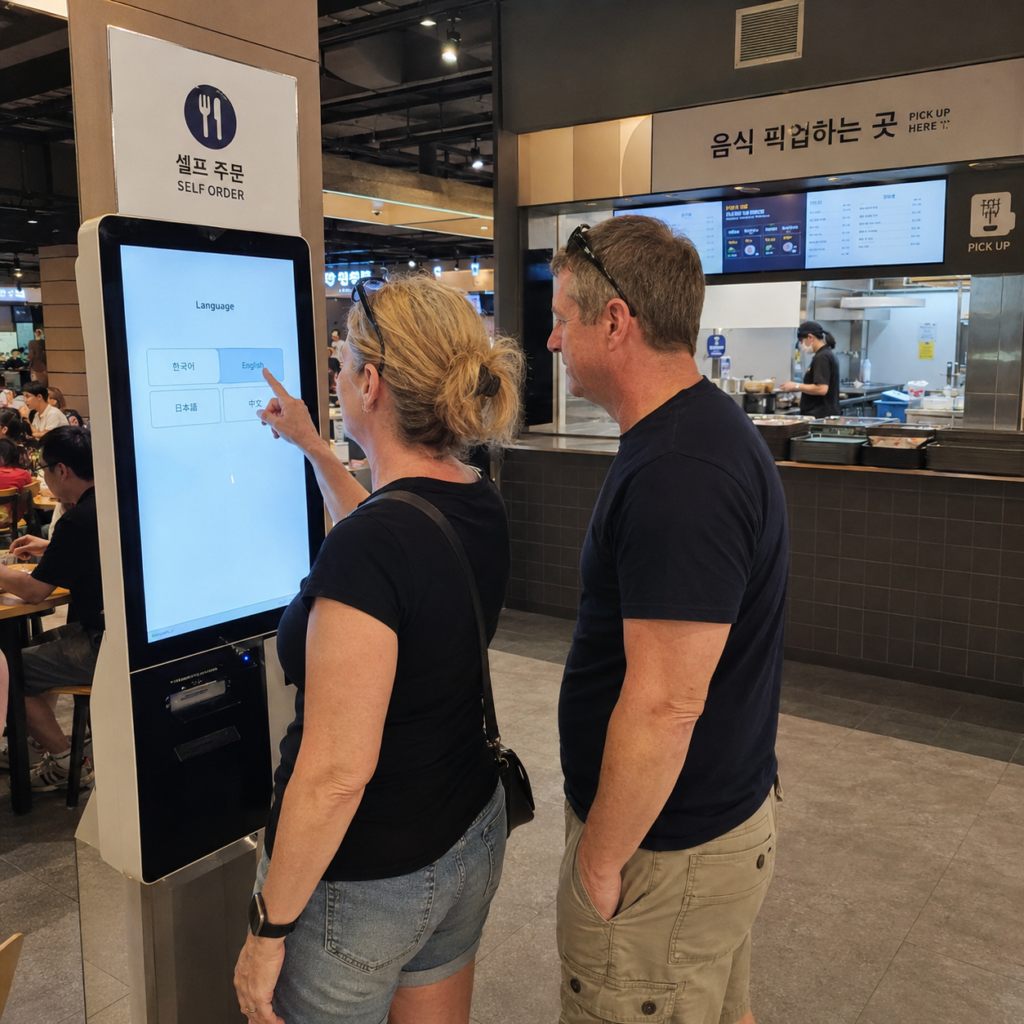
Some casual restaurants, cafés, food courts and chains use unmanned kiosks. Look for an English, language, ENG or globe button before trying to work through the Korean interface.
Before reaching the payment screen, review the item, quantity, size, dine-in or takeout choice, any optional toppings and the total amount. Do not rush just because another customer is waiting behind you.
If the restaurant uses a QR code instead of a printed menu, check the restaurant name, table number and order total before submitting anything. Our guide to what to do when a Korean restaurant has only a QR code menu covers the process in more detail.
If the ordering screen works but the payment itself fails, move to a staffed counter when one is available rather than repeatedly submitting the same transaction. Our guide to what to do when a foreign credit card does not work in Korea explains card terminals, mobile payments, issuer checks and payment backups.
6. Understand the Restaurant Type Before You Order
| Restaurant Type | What to Check |
|---|---|
| Gimbap or bunsik shop | Point to a dish or menu number and confirm the quantity. |
| Soup or noodle restaurant | Check the size, set options and whether the dish has a spicy or mild version. |
| Korean barbecue | Check the minimum number of servings, price per serving and whether one-person dining is available. |
| Food court | Check whether you order and pay first and how your collection number is called. |
| Market stall | Confirm the item, quantity, price and accepted payment method before ordering. |
Korean barbecue deserves extra attention because minimum orders are set by the individual restaurant. Do not assume that every restaurant requires two servings or that every grill table accepts a solo diner.
If you are eating alone, our solo Korean BBQ guide explains one-person seating, minimum portions, serving sizes and what to confirm before sitting down.
7. Ask About Spice and Ingredients Separately
안 맵게 해주세요, or an maepge haejuseyo, means “please make it not spicy.” The request is useful only when the restaurant can actually adjust the sauce, seasoning or preparation.
Some soups, marinades, sauces and prepared dishes cannot be changed after they have been made. Asking 이거 매워요?, meaning “Is this spicy?”, before ordering may be more useful than assuming the dish can be modified.
A less-spicy request does not confirm the ingredients and does not make a dish suitable for an allergy, vegetarian diet, vegan diet, halal requirement or gluten restriction. Treat those as separate questions.
8. Prepare Allergy and Dietary Information in Advance
If you have a serious food allergy or a strict dietary requirement, prepare a short written note in Korean and English before entering the restaurant. State the exact ingredient you need to avoid and, when relevant, that cross-contact is also a concern.
Ingredients and preparation methods vary by restaurant. A dish may contain a broth, sauce, garnish or cooking ingredient that is not obvious from the English dish name or a translated menu description.
If the restaurant cannot clearly confirm whether the food meets your requirement, choosing another dish or restaurant is safer than guessing. Do not treat a translation app, menu photograph or general description of a Korean dish as an ingredient guarantee.
If someone develops a serious allergic reaction, breathing difficulty, loss of consciousness or another medical emergency, call 119. The official VISITKOREA emergency information page lists 119 for medical emergencies.
9. Know What Happens After You Order
Ordering the food is only part of the restaurant process. Some casual restaurants use counter payment, self-service water, utensil drawers, side-dish stations, table tablets or call bells.
The official VISITKOREA guide to Korean food and restaurant dining explains that some restaurants use self-service systems or unmanned ordering machines and that tipping is generally not required or expected at Korean restaurants.
- Check whether water, utensils, napkins or side dishes are self-service.
- If there is a call bell, press it once and wait for the staff.
- Do not assume that every extra menu item or special side dish is free.
- Watch whether customers pay before eating or at the counter afterward.
- Return trays or dishes when a return station is clearly marked.
If the button on the table is unfamiliar, our guide to how Korean restaurant call bells work explains when to press it and when to check for self-service first.
You also do not need to add a percentage to an ordinary restaurant bill simply because the staff helped you with a menu or translation. For the broader rules, see our guide to tipping culture in Korea.
When to Use the 1330 Travel Helpline
VISITKOREA currently lists the 1330 Korea Travel Helpline for tourist information, interpretation assistance and tourist complaint guidance. Because service availability can change, check the current VISITKOREA 1330 page before relying on call or chat.
It can be useful when language is the main travel problem, but it cannot guarantee a restaurant ingredient, provide medical treatment or replace emergency services. Use 119 for a medical emergency.
A Simple Ordering Checklist
- Identify whether you order at the table, counter, kiosk, QR code or tablet.
- Translate the menu before the staff asks for your order.
- Choose a first dish and a backup choice.
- Point to the exact item and confirm the quantity.
- Ask one short question at a time.
- Check minimum-order rules for barbecue and shared dishes.
- Review the cart and total before paying at a kiosk or QR menu.
- Handle allergies and strict dietary requirements separately from ordinary customization.
- Check whether payment, water, utensils and tray return are self-service.
Frequently Asked Questions
Can I order food in Korea if I speak no Korean?
Yes, many restaurant situations can be handled by pointing to the menu, confirming the quantity and using a translation tool for short follow-up questions. The easiest restaurants are usually those with clear menus, prices, pictures or a straightforward ordering system.
Pointing to a specific menu item or photo is a practical communication method in a casual restaurant when language is limited. Point calmly, confirm the quantity and use a polite expression such as 주세요 when possible.
What should I do if a kiosk has no English option?
Use camera translation, look for photos and menu numbers, and review the order before paying. If the interface remains unclear, use a staffed counter when available or choose another ordering method.
Can I ask for Korean food to be made less spicy?
You can ask, but the restaurant may not be able to change a prepared broth, sauce or marinade. Asking whether the dish is spicy before ordering is often more reliable.
What should I do if a restaurant cannot confirm my allergy?
Do not guess based on the dish name or a translation app. Choose a dish or restaurant where the ingredients and preparation method can be confirmed more clearly. Call 119 if a serious medical reaction occurs.
Final Takeaway
Ordering food in Korea without speaking Korean is mainly about reducing uncertainty. Identify the ordering system first, choose the exact dish, point clearly, confirm the quantity and ask one short question at a time.
Use translation tools for ordinary menu questions, but treat allergies and strict dietary requirements more carefully. At barbecue restaurants, kiosks and QR-menu restaurants, check the specific restaurant’s ordering and payment rules rather than assuming every place works the same way.
You do not need to understand every Korean word to complete a meal successfully. A clear menu choice, a few short phrases and a sensible backup plan are usually more useful than trying to memorize an entire restaurant conversation.
※ This article provides general travel and dining information and does not replace medical advice. If a serious allergic reaction or other medical emergency occurs, call 119.