
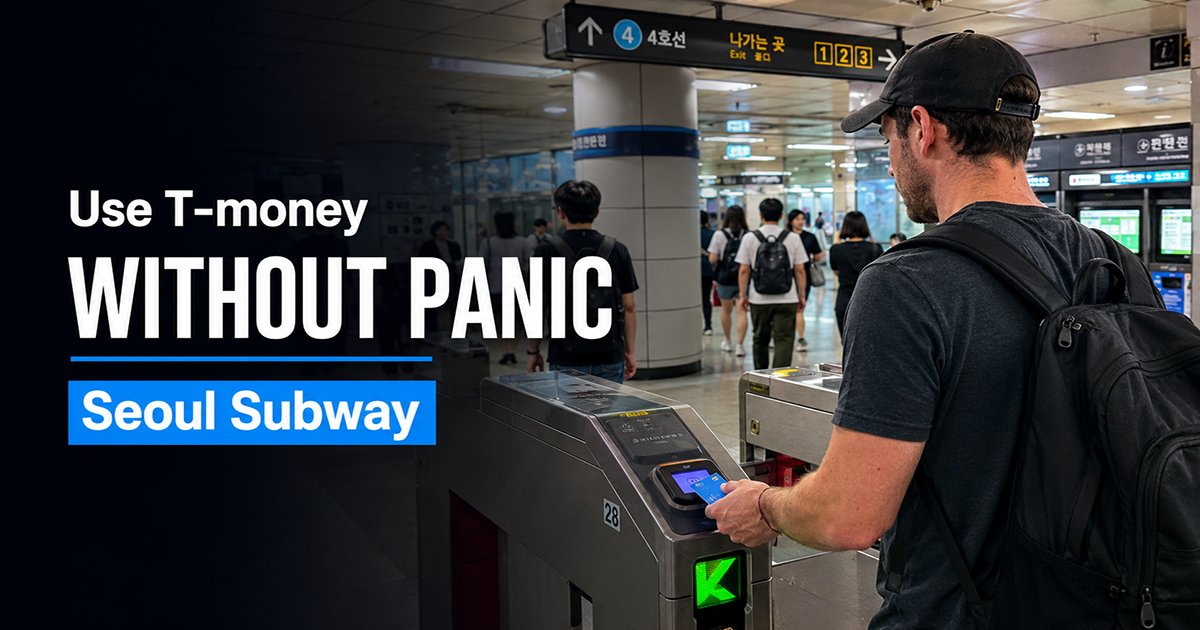
Using a T-money card in Seoul follows one basic rhythm: tap the same card when entering and leaving the subway, and tap when boarding and getting off a bus. Place the card close to the reader, wait for the beep or screen response, and then move through.
The details that cause confusion are usually not the tap itself. Travelers are more likely to get stuck over cash reloads, low balance, bus exit taps, airport trains, transfer rules, or the difference between an ordinary T-money card and newer ticket products that accept international cards.
Quick answer
- Buy a T-money card at a participating convenience store or other authorized sales point.
- The card purchase price is separate from the transportation balance.
- Prepare Korean-won cash for an ordinary physical T-money reload.
- Tap the same card when entering and exiting the subway.
- Tap when boarding and getting off a Seoul bus.
- Use one card per traveler for the simplest subway and transfer experience.
- AREX All-Stop trains accept transportation cards, but the Express Train requires a separate ticket.
- Do not assume that an overseas contactless card can replace T-money at every gate or bus reader.
What a T-money card does
T-money is a rechargeable transportation card widely accepted on Seoul subways, city buses, and other participating transportation services. The fare is deducted from the stored balance when the card is tapped.
The card can also be accepted by some taxis and affiliated stores displaying the applicable Tmoney logo. It should not be treated as a universal bank card because acceptance depends on the operator or merchant.
The purchase price pays for the physical card and does not become transportation balance. After buying the card, add funds before attempting the first ride.
Where to buy a T-money card
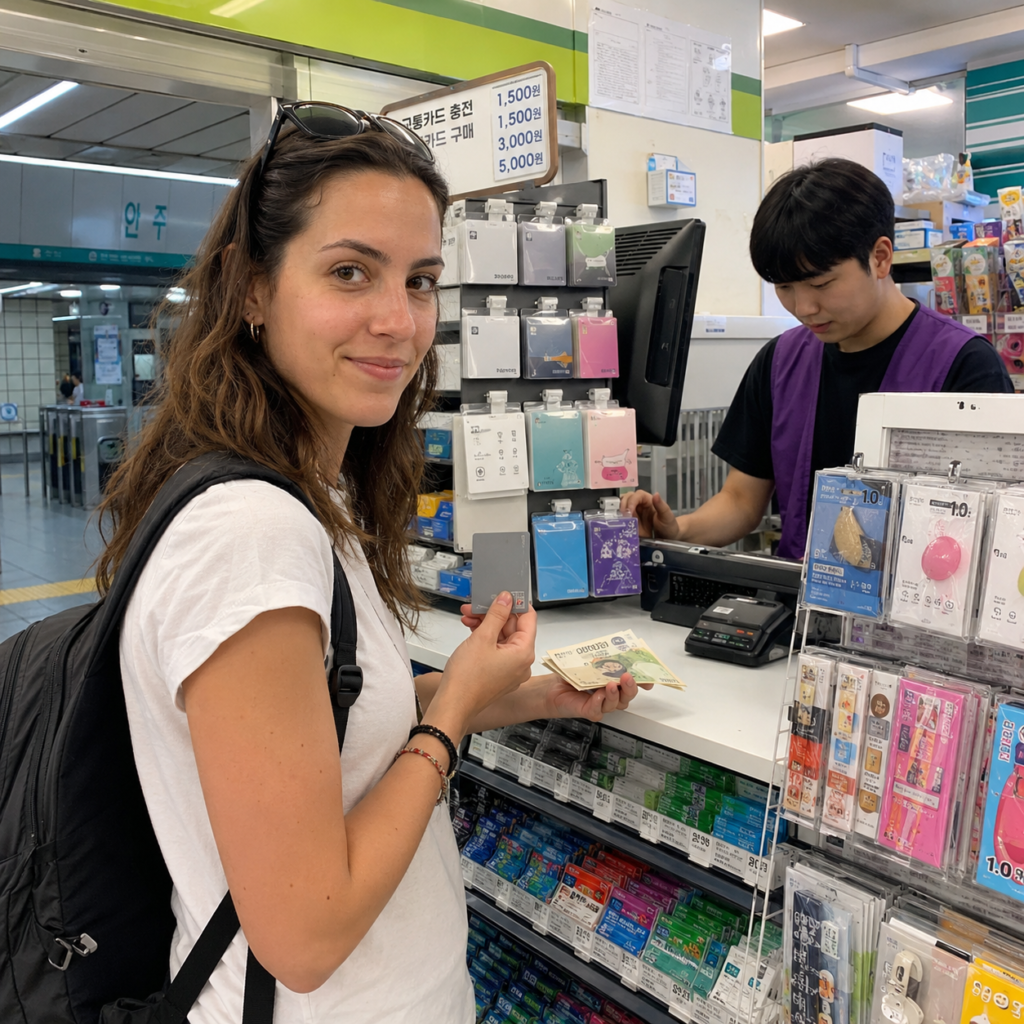
Participating convenience stores are a common place to buy an ordinary physical T-money card. Availability, design, and card price vary by store.
You may also encounter transportation-card sales points, vending machines, airport counters, or tourist products that include a T-money function. A special tourist design is not required for ordinary subway and bus use.
When asking at a staffed counter, show this text if needed:
티머니 카드 있어요?
T-money kadeu isseoyo?
Do you have a T-money card?
Check that you are buying a rechargeable transportation card rather than a single-journey subway ticket or a time-limited transportation pass.
How to reload an ordinary T-money card
The official Tmoney foreigner guide instructs customers to present the card and Korean-won cash at an authorized sales or reload location. The card can be reloaded in KRW 1,000 units, from KRW 1,000 to KRW 90,000 in one transaction, and the total balance cannot exceed KRW 500,000.
For a first reload, add an amount that matches the transportation you expect to use over the next day or two. There is no universal recommended amount because the answer depends on the trip length, airport route, and number of rides.
Reloading at a convenience store
- Give the T-money card to the cashier.
- State or show the amount you want to add.
- Pay with Korean-won cash.
- Wait until the cashier confirms that the reload is complete.
- Take the card and any change before leaving.
티머니 만 원 충전해 주세요.
T-money man won chungjeonhae juseyo.
Please add KRW 10,000 to this T-money card.
Reloading at a subway station
Look for a transportation-card reload or ticket machine and select the available language option. Place the card on the indicated reader, choose the reload amount, insert the supported payment, and leave the card in position until the completion message appears.
Payment support can differ by machine. For an ordinary physical T-money balance, carrying Korean-won cash remains the dependable approach.
Do new subway machines accept international cards?
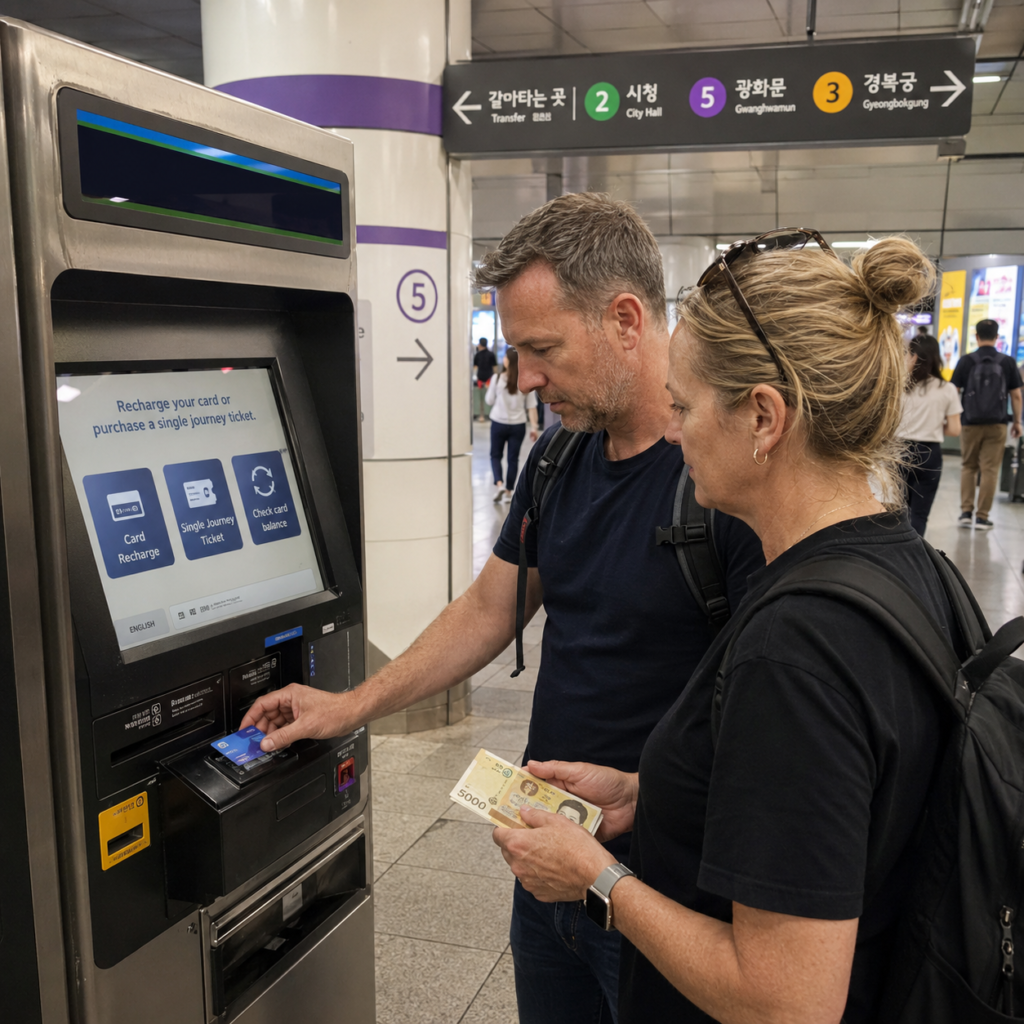
Starting in March 2026, Seoul introduced international-card support at hundreds of new ticket vending machines on Lines 1–8. The current official announcement applies to Climate Card short-term passes and single-journey subway tickets.
Do not assume that this means an ordinary T-money balance can be reloaded with an overseas card at every machine. The products use different payment and fare systems.
| Product or payment method | What tourists should know |
|---|---|
| Ordinary physical T-money | Prepare Korean-won cash for standard reloads at Tmoney sales locations. |
| Climate Card short-term pass | Supported new machines can accept eligible international cards. |
| Single-journey subway ticket | Supported new machines can accept eligible international cards. |
| Overseas card tapped directly at the gate | Not yet a reliable Seoul-wide replacement for T-money. |
For general payment backup ideas outside transportation, read what to do if your credit card does not work in Korea.
How to use T-money at a subway gate
- Take the card out before reaching the reader.
- Use the entrance gate for the correct direction.
- Place the card close and flat on the reader.
- Wait for the beep, screen response, or gate opening.
- Walk through without stopping inside the gate.
- At the destination, use the same card at the exit gate.
Do not swipe the card across the reader or wave it from a distance. A wallet containing several transportation or contactless cards may also cause a reading error, so remove the T-money card when needed.
If the gate stays closed, step aside so other passengers can pass. Read the message, try one deliberate tap, and use the staff gate or nearby fare-adjustment equipment when the error continues.
Always use the same card to enter and exit
The system connects the entry and exit records to calculate the fare. If you enter with one card and try to leave with another, the journey cannot be matched correctly.
Each subway passenger should use an individual card. One card does not create separate entry and exit records for multiple people at the same gate.
How to use T-money on a Seoul bus
On a typical Seoul city bus, board through the front door and tap the reader near the driver. Before your stop, press the stop bell, move toward the exit, and tap the rear-door reader before getting off.
The exit tap records where the bus journey ended. It is important for distance-based fare calculation and eligible transfers.
- Check the bus number and direction before boarding.
- Have the card ready before stepping onto the bus.
- Tap once at the front reader.
- Listen for the normal confirmation sound.
- Press the stop bell before your destination.
- Tap at the rear reader before exiting.
Keep the card accessible when the bus is crowded. Waiting until the door opens to search through a bag can make it easy to miss the exit tap.
How Seoul transfer discounts work
Seoul’s integrated fare system can link eligible subway and bus journeys when the same transportation card is used correctly.
The current official rules include:
- Tap when getting off a bus.
- Begin the next eligible ride within 30 minutes.
- The transfer window is extended to 60 minutes from 9 PM to 7 AM the next day.
- Up to four transfers can be linked, creating up to five boardings.
- Reboarding the same bus route does not receive the ordinary transfer treatment.
Transfer discounts do not mean every new ride is free. The integrated fare can include a base fare difference or distance-based amount.
The easiest habit is to use the same card, tap at every required entry and exit point, and avoid changing cards during a connected journey.
Can one card pay for several people?
Multi-passenger payment can be possible on some buses when the passenger count is given to the driver before tapping. The boarding and exit conditions must remain consistent, and the arrangement does not work like an individual subway record.
For tourists, one card per traveler is the simplest approach, especially when the group will use both buses and subways or split up during the day.
Using T-money for airport transportation
Do not assume that every airport service accepts an ordinary T-money tap.
| Airport transportation | T-money use |
|---|---|
| AREX All-Stop Train | Prepaid transportation cards can be used at the gates. |
| AREX Express Train | A separate Express Train ticket is required. |
| Incheon Airport limousine bus | Check the current ticketing rules; the official airport guide currently directs passengers to purchase a ticket in advance. |
| Taxi | Transportation-card acceptance can depend on the vehicle and payment terminal. |
Review the official VISITKOREA airport transportation guide before choosing a payment method.
Can you tap a foreign credit card directly?
Seoul is gradually developing an EMV open-loop system that is intended to support overseas contactless cards directly on public transportation. The transition is being implemented in stages rather than appearing on every bus and subway gate at once.
For a current first-time trip, do not depend on an overseas card as the only way to pass ordinary Seoul subway gates or board city buses. A charged T-money card remains the clearer fallback when the route uses the existing transportation-card system.
Do not confuse these three situations:
- using an international card to buy a supported ticket at a new machine
- using an international card to reload a specific pass
- tapping the international card directly on the bus or subway reader
They are separate functions and may not be available at the same location.
What the reader screen shows
After a successful tap, the reader may briefly show the fare charged and the remaining balance. The display can disappear quickly, so focus first on whether the gate opens or the bus reader gives the normal confirmation.
Check the balance before it becomes too low by using a reload machine or asking at a participating convenience store. Keep enough for the next planned ride rather than waiting until the final airport journey.
What to do when the card does not work
| Problem | What to do |
|---|---|
| The reader does not react | Place the card closer and remove it from a wallet containing other contactless cards. |
| The subway gate stays closed | Step aside, check the message, and try one calm tap. |
| The balance is too low | Use a reload or fare-adjustment machine, or ask station staff. |
| The entry and exit records do not match | Show the card to station staff instead of trying another card. |
| The bus reader shows an error | Keep the card visible and ask the driver before tapping repeatedly. |
| The card appears damaged | Visit a supported Tmoney service or sales location for guidance. |
For route planning and station exits, read how to use Naver Map and KakaoMap for Seoul transit.
Refunding the remaining balance
The current official Tmoney guide states that a balance refund can be requested at supported sales or reload locations. The money is returned in Korean-won cash.
Current conditions include:
- The physical card purchase price is not refunded.
- A KRW 500 service fee is charged.
- Partial refunds are limited to specified service locations and amount conditions.
Check the official Tmoney foreigner guide shortly before requesting a refund because locations and procedures can change.
Common first-time mistakes
- Buying the card but forgetting to add transportation balance
- Trying to reload an ordinary T-money card with a foreign card without carrying cash
- Swiping or waving the card instead of placing it close to the reader
- Using different cards for subway entry and exit
- Forgetting to tap when leaving a bus
- Assuming every airport service accepts T-money
- Assuming a new international-card ticket machine means foreign cards work at every gate
- Sharing one card among several subway passengers
- Changing cards during a bus-subway transfer
- Waiting until the final airport ride to check the balance
Frequently asked questions
Can I top up an ordinary T-money card with a foreign credit card?
Do not rely on it. The official foreigner guide describes Korean-won cash reloads at Tmoney sales locations. Some new machines accept international cards for specific products, but that does not mean every machine supports ordinary T-money balance reloads.
Can one T-money card be used for two people on the subway?
No. Each passenger needs an individual entry and exit record, so one card per person is the practical subway rule.
Do I need to tap when leaving a Seoul bus?
Yes. The exit tap records the end of the ride and is needed for the correct distance and eligible transfer calculation.
Can I use T-money on the AREX Express Train?
The AREX All-Stop Train accepts transportation cards. The Express Train uses a separate ticket.
Can I tap my Visa or Mastercard directly at a Seoul subway gate?
Do not assume that this works across Seoul. Open-loop payment is being introduced gradually, and international-card support at a ticket machine is different from direct gate acceptance.
How long do I have to transfer?
The current Seoul rule generally provides 30 minutes after tapping off the previous ride, extended to 60 minutes from 9 PM to 7 AM the next day. Route and transfer conditions still apply.
Can I refund the remaining balance?
Supported locations can process eligible balance refunds in Korean-won cash. The card purchase price is excluded, a KRW 500 fee currently applies, and partial refunds have additional restrictions.
Final takeaway
Using T-money in Seoul becomes simple once four habits are automatic: keep the card ready, tap close to the reader, use the same card throughout the journey, and tap when leaving a bus.
Carry Korean-won cash for an ordinary reload, check the balance before an important trip, and distinguish T-money from Climate Card passes, single-journey tickets, AREX Express tickets, and future overseas-card gate payments.
Transportation fares, machine payment methods, transfer conditions, airport ticketing, open-loop availability, reload locations, and refund procedures can change. Confirm time-sensitive details through the linked official sources before traveling.
You might also like: eSIM vs Physical SIM vs Roaming in Korea